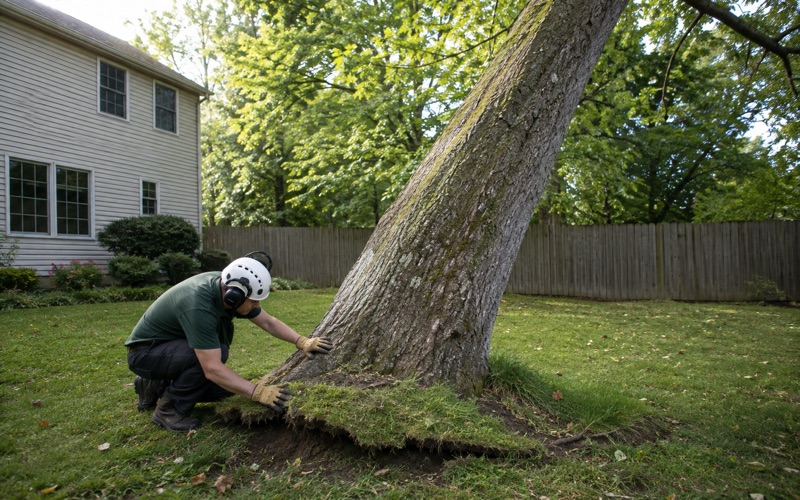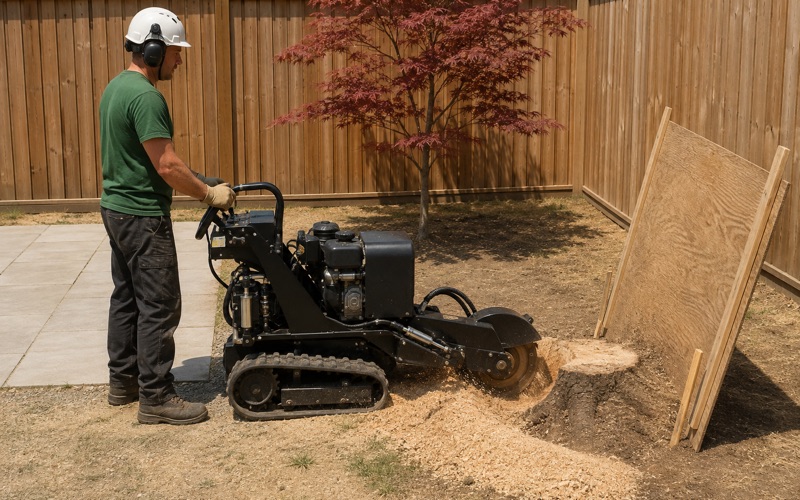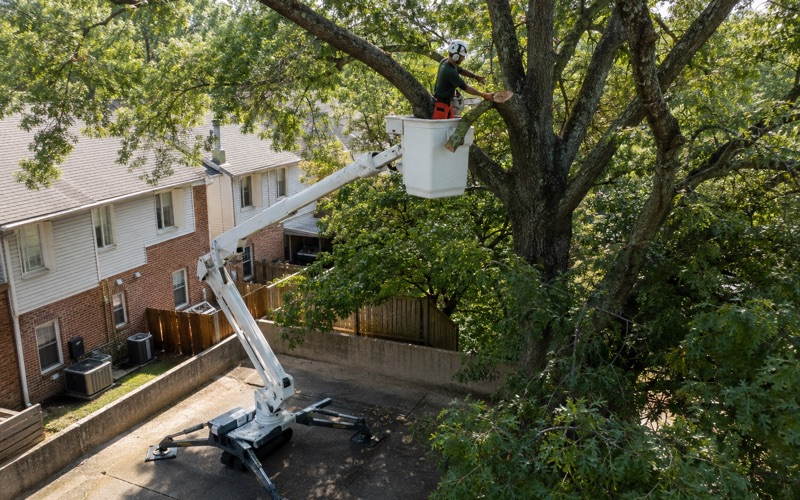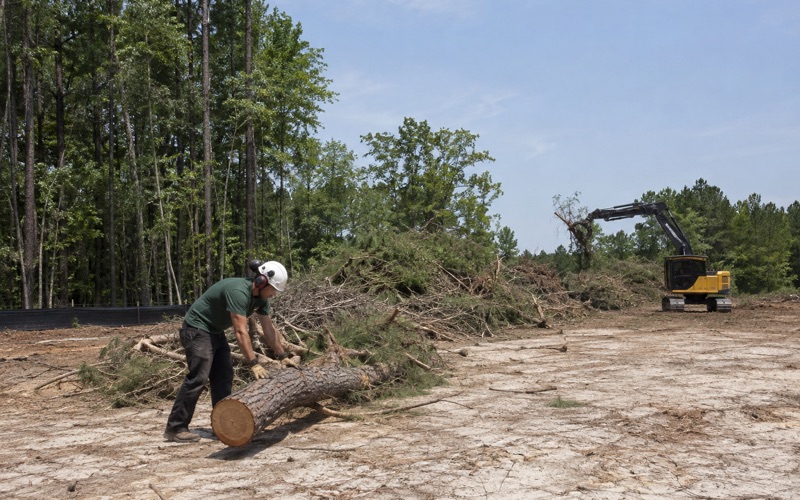
Severn Tree Removal has been doing tree removal in Arbutus for more than 20 years, and the job here is almost always a large one. The trees we get called out to look at on these streets are finished growing, and that single fact changes the equipment we bring, the rigging plan we write and the number on the estimate before anybody puts a rope in a tree.
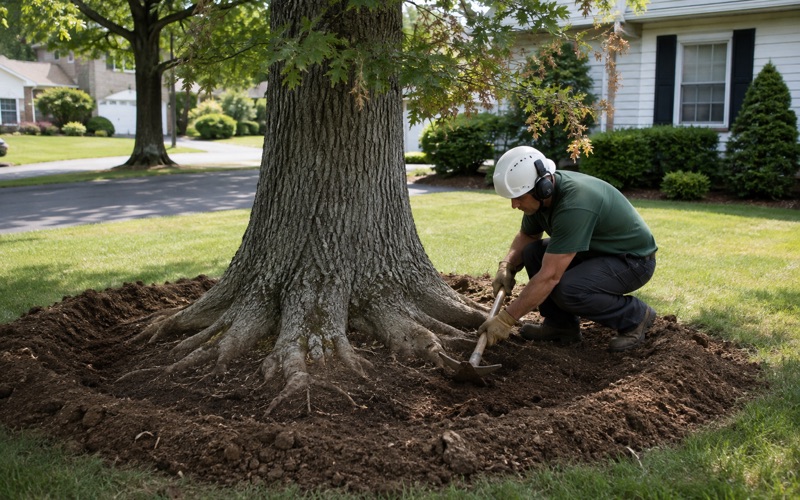
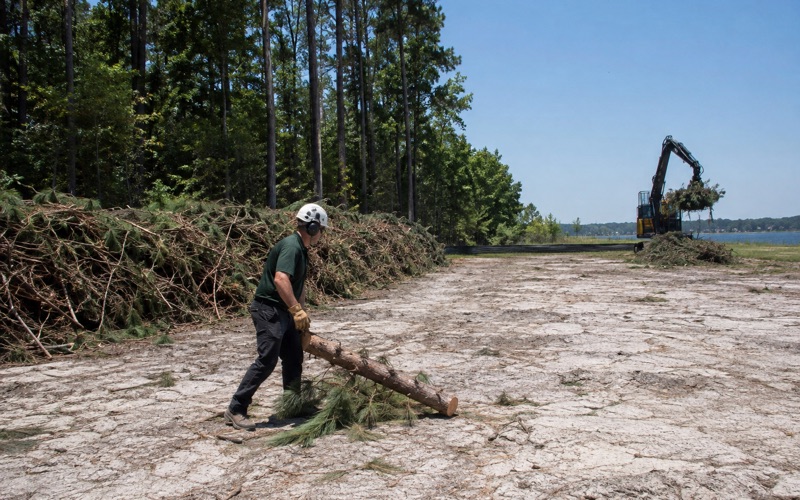
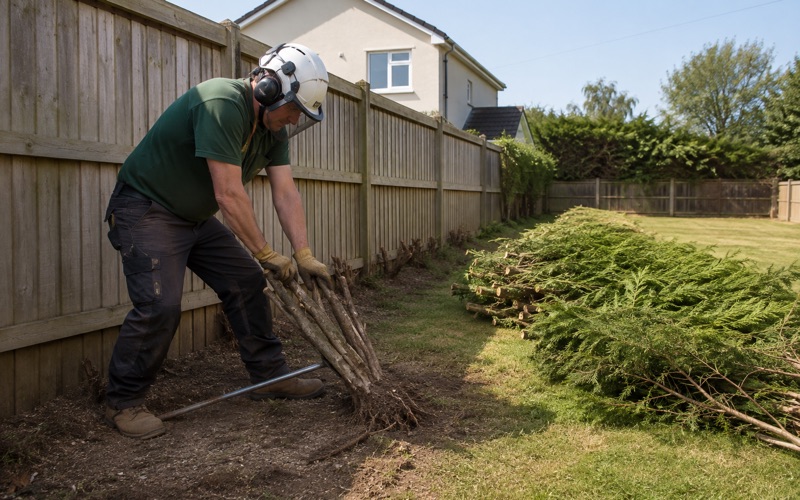
Every removal starts with a free on-site estimate and a written scope, so the price you approve is the price you pay. That scope names what happens to the wood as well as the tree — brush chipped, trunk cut into rounds, stump ground and the grindings settled — because the wood is the part homeowners most often find out about only after the crew has packed up and gone.
We answer storm calls within 24 hours, whether the tree is lying across a driveway, hung up in a neighboring canopy or resting on a roof. The crew that walks the property with you at the estimate is the crew that arrives with the saws, and the same people do the final rake-out, so nothing gets lost in a handoff between one team and the next.
Arbutus trees have already finished growing
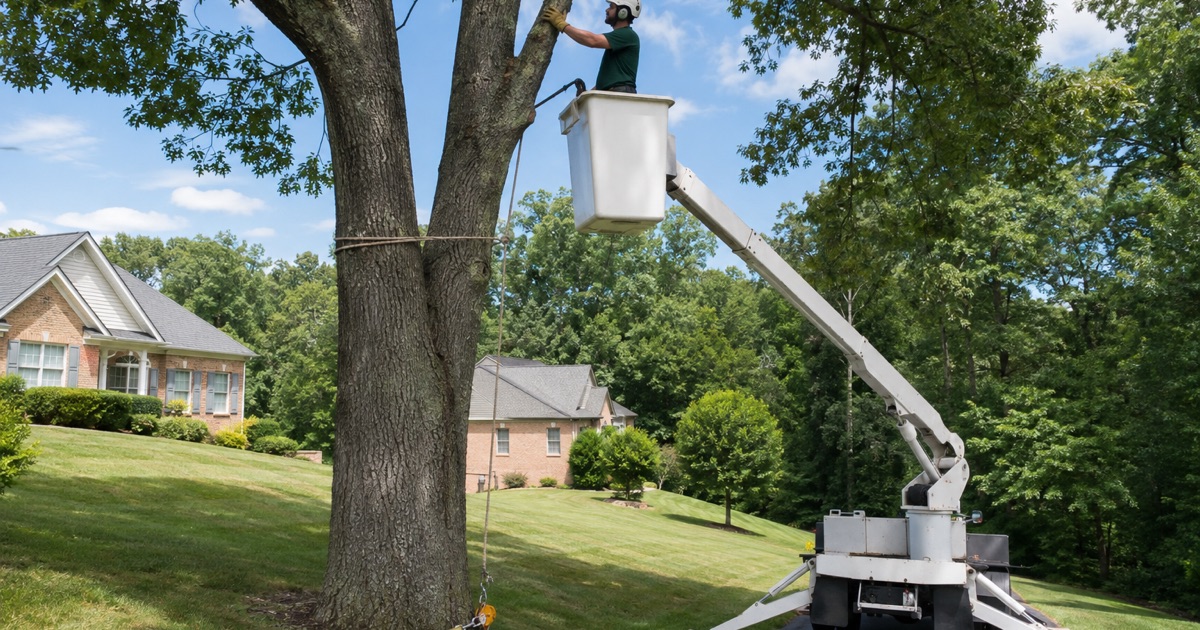
Most residential tree work in this country happens on trees that are still filling out and still adding height. In Arbutus it is the other way around: the canopy over these streets reached its mature size decades ago, and what we are usually asked to price is a tree at terminal height carrying a full crown, a heavy limb structure and a root plate to match.
The age of the houses tells you the age of the canopy
About 62.8% of housing units in Arbutus were built before 1960, and 79.7% of the stock predates 1980. The 1950s alone account for 30.5% of the units standing today, and 18.1% of them were already standing before 1940.
Yard trees generally go in within a few years of the house they shade, so those construction dates are a reliable proxy for the age of what is growing beside them. A maple or an oak planted with a 1950s house is seventy years old, and seventy years is well past the point at which most of the species used on these lots are still gaining height.
Only 6.3% of the stock is newer than 2000
Only 6.3% of Arbutus housing units were built in 2000 or later, so there is very little of the young replacement canopy that fills newer subdivisions and very little of the recent planting that would eventually take over from what is here now. There is also comparatively little Callery pear, the species planted heavily across 1990s and 2000s developments, which Maryland prohibits from sale beginning January 15, 2026.
The practical effect is that we rarely quote a genuinely small removal in this community. Nearly every tree on the list is big enough to need sectional dismantling rather than a straight fell, and the diameter at breast height we record on the estimate sheet is routinely in the range where a crane pays for itself in time saved and risk avoided.
What terminal size does to a tree
A tree that has stopped growing upward puts its energy somewhere else, and the defects that follow are predictable enough that we look for them in a set order. Co-dominant stems with included bark at the union, deadwood scattered through the upper crown, and epicormic shoots along limbs that lost their leaders years ago are the three that decide most of our recommendations.
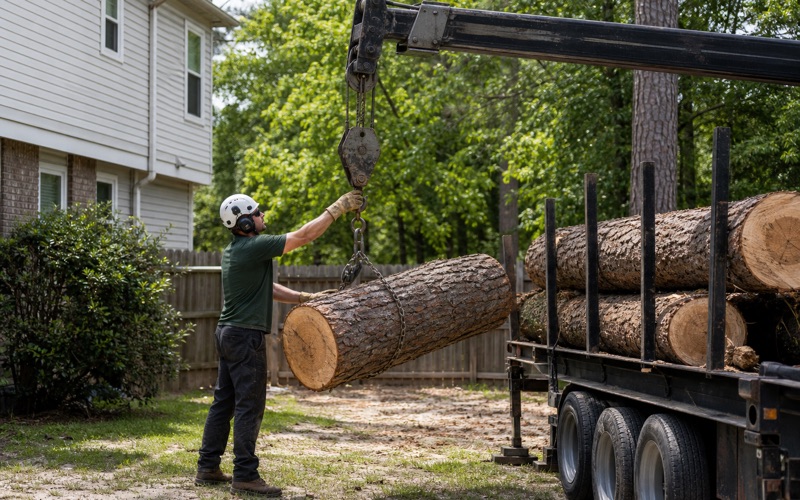
None of that means a tree has to come down, and cabling and bracing, deadwooding or a measured crown reduction is frequently the better answer on a specimen worth keeping. When removal genuinely is the answer, size dictates method: with no clear drop zone we dismantle in sections, and where the rigging would swing weight over a roof, a fence or a parked car we bring a crane instead.
Looking for tree removal closer to Pasadena? See Tree Removal in Pasadena.
Clearing in Arbutus falls under the county forest conservation law
Two separate Maryland programs regulate tree clearing on private land, and which of them applies to a given property is a matter of mapping rather than opinion. In Arbutus the question is settled across the whole community, and the answer is the simpler of the two programs.
None of Arbutus lies inside the Chesapeake Bay Critical Area
No part of the Arbutus CDP falls within the Chesapeake Bay Critical Area. A polygon intersect against the state layer returned zero features, and grid sampling at roughly 55-meter spacing across 6.49 square miles — against a census land area of 6.526 square miles — turned up no cells inside the layer anywhere in the community.
That is worth stating plainly, because Arbutus sits close enough to the tidal Patapsco that owners frequently assume the shoreline rules reach them, and the assumption costs them weeks of unnecessary review before anyone touches a tree. Nothing on an Arbutus lot triggers those buffer requirements, so the only program left to consider is the county’s own.
Article 33, Title 6 and the declaration of intent
Clearing here therefore falls under Baltimore County’s forest conservation law at Article 33, Title 6 of the county code, sections 33-6-101 through 33-6-122, adopted in 1993. The Department of Environmental Protection and Sustainability implements and enforces that program, and the two schemes do not overlap: section 33-6-103(b)(2) hands Critical Area land to a different article of the code instead.
Most single-tree removals on a developed Arbutus lot never touch the forest conservation law at all, because it attaches to grading, development and certain commercial timber harvesting rather than to a homeowner taking down one hazard tree. Where it does apply, section 33-6-104 provides a declaration of intent carrying a five-year forward window, which the department has to approve before the work proceeds.
The permit that actually catches people out
The requirement homeowners trip over is the state one, and it has nothing to do with lot size or acreage. Maryland’s Roadside Tree Care Permit is required before removing, trimming or otherwise caring for a tree whose trunk stands in the public right-of-way, and it turns on where the trunk sits rather than on who planted the tree or who has been mowing around it.
Natural Resources Article section 5-406(d) bars a county or municipality from issuing a building permit until that roadside tree permit is obtained, and the penalties attached to the law run to $2,000 and $5,000. Grading and building permits themselves come from the Department of Permits, Approvals and Inspections, and we route all of it before a date goes on the calendar.
Licensing, contracts and who owns the tree
Maryland regulates tree work considerably more tightly than most states do, and the rules are easy for a homeowner to verify in about a minute. Two of them between them decide whether the outfit standing in your driveway is legally allowed to be there at all.
The Maryland Licensed Tree Expert requirement
Natural Resources Article section 5-417(a)(1) requires a Maryland Licensed Tree Expert license to perform tree work for hire. Section 5-415(c)(2)(iii) carves out trees 20 feet tall or less, loggers and underground-utility installers, while section 5-417(a)(2) lets a crew work under a licensed expert’s supervision without every member holding an individual license.
COMAR 08.07.07.03D then requires a written contract carrying that license number, which is the single easiest document to ask for and the one most often missing from a cheap verbal quote. Ours carries it, our arborist recommendations follow ANSI A300 for pruning and removal practice, and the crew works to ANSI Z133 for safety, including around the wire we discuss below.
Trees standing in the county right-of-way
Where the trunk sits inside the Baltimore County right-of-way, the tree is the county’s responsibility rather than the adjoining owner’s. The Bureau of Highways removes dead and storm-damaged trees and broken limbs from county roads and roadsides by work order, and whether a particular tree is actually within the right-of-way gets determined when the work order application is opened.
Requests go to highways@baltimorecountymd.gov or 410-887-3560, and the county applies the same criteria the state forest service does, including the roadside tree permit. Fallen trees and debris on private property remain the property owner’s responsibility, and that boundary is where the majority of post-storm calls in this community land.
Wires, and what the utility will not do
BGE performs line clearance on its own distribution circuits under COMAR 20.50.12.09, and on streets built this long ago the overhead service commonly runs straight through the canopy we are working in. What the utility does not do is clean up after itself: it is not responsible for removing the wood its clearance work drops, and that debris comes back to the property owner.
Report a downed line to 1-877-778-2222 and a limb resting on a line to 1-800-685-0123, and stay well clear of both until somebody with authority over the circuit has arrived. When a removal sits close to energized conductors we coordinate with the utility first rather than rigging around live wire and hoping the drop goes where we planned it.
Booking a removal on an older Arbutus street
The ground and the access decide a day’s plan about as much as the tree itself does, and in Arbutus both are consistent enough that we can usually tell you what to expect straight from the estimate visit. The soil in particular behaves in a way that is much better understood before a storm than discovered during one.
What the ground under Arbutus does
Surface geology across the community is dominated by the Cretaceous Patuxent, Arundel Clay and Patapsco formations at 62.2%, with 22.5% Cenozoic lowland deposits of silt, clay and sand and the balance split between Baltimore Gneiss and Relay quartz diorite. Most of Arbutus therefore sits on soft, unconsolidated ground rather than on shallow crystalline rock.
That cuts in both directions on a job. Stump grinding runs faster and cleaner here than it does over rock, but where the Arundel Clay surfaces the ground holds water for days after rain, which limits where we can safely set a crane or an aerial lift and raises windthrow risk on a tall tree whose root plate is sitting in saturated soil.
Storm season over this part of the county
Arbutus sits in NWS forecast zone MDZ011, Southern Baltimore, under the Baltimore/Washington forecast office. On August 10, 2026 a destructive-tier Severe Thunderstorm Warning covering northern Howard County and southwestern Baltimore County named Arbutus among the communities in its path, the destructive tier being triggered when radar indicates gusts of 80 mph or greater, and more than 25,500 BGE customers lost power.
A mature tree carrying a compromised union does not reliably survive that kind of gust, which is why we would much rather assess a questionable tree in March than lift it off a roof in August. There is no charge for the estimate visit and none for a second look at a tree you are unsure about, so a wait-and-see decision costs nothing to revisit.
Access, protection and what you get back
Lots here are a mix rather than a pattern: detached single-family units make up 52.6% of the stock and attached single-family another 28.7%, so gate widths, side yards and driveway approaches vary street by street. Our compact tracked equipment is sized to pass a standard gate, and lawn and hardscape protection matting goes down on every job regardless of how the machine gets to the tree.
With 69.2% of the 8,424 occupied units owner-occupied, most of what we quote in Arbutus is a homeowner’s decision rather than a management company’s, though we schedule around HOA boards, property managers and multifamily grounds staff where that is who we are working for. Either way, the wood, the brush, the stump and the grindings are settled in writing before the crew is booked.
- 20+ Years in Anne Arundel County
- Free On-Site Estimates
- 24-Hour Storm Response