Severn Tree Removal has handled tree removal in Arnold for more than 20 years, and the first thing we settle on an Arnold job is which government actually signs off on it. The address on the work order rarely answers that question. The parcel does.
Arnold is unincorporated. It is a census designated place in Anne Arundel County rather than a municipality, so there is no town hall, no municipal permit counter and no local tree board standing between a homeowner and a takedown. What stands there instead is the county, and across much of this peninsula the Chesapeake Bay Critical Area program sits on top of it.
That distinction moves the price and the schedule, not just the paperwork. We quote against the rules that govern the ground, we route whatever approvals apply before a crew is booked, and the scope is written down — brush chipped, trunk rounds, stump and grindings — before anyone agrees to anything.
An Arnold job that arrives labeled Annapolis
Mail is the most reliable way to get an Arnold address wrong. Arnold’s own post office carries the 21012 ZIP code, while neighboring stretches of the Broadneck peninsula carry Annapolis, MD 21409 mailing addresses instead. Neither line on an envelope describes a jurisdiction.
The postal label is not the permitting authority
An Annapolis, MD 21409 mailing address is a delivery route, and we have watched it mislead estimates written by contractors working this corridor for the first time. Broadneck addresses carrying that designation return Anne Arundel County with no incorporated place when they are run through the Census Bureau’s geocoder. The mail says one thing; the parcel record says another.
So we check the parcel rather than the letterhead. A point at Anne Arundel Community College on College Parkway returns Anne Arundel County, no incorporated place, Arnold CDP — the same answer we expect from a lot anywhere inside the community, and the answer that decides which permit chain we work.
City of Annapolis rules do not apply
The state capital sits southwest of here across the Severn River, and its municipal code is real enough; it simply stops at its own boundary. City of Annapolis rules do not apply to an Arnold property, whatever the mailing address reads, and no municipal arborist holds standing over a tree on this side of the water.
That cuts both ways for a homeowner. There is no municipal permit to wait on for an ordinary back-yard removal here, and equally no municipal review to lean on when a neighbor disputes the work. Anne Arundel County and the state of Maryland are the two authorities that matter, and they are the two we quote against.
A civic voice is not a permitting desk
The Arnold Preservation Council speaks for the community on land use and development questions, and it is worth knowing about when a project is large enough to draw attention. It is a civic body, not a permitting authority, and it issues nothing and denies nothing. We say that plainly rather than letting a letter from a community group read like a stop-work order.
Looking for tree removal closer to Woodlawn? See Tree Removal in Woodlawn.
The permit chain that actually applies here
Because Arnold is unincorporated, the chain runs county and state rather than town. Permit routing is something we handle before scheduling, since five counties and four towns across our service area answer these questions differently and a wrong assumption costs a crew day.
The Chesapeake Bay Critical Area buffer
Arnold sits on the Broadneck peninsula with the Severn River to the south, the Magothy River to the north and the Chesapeake Bay to the east, so the Critical Area reaches the community from more than one direction at once. Cutting, pruning or removing existing natural vegetation inside the buffer — a minimum of 100 feet from tidal waters and tidal wetlands — requires a Standard Vegetation Management Plan.
That plan goes to the Anne Arundel County Department of Inspections and Permits, Forestry Program, and the county forester is reached at (410) 222-7441. Recorded Forest Conservation Easements and Bog Protection Areas carry the same requirement. Intensely Developed, Limited Development and Resource Conservation Area polygons are all mapped inside the community’s boundary, so the applicable standard shifts as a lot approaches either river.
Grading, sediment control and forest conservation
Building, grading and sediment control permits come from the same Department of Inspections and Permits. Anne Arundel County’s Forest Conservation Regulations enter the picture where a subdivision, grading permit or sediment control permit covers a site of 40,000 square feet or greater, which is development review rather than a single hazard tree.
That review runs through the Office of Planning and Zoning, Development Division. For a homeowner taking down one declining oak in a yard it is usually not in play at all, but we put that on the estimate rather than leaving it as an open question that surfaces after a deposit.
Right-of-way trees and the state license
A tree whose trunk stands in a public right-of-way is a different job with a different signature on it. The Maryland Department of Natural Resources Forest Service issues the Roadside Tree Care Permit for that work and licenses the Maryland Licensed Tree Expert required to perform it.
Which agency owns the road decides the rest. State highway right-of-way belongs to the Maryland Department of Transportation State Highway Administration, county road right-of-way to the Anne Arundel County Department of Public Works, Bureau of Highways, and anything near an energized distribution conductor is a call to Baltimore Gas and Electric before a saw comes out of the truck.
Quoting a removal on the Broadneck peninsula
Two things move an Arnold price further than species does: the slope the tree stands on, and whether there is a drop zone at all. The community covers 10.819 square miles of land against 2.736 square miles of water, which is a fair description of how often the second answer is no.
Slopes, soils and machine footing
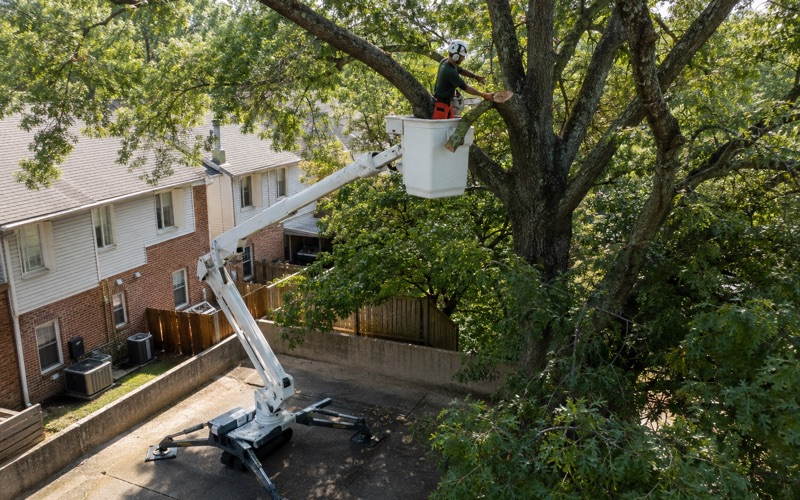
The interior of the community maps as Collington, Wist and Westphalia soils on 15 to 25 percent slopes, all three well drained Ultisols, while Annapolis fine sandy loam is mapped locally at 25 to 40 and even 40 to 80 percent slopes on the ravine and shoreline walls. Those grades decide whether an aerial lift can be set at all, or whether the whole removal is climbed.
Footing changes quickly here too. Excessively drained Evesboro and Galestown sands sit alongside somewhat poorly drained Fallsington sandy loams and moderately well drained Mattapex and Adelphia soils, so root plate condition can differ within a single street. Tidally flooded Mispillion and Transquaking soils map at the shoreline edges, and that is not ground a wheeled chipper or stump grinder crosses.
Waterfront lots and sectional dismantling
Lots on the Magothy and Severn sides slope down toward the water, which puts the drop zone below the crew and often leaves the only equipment approach on the street side of the house. That is a sectional dismantling job: the tree comes down in controlled pieces, rigged rather than felled.
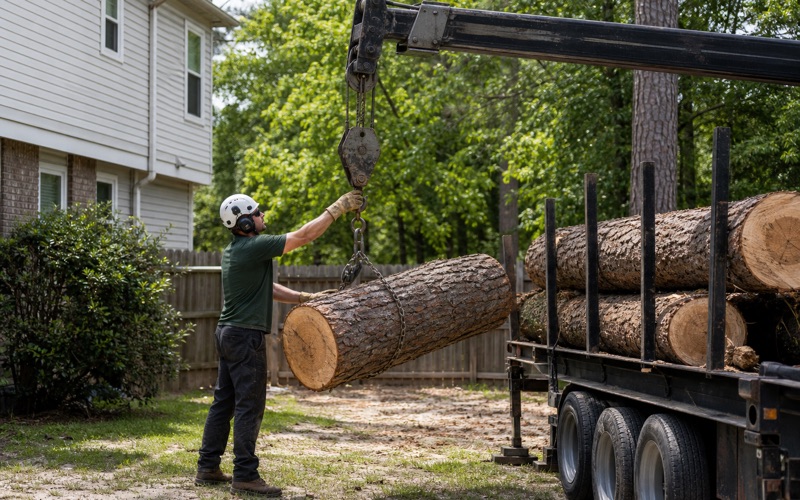
Where the pieces have nowhere to land, we quote a crane-assisted removal instead and say on the estimate why the crane is there. Our compact tracked equipment passes through a standard back-yard gate, which keeps a good share of Arnold work off the crane entirely, and lawn and hardscape protection matting goes down on every job either way.
Storm wind is the recurring driver
Severe thunderstorm wind, not ice or drought, is what puts trees on the ground here. Mesonet stations inside the community measured a 67 mph gust on May 19, 2017, and on June 25, 2025 trees blew down on MD 2 College Parkway and Governor Ritchie Highway and blocked the southbound lanes. Hail reaches the community as well: quarter-size stones fell near Governor Ritchie Highway and Chautauqua Road on July 1, 2020.
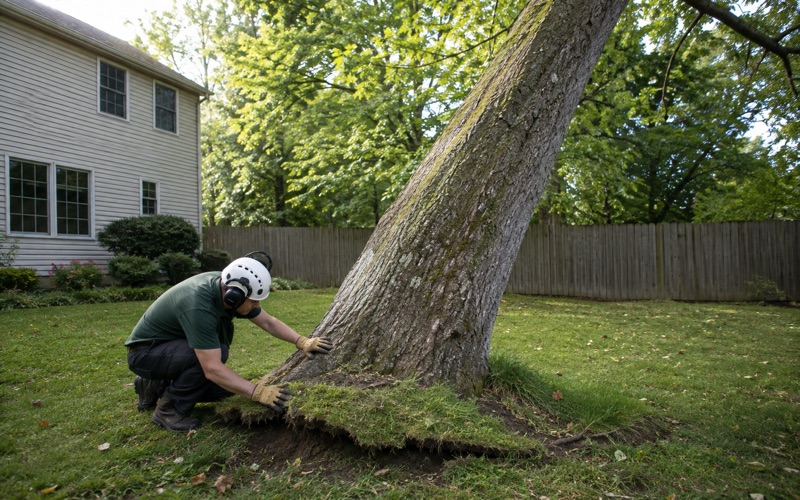
The housing stock is old enough for that to matter. The American Community Survey counts 9,102 housing units in Arnold, 86.5 percent of them owner-occupied, with 2,547 built between 1970 and 1979 and 2,388 between 1980 and 1989. Yard trees planted with those houses are now large enough that windthrow lifts a root plate and a section of lawn with it, which is why we run 24-hour response for storm damage, fallen trees and trees resting on a structure.
What to send us so the address does not mislead the quote
The estimate visit costs nothing, and neither does a second look at a tree you are unsure about. Even so, the more a first message tells us about the parcel rather than the mailbox, the closer the first number lands to the final one.
Send the parcel, not only the street address
A tax account number, a plat reference or a pin dropped on the tree itself tells us more than the mailing line does, particularly when that line reads Annapolis. We confirm the jurisdiction before quoting, and a lot sitting inside the Critical Area buffer gets flagged on the estimate rather than discovered on the work day.
If the tree stands anywhere near a road, name the road. That one detail decides whether the job needs a right-of-way permit and which agency owns the shoulder, and it is the item most often missing from a first email.
Photograph the approach, not only the tree
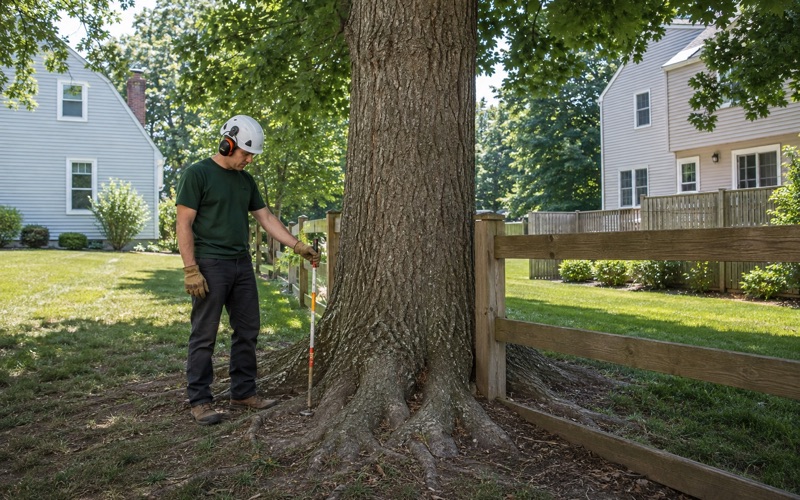
Two photographs from the street and one from the far side of the trunk tell us whether a lift can reach the tree, whether the slope rules out wheels, and where a drop zone would have to be. A tape measure around the trunk at diameter at breast height helps us price the grind before we arrive.
Tell us what sits under the canopy as well: a septic field, a seawall or bulkhead, a deck footing inside the critical root zone. Those change the rigging plan and sometimes the equipment, and they are far cheaper to plan around than to discover mid-removal.
Ask what is included before comparing prices
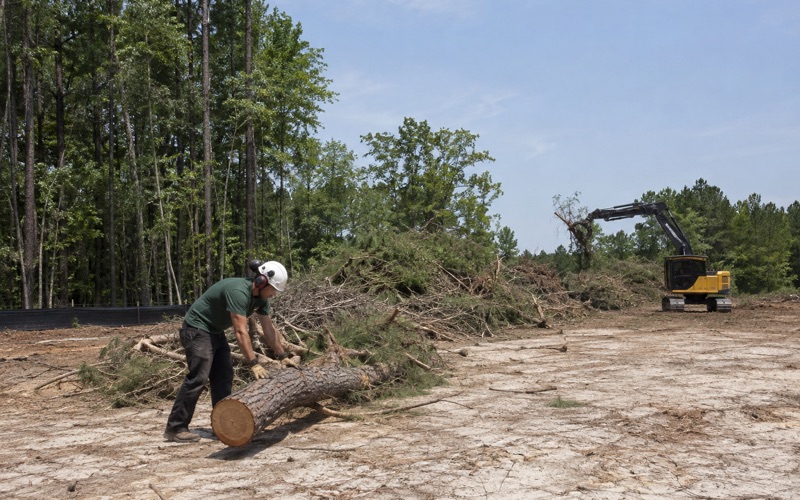
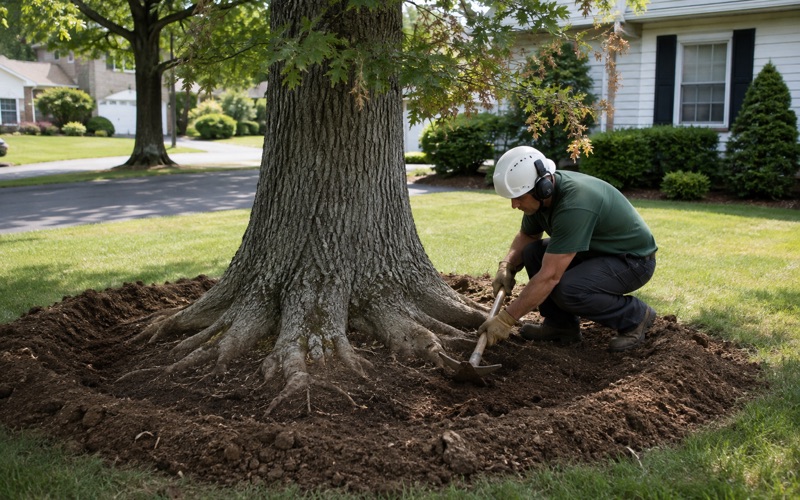
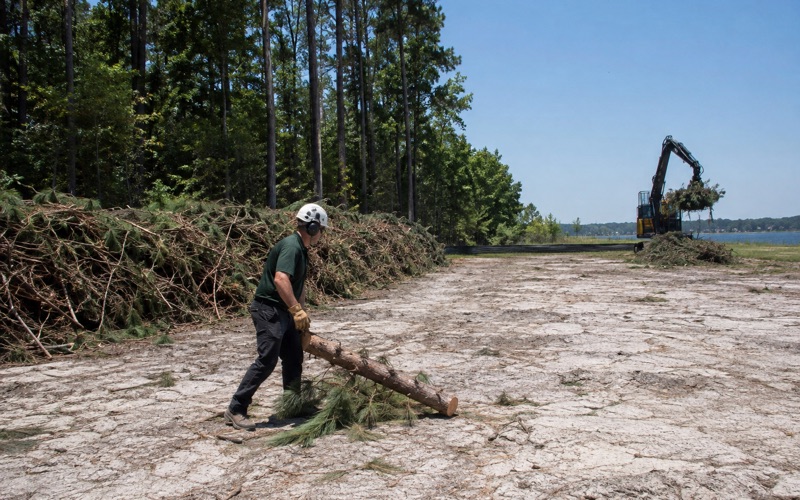
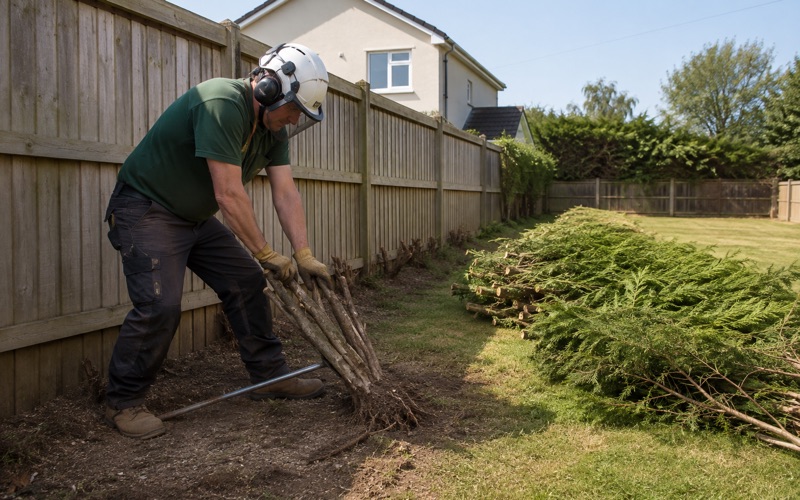
Every removal we quote states its inclusions in writing — brush chipped, trunk rounds cut and stacked where you want them, the stump ground and the grindings settled up front. Set that against a lower number that leaves a stump and a pile of brush behind and you are not comparing the same job.
The crew that walks the property at the estimate is the crew that does the work and rakes out at the end. We schedule around HOA boards, property managers and multifamily grounds staff when the tree is not on a single-family lot, and if an approval is required we have it in hand before the truck goes on the calendar.
- 20+ Years in Anne Arundel County
- Free On-Site Estimates
- 24-Hour Storm Response