Severn Tree Removal has handled tree removal in Baltimore Highlands for more than 20 years, and the first thing we settle on a job here is not the rigging plan but which county program the property answers to. Baltimore County runs two separate tree-clearing programs, and an address in this community can fall under either one. Which one applies decides who reviews the work and how long the approval takes.
That is not a question a homeowner should have to chase down. We establish the answer during the free on-site estimate, route whatever approval the property needs before a crew is booked, and put the scope in writing first. Nothing gets scheduled until the paperwork question has a definite answer.
Our crews carry Maryland Licensed Tree Expert credentials and work to ANSI A300 pruning standards and ANSI Z133 safety practice. The people who walk the property at the estimate are the same ones who arrive with the saws and handle the final rake-out.
Two County Programs, and Only One of Them Governs a Given Lot
Baltimore County implements its local forest conservation program through Article 33, Title 6 of the Baltimore County Code, sections 33-6-101 through 33-6-122, adopted in 1993. Implementation and enforcement belong to the Department of Environmental Protection and Sustainability. The program regulates certain commercial logging and timber harvesting operations, and it accepts a declaration of intent under section 33-6-104 carrying a five-year forward window.
Section 33-6-103(b)(2) draws the line
Section 33-6-103(b)(2) exempts areas governed by the Chesapeake Bay Critical Area Protection Law, Natural Resources Article sections 8-1801 through 8-1817, from the county forest conservation law. The two programs are mutually exclusive by design. Where the Critical Area program reaches a property, Title 6 steps back and Article 33, Title 2 takes over.
That is the single most useful thing to know before planning a removal here. It is not a question of which rule is stricter, or of satisfying one program and hoping it covers the other. The code answers it once, at the property line, and the answer sends the job down one review path rather than the other.
What the Title 2 program asks instead
Baltimore County’s Chesapeake Bay Critical Area regulations sit at Article 33, Title 2 of the county code. They require development within 1,000 feet of tidal waters and tidal wetlands to meet setbacks from the water along with limits on lot coverage and on forest and tree clearing. The Patapsco is tidal at Baltimore Highlands, so that 1,000-foot band landward of tidal water reaches a substantial part of the community.
The clearing limits are the part that bears on a removal. A tree that would come down without comment on one lot can need the county’s sign-off two streets away, because the review is triggered by where the parcel sits rather than by the size or condition of the tree.
Where forest conservation still runs
On land the Critical Area program does not reach, Title 6 is the program in play, and its exemptions are narrow. The one at section 33-6-103(b)(3) applies inside the Urban Rural Demarcation Line only where there is a Forest Conservation and Management Agreement or Forest Management Plan accepted by Maryland DNR before July 1, 1992, no grading or building permit application for development within five years after the harvest, and a declaration of intent under section 33-6-104 approved by the Department.
We read a set of conditions that specific as a reason to check rather than assume. A residential removal rarely approaches the thresholds a timber harvest does, but the determination belongs on paper before the crew is scheduled, not afterward.
Looking for tree removal closer to Severna Park? See Severna Park Tree Removal.
Environmental Impact Review Before the Saw
Baltimore County implements and enforces its Title 2 Critical Area regulations through the Environmental Impact Review program, run out of the Department of Environmental Protection and Sustainability. On Critical Area land, that is the desk a clearing question lands on, and the forest conservation route is simply not the one being traveled.
What the review is actually looking at
Environmental Impact Review considers what clearing does to the site rather than weighing an individual tree in isolation. Setbacks from tidal water, lot coverage and clearing limits are the terms it works in, and every one of them attaches to the parcel rather than to the stem.
For a customer that reduces to two practical questions: how much canopy is coming off, and what happens to the ground afterward. We size the answer from a measured diameter at breast height and a mapped critical root zone instead of an estimate made from the driveway, because a submission built on real numbers moves faster than one that has to be corrected.
The review window is part of the schedule
A removal on Critical Area land is not a same-week job unless something has already failed. Building the Environmental Impact Review window into the calendar at the front end is exactly why we route permits before booking a crew rather than after.
Storm work is the exception, and we run 24-hour response for fallen trees, hangers and trees resting on a structure. Emergency work and elective work are handled on different clocks, and we say which one a job is when we quote it.
The calls that belong somewhere else entirely
A tree standing in the county right-of-way is not the property owner’s job at all. The Baltimore County Bureau of Highways removes dead and storm-damaged trees and broken limbs from county roads and roadsides by work order, with the right-of-way boundary determined when the application is started; requests go to highways@baltimorecountymd.gov or 410-887-3560. Fallen trees and debris on private property stay the owner’s responsibility.
Wires are their own category again. BGE handles line clearance on its own distribution circuits under COMAR 20.50.12.09 and is not responsible for removing wood debris; report a downed line to 1-877-778-2222 and a limb resting on a line to 1-800-685-0123.
Establishing Which Program Covers Your Lot
Roughly 43.1% of the Baltimore Highlands CDP, about 0.78 square miles, lies within the Chesapeake Bay Critical Area. The balance of the community does not. That split is what makes the program question a genuine first step on a job here rather than a formality.
Boundary first, classification second
The mapped Critical Area land here breaks down as about 0.57 square miles of Resource Conservation Area, 0.17 square miles of Intensely Developed Area and 0.03 square miles of Limited Development Area, all mapped to Baltimore County. All three classifications occur inside this one small community.
Classification matters as much as the boundary does, because Resource Conservation Area, Limited Development Area and Intensely Developed Area carry different clearing and lot-coverage limits. Two neighbors can sit on the same side of the line and still be working to different numbers.
What we confirm at the estimate
On the estimate visit we establish whether the property falls inside the Critical Area and which classification it carries, then state plainly which program the removal will be reviewed under. The visit costs nothing, and neither does a second look at a tree you are unsure about.
From there the scope goes in writing before a crew is booked: what comes down, whether brush is chipped, what happens to the trunk rounds, whether the stump is ground and who takes the grindings away. Permit routing is handled ahead of scheduling because the five counties and four towns we work across answer these questions differently.
The state requirements that apply either way
Two state rules sit on top of the county program, whichever one turns out to govern. Maryland Natural Resources Article section 5-417(a)(1) requires a Licensed Tree Expert license to do tree work for hire; section 5-415(c)(2)(iii) exempts trees 20 feet tall or less along with loggers and underground-utility installers, and section 5-417(a)(2) lets a crew work under a Licensed Tree Expert’s supervision without individual licenses. COMAR 08.07.07.03D requires a written contract carrying that license number.
The second is the Roadside Tree Care Permit, which the Maryland Department of Natural Resources Forest Service requires before removing, trimming or caring for a roadside tree. The law turns on where the trunk sits within the public right-of-way, not on who planted the tree, and Natural Resources Article section 5-406(d) bars a county or municipality from issuing a building permit until the permit is obtained. Penalties are $2,000 and $5,000, and the emergency exception carries a one-week reporting duty under COMAR 08.07.02.03C.
What That Changes About the Work Itself
Program aside, Baltimore Highlands has a physical character that shapes how a removal gets staged. It is a census-designated place in Baltimore County directly south of the city of Baltimore, with a population of 7,019 at the 2010 census, and at the 2000 census and earlier it was delineated as part of the Lansdowne-Baltimore Highlands CDP.
Old stock, mature canopy, close quarters
73.4% of housing units here were built in 1979 or earlier and 52.0% before 1960; 25.6% went up in the 1950s and 20.1% predate 1940. Detached single-family homes make up 42.7% of the stock and attached single-family units 43.1%, and 54.1% of the 2,911 occupied units are owner-occupied.
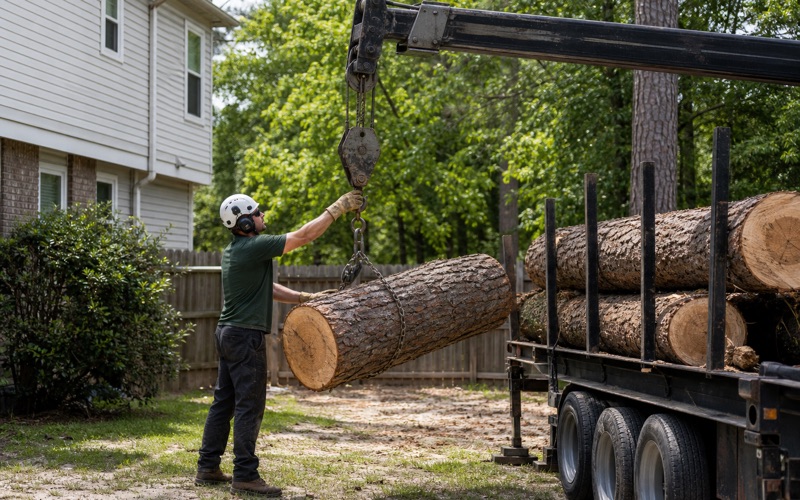
On the ground that means short setbacks, close neighbors and trees that have had decades to grow into wires and rooflines. Sectional dismantling is the norm rather than the exception, and where there is no drop zone to fell into we bring a crane instead of forcing the piece count.
Access through a standard gate
With attached rows accounting for so much of the housing, gate width is frequently the binding constraint on a back-yard removal rather than the tree itself. A standard stump grinder needs a gate roughly 35 inches wide to reach a rear yard at all.
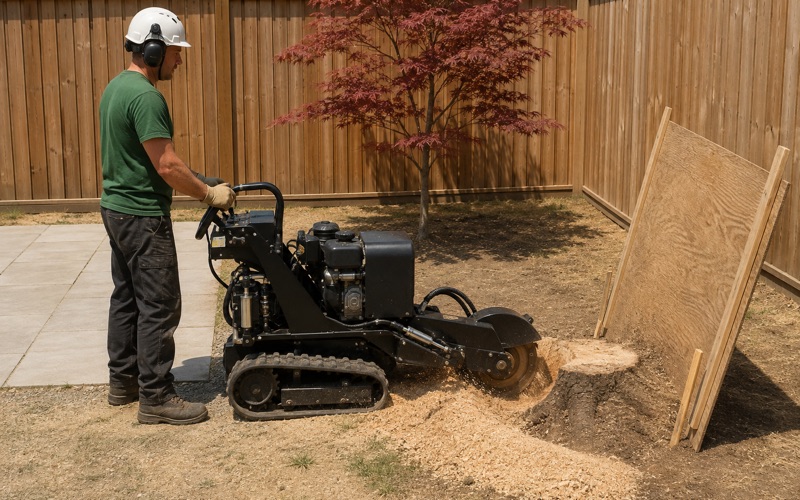
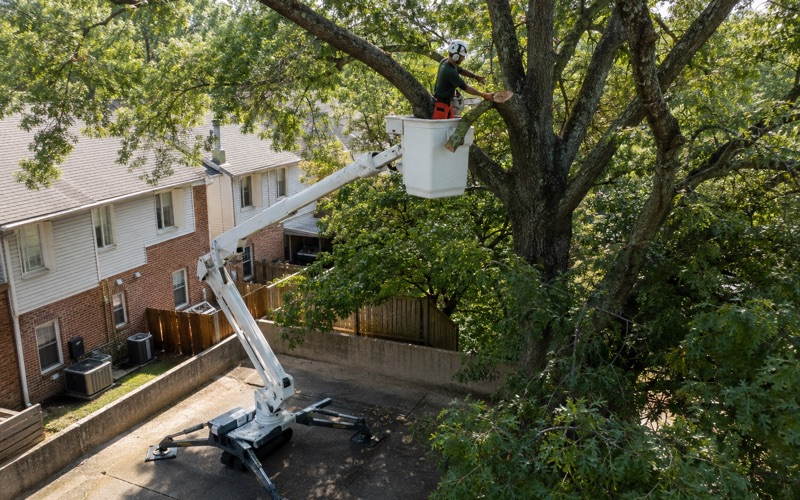
Our compact tracked equipment is sized to pass a standard back-yard gate, and lawn and hardscape protection matting goes down on every job. An aerial lift only helps where it can be set; on a narrow lot with a single side passage, a climbing removal is usually the faster answer.
Ground that grinds easily and lets go easily
Surface geology across the community samples as 51.8% Cenozoic Lowland Deposits of silt, clay and sand and 45.6% Patuxent, Arundel Clay and Patapsco formations, and no crystalline bedrock is mapped at the surface anywhere in Baltimore Highlands. Stump grinding is straightforward in ground like that.
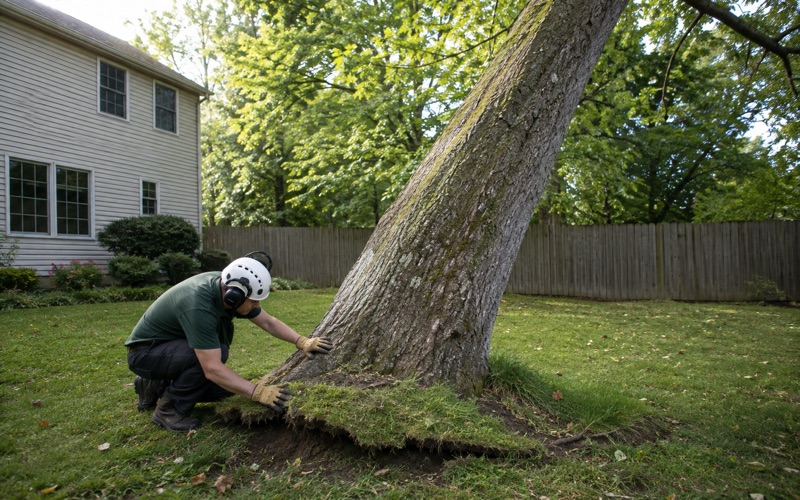
The same softness works against a standing tree. Root plates run broad and shallow and lift readily once the soil is saturated, which puts windthrow ahead of stem failure on the risk list after a wet stretch. The community sits in NWS forecast zone MDZ011, Southern Baltimore, under the Baltimore/Washington forecast office, and that is the zone we watch when weather is moving in.
What ends up in writing
Every removal we quote here names the county program that reviews it, the approval being sought and the office signing off on it. The written inclusions cover brush chipping, trunk rounds, stump grinding and the grindings themselves, so there is nothing left to settle up after the work is done.
Scheduling is built around HOA boards, property managers and multifamily grounds staff as readily as around homeowners. The crew you met at the estimate is the crew that finishes the rake-out, and two decades of working this region’s storm season is what makes that predictable.
- 20+ Years in Anne Arundel County
- Free On-Site Estimates
- 24-Hour Storm Response