Severn Tree Removal has handled tree removal in Brooklyn Park for more than 20 years, and the first thing we settle on a job here is not the price but which office has to review the work. That is not a formality in this community. Two properties a few hundred feet apart can print an almost identical address and still answer to different rules about what may come down and who signs off on it.
Every removal we quote begins with a free on-site estimate and a written scope, so brush chipping, trunk rounds, stump grinding and what happens to the grindings are all decided before a crew is booked rather than argued about afterward. The permitting route goes into that same document. We would rather find a review requirement at the estimate than on the morning an aerial lift is already blocking the street.
The crew that prices the tree is the crew that takes it down, and the work is performed under the state license Maryland requires for tree care done for hire. What follows is how the boundary at the top of this community changes the paperwork, and the parts of the job it does not change at all.
One address, two authorities
Brooklyn Park is an Anne Arundel County census-designated place, and the Baltimore City corporate line forms its northern edge. The Baltimore City neighborhood of Brooklyn lies immediately across that boundary, close enough that the two share a mailing address and a postal geography.
Where the line actually runs
The line is a jurisdictional edge, not a visible one. It does not follow a river or a ridge, and nothing about the housing stock changes as you cross it, which is exactly why it catches people out when a tree comes into the conversation.
What changes at that edge is who holds authority. Properties on facing sides of the boundary can address an envelope the same way and still fall to different forestry authorities and different right-of-way rules, because jurisdiction follows the parcel rather than the postal route that serves it.
The mailing address is a postal fact
The clearest illustration is a county building. Anne Arundel County publishes its own fire station here, Brooklyn station, Company 31 at 5100 Ritchie Highway, with a Baltimore, MD 21225 mailing address, and the station is a county facility all the same.
The county police presence sits inside the community too, at the Northern District station on Hammonds Lane. Both are Anne Arundel County operations working out of buildings whose mail reads Baltimore, which is the whole point: mail delivery and jurisdiction are two different systems that happen to overlap here.
What the postal detail does not decide
So the address on your utility bill does not settle who reviews a removal. It tells us where a letter goes, and nothing more, which is why we confirm the parcel’s county before we quote rather than reading it off the envelope.
For a homeowner that is one question answered at the estimate visit. For a property manager holding buildings on both sides of the boundary it matters more, because two portfolios that look identical on a spreadsheet can run on two separate approval routes.
Looking for tree removal closer to Lansdowne? See Tree Removal Services in Lansdowne.
Right-of-way trees on either side of it
A tree in the public right-of-way in Anne Arundel County is not the owner’s to cut at will. Maryland’s Department of Natural Resources Forest Service issues the Roadside Tree Care Permit that covers it, and the project fee is 25 dollars.
Where the trunk stands is the test
The test turns on where the trunk stands, not where the canopy reaches. A tree overhanging the roadway from inside the property line is not a roadside tree, and a trunk in the right-of-way is one even if most of its crown leans back over the yard.
That distinction is worth getting right before anyone climbs. Natural Resources Article Section 5-406(d) bars a county or municipality from issuing a building permit until the DNR permit is obtained, and the penalties attached to unpermitted roadside work run to 2,000 and 5,000 dollars.
Storm work and the week that follows
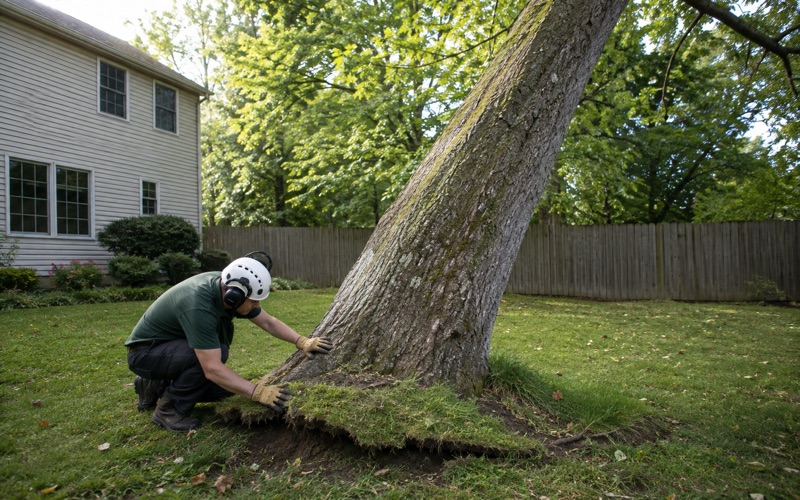
Emergency removal is treated differently, as it has to be, but it is not treated as unregulated. COMAR 08.07.02.03C carries a one-week reporting duty on an emergency removal, so the paperwork follows the saw rather than preceding it.
We run 24-hour response for storm damage, fallen trees and trees resting on a structure, and the reporting obligation is part of what we take on with the call. Nobody clearing a trunk off a porch at two in the morning should be tracking a filing deadline.
Across the line the answer changes
Baltimore City has its own forestry rules and its own right-of-way authority. A street tree a block north of the boundary is reviewed by the city, and the state roadside route we use on this side is not the process to assume for an address over there.
We say that plainly because the assumption runs both directions. Nothing about a Baltimore mailing address pulls a Brooklyn Park property into the city’s process, and nothing about proximity pushes a city property into the county’s.
Confirming who reviews your job
The license does not change at the line
One thing holds statewide regardless of which side you are on. Natural Resources Article Section 5-417(a)(1) requires a Maryland Licensed Tree Expert to perform tree care for hire, Section 5-415(c)(2)(iii) exempts trees 20 feet tall or less, and Section 5-417(a)(2) allows crew working under a licensed expert’s supervision to work without individual licenses.
COMAR 08.07.07 holds the program’s regulations, and COMAR 08.07.07.03D makes a written contract carrying the license number mandatory. If a bid for a mature tree arrives without a license number on it, that is not a paperwork quibble, it is a contractor operating outside the rule.
Anne Arundel County Forestry
Vegetation removal that falls outside a building or grading permit is reviewed by the Anne Arundel County Department of Inspections and Permits, Forestry Program, reachable at (410) 222-7441 and forestry@aacounty.org. The county states directly that contracted tree removal or pruning may only be performed by a Maryland Licensed Tree Expert.
A Vegetation Management Plan is required for any cutting, pruning or removal inside a Critical Area buffer, an expanded buffer, a Forest Conservation Easement or a Bog Protection Area, with farming, gardening and ordinary lawn maintenance excepted. That includes dead trees, and the county specifically rebuts the common belief that stems under 4 inches are exempt.
The Chesapeake Bay Critical Area reaches this community along its Patapsco frontage, in the 1,000-foot band landward of tidal water and tidal wetlands. The obligation therefore attaches to a waterfront address rather than to the community as a whole, and no mapped bog protection area falls inside Brooklyn Park at all.
Forest conservation on larger sites
A separate layer applies to development rather than maintenance. Article 17 Subtitle 3 of the County Code, administered through the Office of Planning and Zoning with the Department of Inspections and Permits, attaches forest conservation requirements when a subdivision, a grading permit or a sediment control permit is proposed on a site of 40,000 square feet or more.
The enabling state law is the Forest Conservation Act at Natural Resources Article Section 5-1601 and following. Most back-yard removals never touch it, but a multifamily grounds project or a lot being cleared for construction can, and that is a question worth asking before the first tree is marked.
Booking work near the line
Trees older than most of the houses
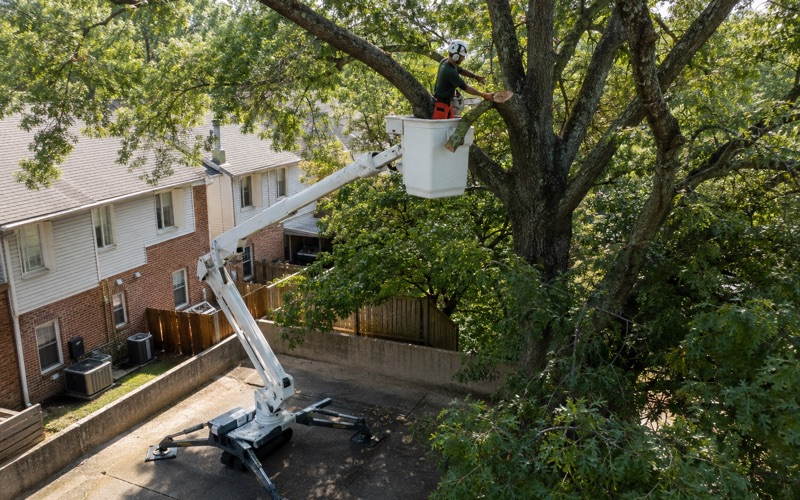
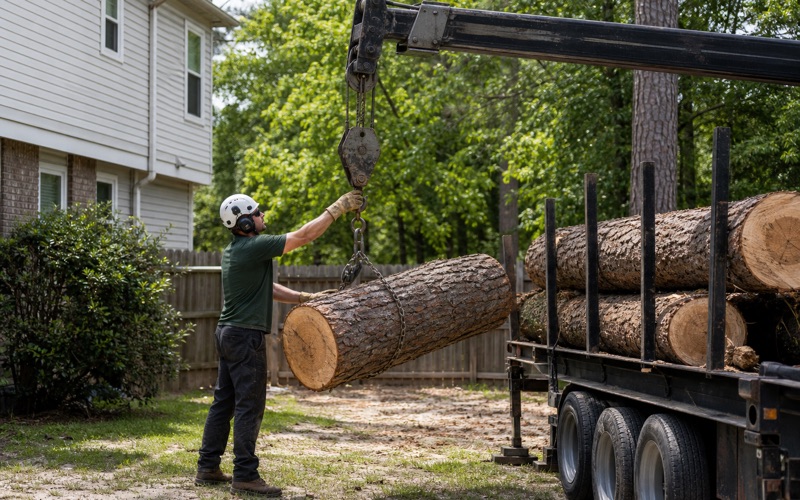
Housing built before 1950 makes up 37.3% of the stock here, which puts a large share of the mature yard canopy at 75 years and older. Trees of that age on lots of that size are usually too big to fell whole, so the work becomes sectional dismantling, or a crane-assisted removal where there is no drop zone to fell into.
Condition changes the method too. Emerald ash borer has been established in Maryland since 2003 and a dead ash goes brittle within a few years, which turns what would have been a climb into a bucket or crane job for anyone working to ANSI Z133.
Attached frontage and access
Rowhouse and duplex frontage accounts for 26.4% of the housing, and attached housing means shared party walls, no side access on interior units and rear alleys rather than driveways. Rigging and debris routes have to be planned off the street, which is a decision made at the estimate rather than improvised on the day.
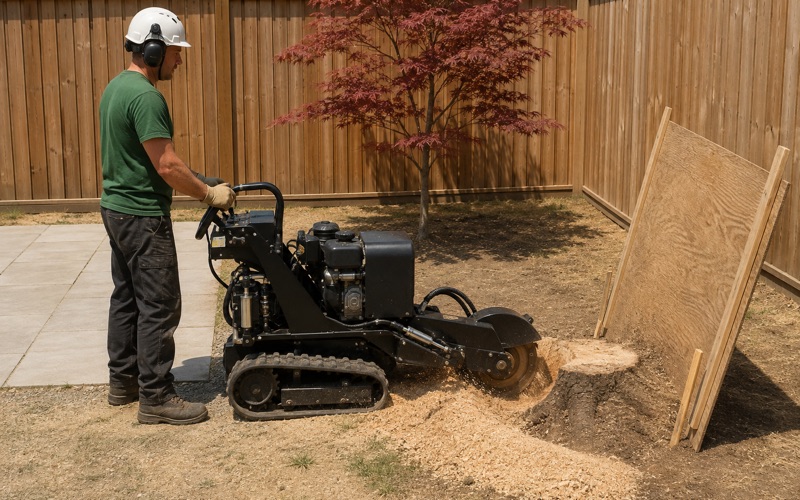
Our compact tracked equipment is sized to pass a standard back-yard gate, and lawn and hardscape protection matting goes down on every job. On tight attached lots that matters as much as the cut itself, because the damage nobody budgets for is the damage done getting to the tree.
What the ground does here
Soils in this community are heterogeneous rather than uniform. A nine-point sample returned nine different map units, among them the Christiana-Sassafras-Urban land complex on 5 to 15 percent slopes, Chillum loam, two Sassafras-Urban land complexes, Russett-Urban land and loamy Udorthents on 5 to 15 percent slopes.
The Christiana series is classed Fine, kaolinitic, mesic Aquic Hapludults, a heavy kaolin clay subsoil that is moderately well drained. Clay subsoil holds water, so a stump hole can stand full after rain and the grinder works wetter, stickier spoil than the sandier parts of the county produce.
Loamy Udorthents on a 5 to 15 percent grade means made ground on a slope, which is the least predictable thing to grind into because fill can carry rubble, slag and buried debris from the industrial history along this stretch of the Patapsco. Slope also restricts where a chipper or grinder can be positioned and where a crane can safely set outriggers.
What leaves the site
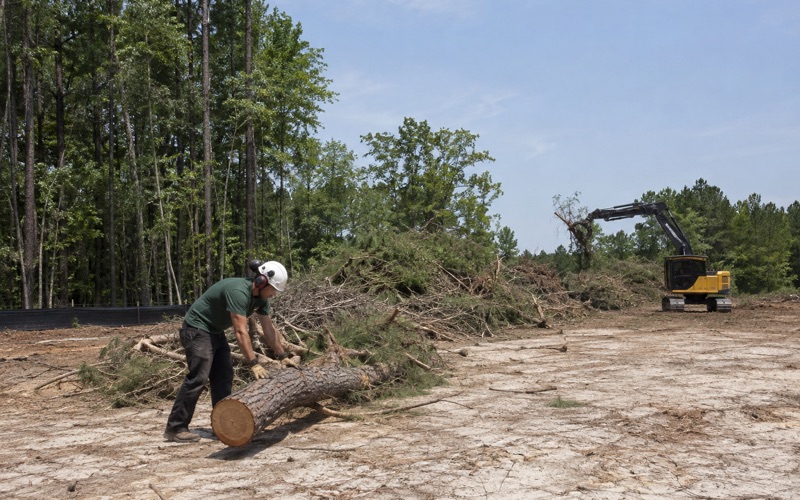
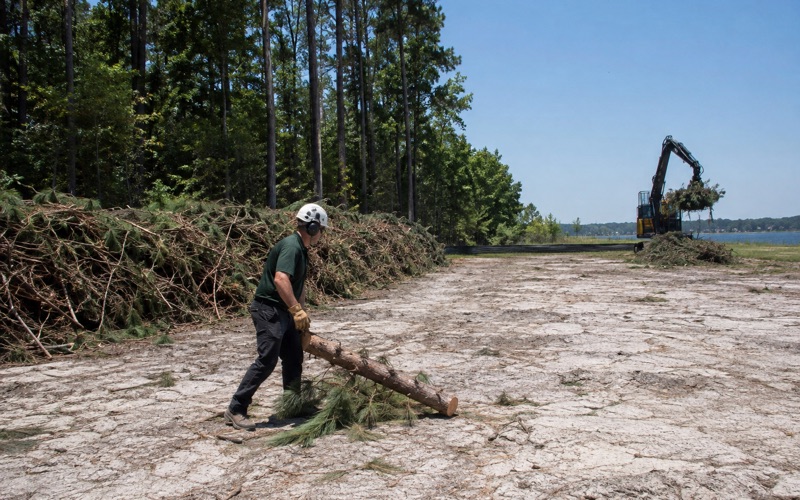
County curbside collection takes limbs under 4 feet long and 4 inches thick, in bundles under 40 pounds, and it will not collect logs. That is the reason removal debris is written into the scope up front rather than left on the curb as somebody else’s problem.
Utility clearance is its own case. Baltimore Gas and Electric carries the line-clearance obligation under COMAR 20.50.12.09 and states that it does not remove wood debris after a clearance cut, so report a downed line to 1-877-778-2222 and a limb resting on a line to 1-800-685-0123, then call us for what is left on the ground.
- 20+ Years in Anne Arundel County
- Free On-Site Estimates
- 24-Hour Storm Response