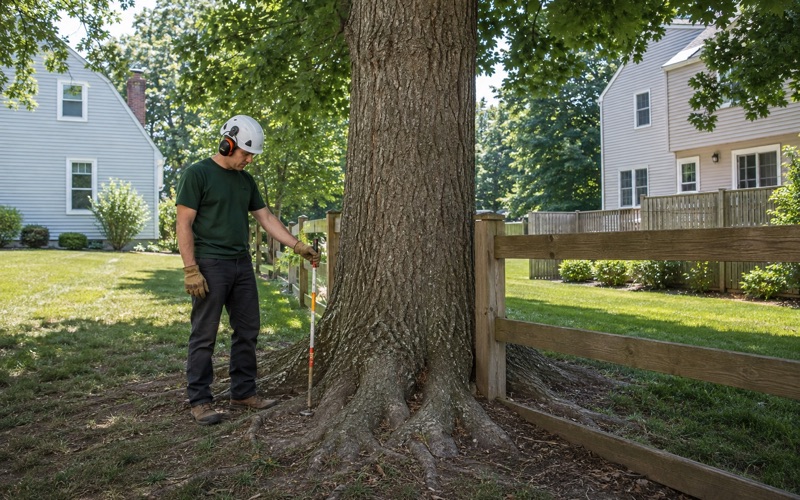
Severn Tree Removal has handled tree removal in Catonsville for more than 20 years, and on a good share of these properties the hard question is not how to cut the tree down. It is how to get the wood back out.
Plenty of removals here are decided before a saw ever starts, by whether a truck, a chipper or a tracked machine can physically reach the trunk. On many of the streets we work, nothing can. The driveway stops beside the house, the yard runs long behind it, and the only route to the tree is on foot.
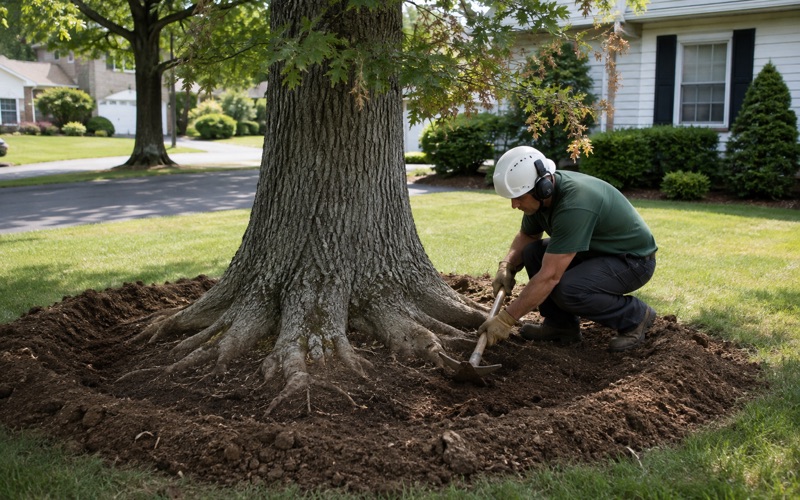
That is the job we price and plan for: a large removal reached by climbing line, dismantled in controlled pieces and carried out by hand to the curb. It is slower than a machine removal and it is a different skill set. We would rather tell you that at the free estimate than have you discover it on the morning of the work.
Rear Yards With No Route to the Trunk
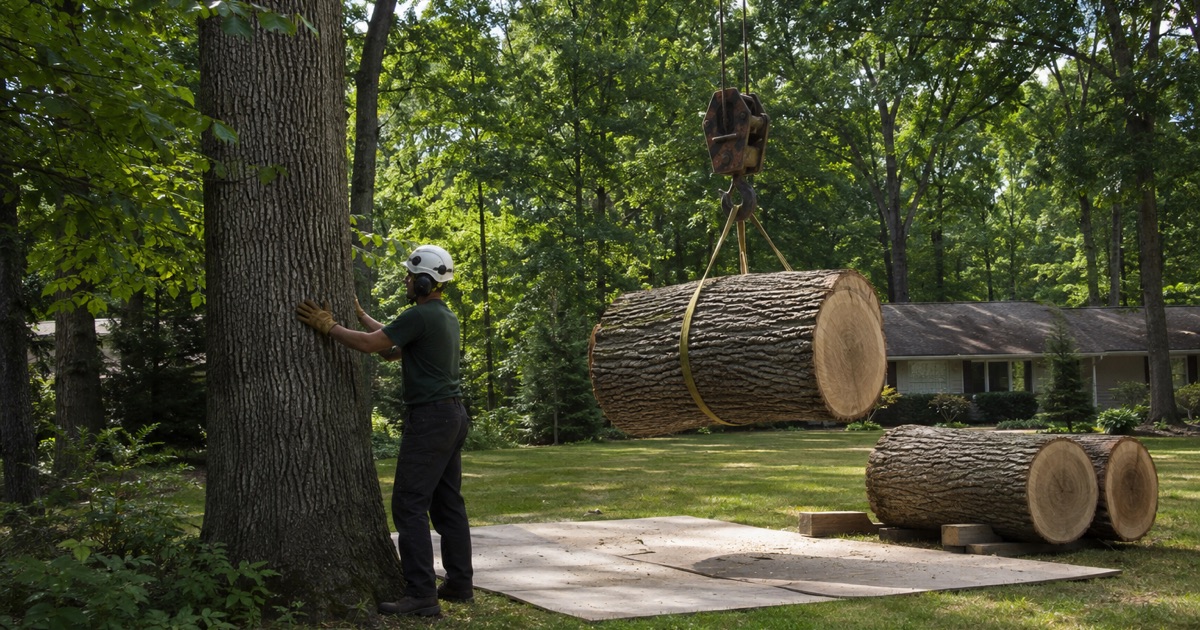
The binding constraint on most Catonsville removals is access, not lot size. These are generous properties, the yards run long and the trees have had room to grow. The space between the house and the property line, though, is usually a walkway rather than a road.
Long lots and the grid that produced them
Catonsville developed as a streetcar suburb along Frederick Road, and the lot pattern that produced runs deep: modest at the street, long to the rear. Houses sit close to the front, so nearly all the usable yard is behind them.
That layout is why we walk the whole route before quoting anything. From the curb we are looking for a continuous path two people can carry a round along, any step or retaining wall in the way, and a legal place for the chipper to stand while they do it.
The trees that had most of a century to fill it
45.7% of Catonsville housing units were built before 1960 and 18.5% predate 1940. The trees planted alongside those houses are specimen trees now in the working sense of the word: full canopy, serious diameter at breast height, frequently the tallest thing on the block.
A tree that size in an open field is a straightforward fell. The same tree sixty feet behind a house, boxed in by a garage, a fence line and two neighbors’ roofs, becomes a rigging job measured in days rather than hours.
What we mean when we write no access
No access is a specific finding on our estimates, not a hedge. It means there is no vehicle route to the rear at all: no side yard a machine can pass, no alley behind, no neighbor’s drive we could borrow with permission.
It also means there is no drop zone worth the name, and nowhere to set a crane that could work past the house on a lot shaped like this. The tree comes apart on rope instead, and that single finding explains both the method and the price.
Looking for tree removal closer to Laurel? See Tree Removal in Laurel.
Rigging and Hand-Carry as the Method
When the machine cannot get there, the removal becomes climbing, rigging and carrying. All three are ordinary parts of the trade. What changes in a Catonsville back yard is that all three are carrying the entire job.
Sectional dismantling from the climbing line
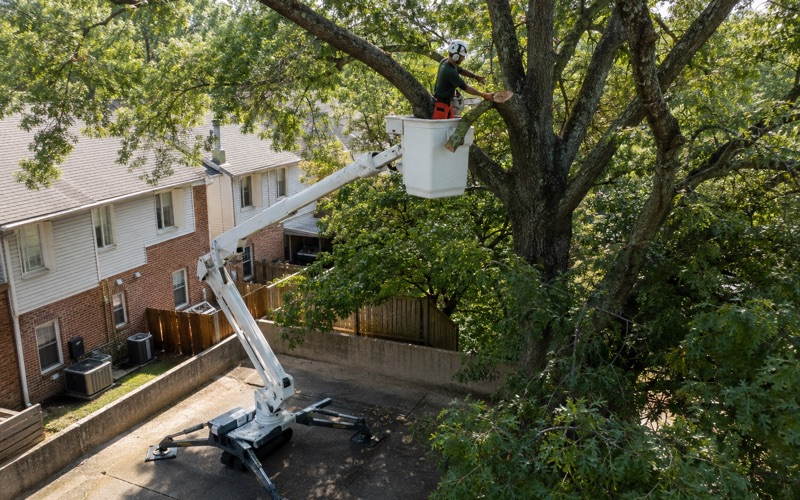
A climber takes the tree down in sections from the top, working to ANSI Z133 on the aerial and rope work and to ANSI A300 on anything left standing. Limbs are cut small enough that a rigging line and a groundman can control where each one lands.
Piece size is a decision, not a habit. With a shed, a patio and a fence inside the fall radius, we cut smaller and take more cuts, because every piece has to land somewhere we picked in advance.
Rigging hardware, anchors and the ground crew
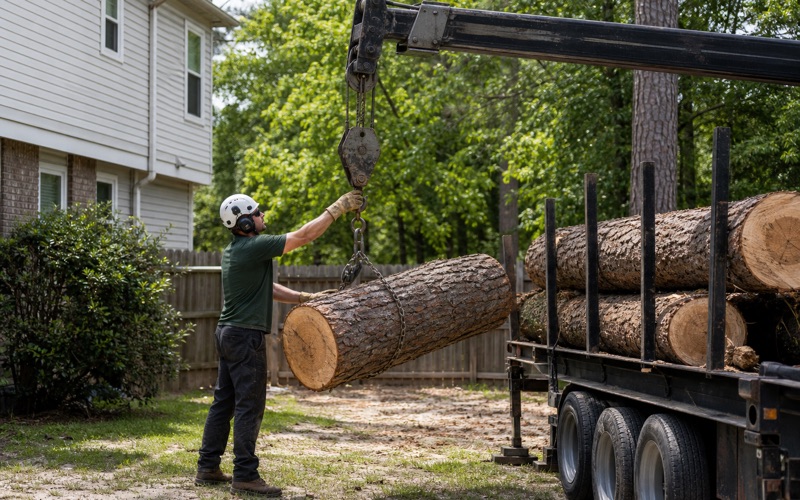
Confined removals run through blocks, slings and a friction device at the base, so heavy wood is lowered under control rather than dropped. Anchor points get chosen on structure: we do not rig off a stem showing included bark or a weak union between co-dominant stems.
That work needs people on the ground, and crew size is part of what a no-access job costs. Rope handling, limb control and clearing the landing area between cuts all have to happen at once, which is why a job like this is quoted on crew hours rather than on the size of the tree. A removal that would take one climber and a chipper on an open lot can take a full crew on a deep, fenced Frederick Road lot.
Carrying the wood back out
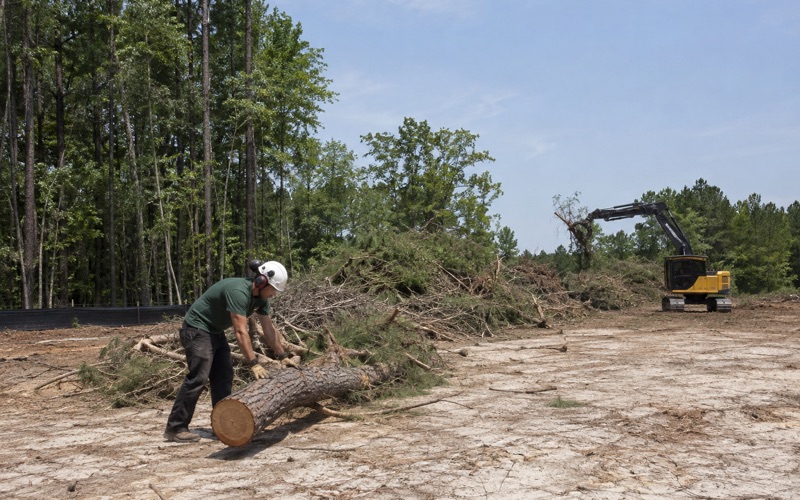
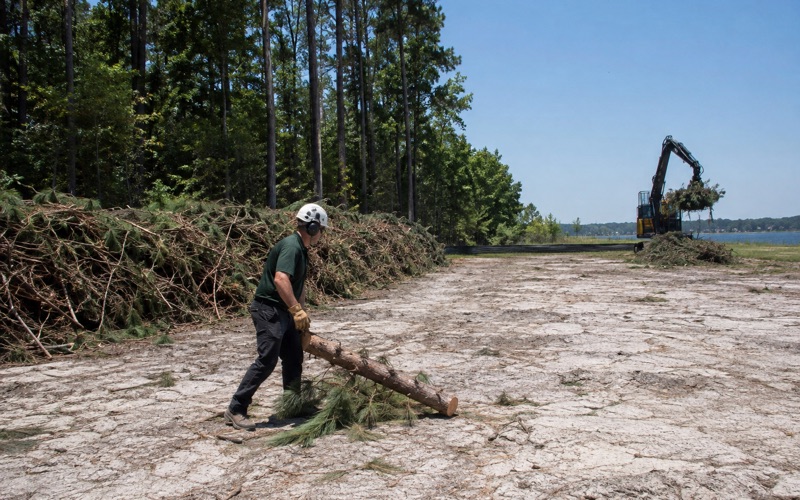
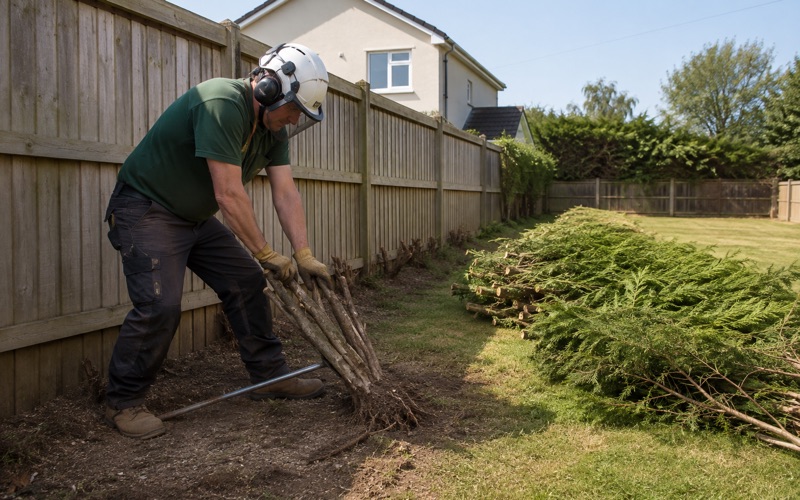
Everything that comes down leaves the way the crew came in. Brush is dragged out in bundles to the chipper at the curb, and trunk wood is cut into rounds a person can actually lift and walked out one at a time.
Round size therefore gets agreed before we start. If you want the trunk left for firewood we cut and stack it in the yard, which takes the longest carry out of the day; if you want it gone, that goes in writing alongside the brush, the stump and the grindings.
What a No-Access Removal Costs in Time
The honest answer is that hand-carry work is priced in labor hours rather than machine hours. The hour count is set by the distance from the trunk to the curb and by everything sitting between the two.
Crew hours instead of equipment hours
A large rear-yard removal a machine could finish in a morning routinely runs a full day or two with a climber and a full ground crew. None of that is padding. It is the same volume of wood moving at walking pace.
We build the estimate on site for exactly that reason, and there is no charge for the visit. Carry distance, slope, steps, side-yard obstructions and the neighbor’s fence all move the number, and not one of them can be judged from an aerial photo.
The stump, and the rock underneath it
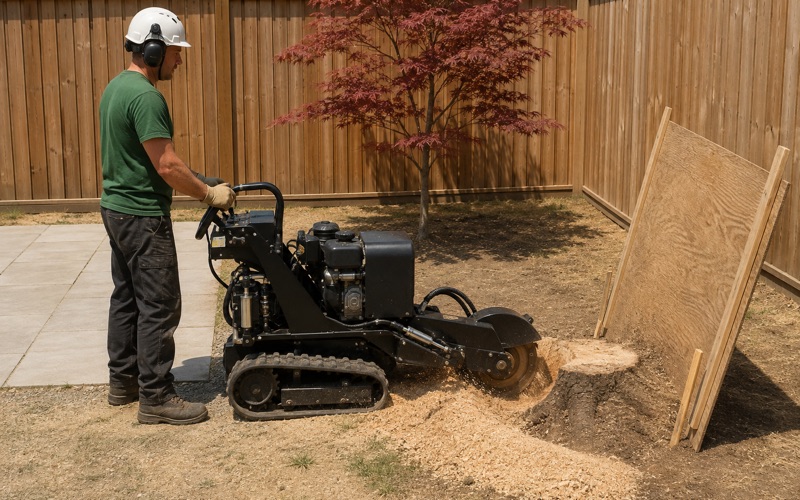
Stump grinding on these lots inherits the same problem, because a stump grinder has to reach the stump along that same footpath. Where the route allows it, we bring the smallest machine that will still finish the grind.
Surface geology in Catonsville samples as 64.3% Baltimore Complex metagabbro, gabbro and amphibolite, with a further 6.6% Ellicott City Granite. Both are hard, dense rock, and where they lie shallow a grinder finds them, so we set grind depth against what is actually under the stump rather than a standard figure.
Shallow root plates and the tree still standing
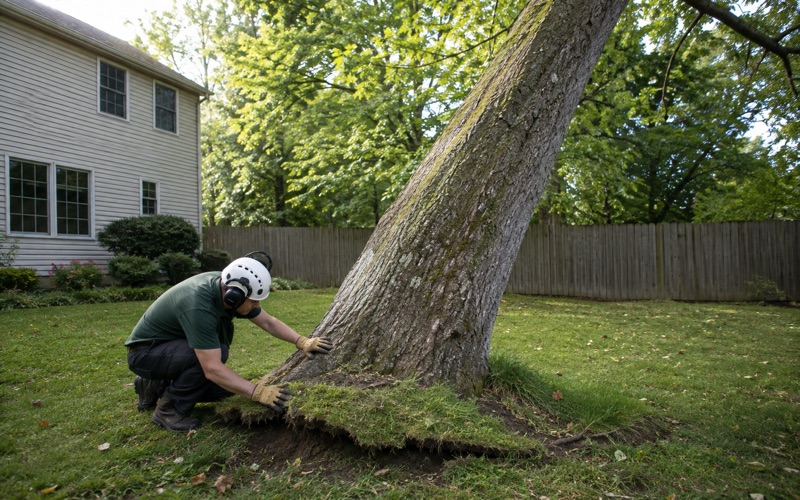
Shallow rock shapes the tree above it as well. A root plate spreads wide and shallow instead of going deep, and that is a windthrow factor on the tall trees these back yards hold, because a plate that cannot anchor at depth relies on width alone. It also means a lifted plate on one side after a wind event is a finding rather than a curiosity, and it is worth looking at while a crew is already on the property.
It is better to know that before a storm than after one. If you are unsure about a tree that has started leaning or lifting turf at the base, we will come back and look at it a second time at no cost.
Permits, Yard Protection and Storm Calls
The regulatory side in Catonsville is more settled than most people expect, and knowing which program actually applies is what keeps a removal from stalling for a week. The questions worth answering before a date is offered are narrow: where the trunk stands relative to the right-of-way, whether the parcel is carrying an obligation recorded against it, and whether anything about the job is a development activity rather than maintenance. Most back-yard removals here answer all three the easy way.
Which county program applies here
No part of the Catonsville CDP lies within the Chesapeake Bay Critical Area. The Patapsco is non-tidal along this edge and the 1,000-foot band landward of tidal water never reaches the community, so Critical Area rules are not a consideration on a Catonsville property.
What does apply is Baltimore County’s forest conservation program at Article 33, Title 6 of the county code, administered by the Department of Environmental Protection and Sustainability, which also accepts the declaration of intent under section 33-6-104. One hazardous tree in a back yard is rarely a forest conservation matter; clearing tied to a permit application can be, and we settle that before scheduling.
Trees standing in the county right-of-way
The older Frederick Road grid carries mature street trees whose trunks stand inside the county right-of-way, and the Roadside Tree Law turns on where the trunk sits, not on who planted it. A Roadside Tree Care Permit from the Maryland DNR Forest Service is required before one of those is removed or trimmed.
Dead and storm-damaged trees on county roads and roadsides come out by work order through the Baltimore County Bureau of Highways, reachable at 410-887-3560, once the right-of-way question is answered. Anything down on private ground stays the owner’s responsibility, which is where we come in.
Protecting the yard on the way out
A hand-carry removal means dozens of crossings of your lawn, and wet turf takes that badly. We lay protection matting along the carry route and over any hardscape the crew has to walk, on every job we run.
We also keep the traffic off the critical root zone of the trees that are staying, so taking one tree out does not compact the soil around the next one. The crew that gave the estimate is the crew that does the final rake-out, and every removal is run under a Maryland Licensed Tree Expert license, with the license number on the written contract as COMAR 08.07.07 requires.
Storm damage behind the house
A destructive-tier Severe Thunderstorm Warning issued on August 10, 2026 named Catonsville among the communities in its path. That tier is used when radar indicates gusts of 80 mph or greater, and it carries the wording that considerable damage to trees and power lines should be expected; more than 25,500 BGE customers lost power.
Storm work in a rear yard is the same access problem under time pressure, and we answer storm calls within 24 hours. If a line is down, call BGE first at 1-877-778-2222: BGE handles vegetation management on its own distribution circuits under COMAR 20.50.12.09 and does not remove the wood, and the wood is the part we take on.
- 20+ Years in Anne Arundel County
- Free On-Site Estimates
- 24-Hour Storm Response