Severn Tree Removal has handled tree removal in Columbia for more than 20 years, and a job here opens with a question that barely comes up elsewhere in Howard County: who actually controls the tree. A single removal can involve the property owner, a village Architectural Committee and the Columbia Association before a saw is started.
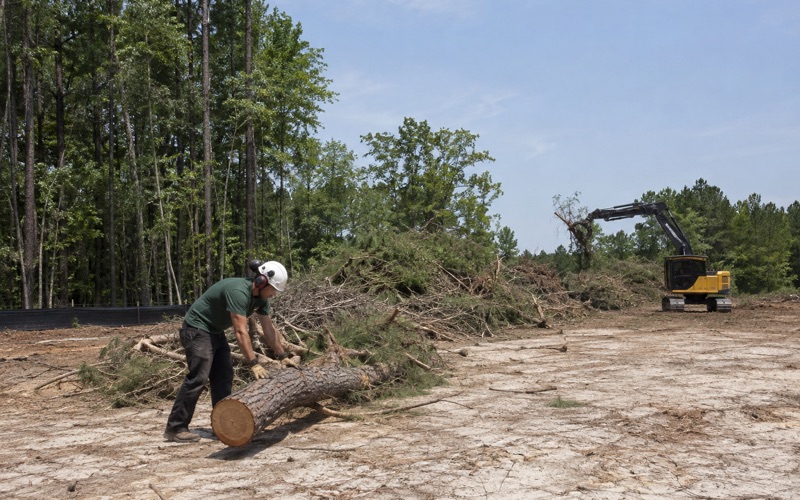
We map that whole path during the estimate rather than discovering it halfway through. The estimate visit is free and on site, and what we write down covers the scope end to end: brush chipped, trunk rounds, stump and grindings all settled before a crew is booked. Approval and permit routing gets sorted ahead of scheduling, because the five counties and four towns we cover each answer differently.
The second thing shaping the work here is age, and it is unusually uniform. Columbia’s trees went in with the houses on a development schedule, and that schedule has now run its course. What we are called out to is one generation of plantings arriving at removal size more or less together.
One build-out, one generation of trees
Columbia was built as a planned new town, and the housing stock records that as a single continuous push: 31.5% of units date from the 1970s and 25.7% from the 1980s. Nothing about that curve is gradual. It means the trees planted around those houses share a birthday to within roughly a decade.
The 1970s cohort is what we are removing now
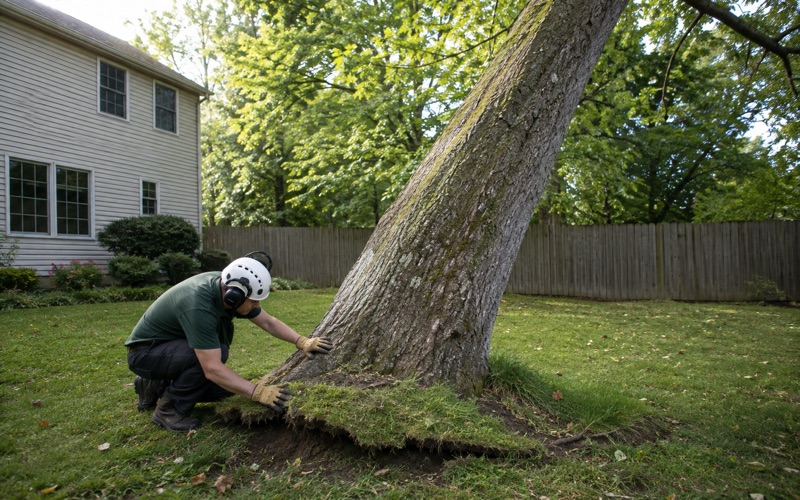
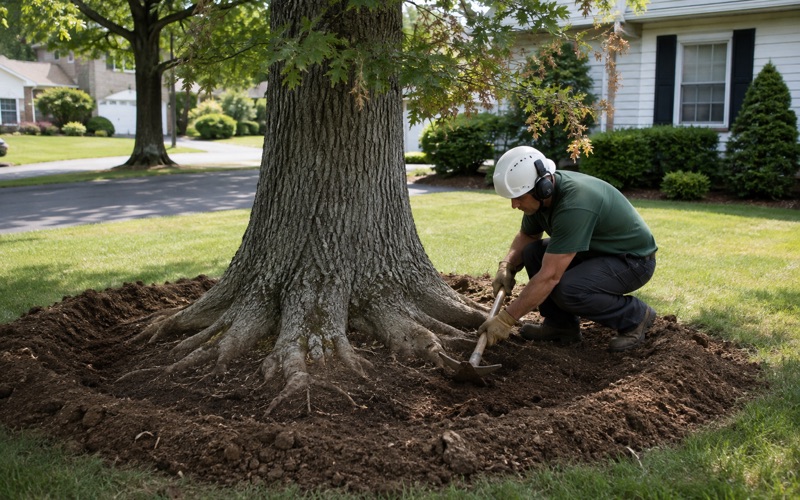
42.9% of Columbia’s units were built in 1979 or earlier, which puts a large share of the yard trees at somewhere around 45 to 55 years old. On a red maple, a silver maple or a fast-grown pin oak, that is the age at which defects invisible at twenty years start to govern the outcome: included bark at a co-dominant union, a compromised root plate, decay working back from an old flush cut.
They also arrive in batches. A street where one tree fails in a storm usually has four more of the same species and the same age within sight, and an inspection that looks only at the one that came down has missed the useful part of the visit. Ash is the sharpest version of this: emerald ash borer has been established in Maryland since 2003 and kills a large ash within about three years, leaving brittle standing deadwood.
There is no older layer here to read the pattern from
Only 2.3% of Columbia’s housing units predate 1960. The new town essentially did not exist before its founding, so there is no earlier round of planting underneath the current one and no older stand on the same soil to compare a declining tree against.
That changes the assessment. In an older Maryland town we can often read a species’ likely span off the trees that got there two generations earlier; in Columbia the oldest cultivated trees on a street are usually the ones we have been asked to look at, so the judgment has to come from the tree in front of us.
The species mix was chosen on the same schedule
The whole Columbia CDP falls in the Piedmont Plateau Province, on the upland side of the Fall Line, which makes northern red oak — flagged as rare down in the coastal plain — a locally appropriate species and a common one in these yards. A mature red oak leaning over a 1970s split-level is a different proposition from anything the tidewater counties send us.
One later arrival breaks the pattern. Callery (Bradford) pear was planted heavily in subdivisions built through the 1990s and 2000s and is prohibited for sale in Maryland from January 15, 2026; those trees are younger than the original build-out and tend to fail early, splitting at a co-dominant union.
Looking for tree removal closer to Scaggsville? See Tree Removal Services in Scaggsville.
Whose tree is it: your lot, or Columbia Association open space
Columbia’s plan threaded common open space between and behind the housing clusters instead of setting it aside in one block. The practical consequence is that a tree standing forty feet from a back door is often not on that lot at all, and the paperwork depends entirely on which side of the line it sits.
Establishing the boundary is the first step, not an afterthought
We open a Columbia estimate by working out where the assessed property ends and Columbia Association Open Space begins. It is routine here precisely because the open space is interleaved with housing rather than fenced off from it, and getting it wrong costs everybody a visit.
Where the trunk turns out to stand on Open Space, the request is not the adjoining resident’s to make. Columbia Association governs Open Space throughout Columbia, the decision to take a tree down there belongs to them, and our part starts only once that decision has been made.
Covenant-regulated trees on assessed property
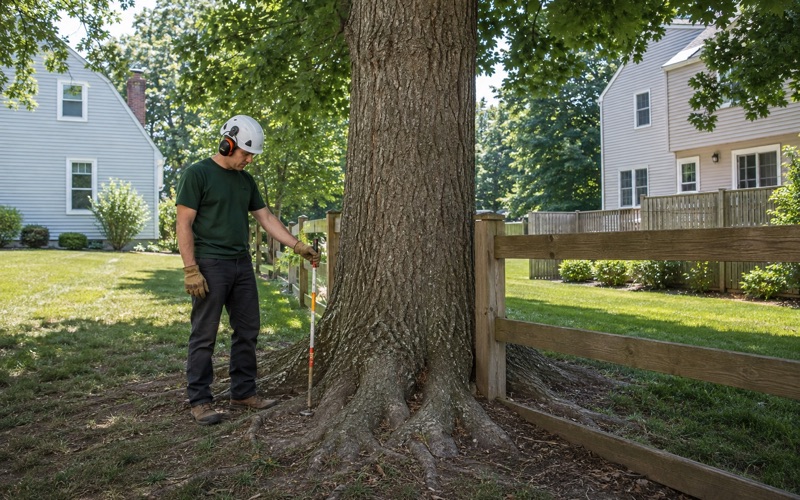
On Columbia Association assessed property a tree can be covenant-regulated even when it is plainly on the lot. Under the Wilde Lake village covenants, removal of a tree with a diameter of six inches or more measured two feet above the ground requires approval, and the request goes to Columbia Association Open Space Management, which inspects the tree before issuing that approval.
Six inches at two feet is a small tree — considerably smaller than what most people picture when they wonder whether anyone needs to sign off. We record diameter at breast height for the removal quote and the covenant diameter for the approval, and both go into the written scope.
An inspection means somebody else reads your assessment
Because Open Space Management inspects before approving, the condition we describe in an estimate is going to be looked at by a second set of eyes. We write to that standard: species, diameter, the specific defect, and what an ANSI A300 approach would do short of removal — crown reduction, deadwooding, cabling and bracing — wherever the tree can reasonably be kept.
That matters most on the borderline cases. A 1970s tulip poplar with one weak union is frequently a cabling job rather than a removal, and being able to say so in writing is often the difference between an approved request and a rejected one.
Two approval tracks that do not talk to each other
Howard County puts the position plainly: the Columbia Village Architectural Committee review and approval is a completely separate process from the issuance of Howard County permits and licenses, the county has no involvement in the village process and vice versa, and issuance of a county building permit does not eliminate the need to apply to the Architectural Committee of the village where the work will occur. We run both tracks in parallel before scheduling rather than tripping over the second one after the first clears.
Your village, through its Covenant Advisor
Columbia has ten villages — Dorsey’s Search, Harper’s Choice, Hickory Ridge, Kings Contrivance, Long Reach, Oakland Mills, Owen Brown, River Hill, Town Center and Wilde Lake — and each carries its own Architectural Committee and Covenant Advisor. Exterior alterations on assessed property are applied for through that village’s Covenant Advisor, which is also where a tree question lands first.
Village practice reported for Town Center allows removal without prior written Architectural Review Committee approval where a tree is a safety hazard and in danger of falling, but requires that the Covenant Advisor be notified immediately. On a storm call we treat that notification as part of the job rather than a loose end left with the resident.
The county side, and where it stops
Howard County’s Department of Inspections, Licenses and Permits issues building, grading and demolition permits, while the Department of Planning and Zoning runs the forest conservation program, reviewing clearing tied to subdivision, development and grading and accepting a Declaration of Intent. Development activity on a single lot smaller than 40,000 square feet is exempt under Section 16.1202(b), provided the area is not already subject to an approved Forest Conservation Plan.
Most residential lots in Columbia sit under that threshold, so the Forest Conservation Act side of a single-yard removal is usually brief. We confirm it rather than assume it, because the exemption stops applying the moment an approved plan already covers the ground.
One review people expect here that genuinely does not apply
Owners often ask whether the Chesapeake Bay Critical Area governs a removal in Columbia. No part of the Columbia CDP falls within it: a polygon intersect run against the state Critical Area layer returned zero features here, with the query shape validated against a known-positive control, the City of Annapolis polygon, which returned 24 intersecting features.
Columbia is inland and non-tidal, and the 1,000-foot band landward of tidal waters does not reach it. That is a checked answer rather than an untested assumption, and it takes a review step off the table that people arrive expecting to face.
When a 1970s planting becomes a crane job
The original trees have outgrown the space they were planted into, and the removal method follows from that far more than from the customer’s preference. Maryland is specific about who may do the work: Natural Resources Article section 5-417(a)(1) requires a Licensed Tree Expert license for tree work for hire, and COMAR 08.07.07.03D requires a written contract carrying that license number. That number belongs on any contract before a crew is scheduled, and it is worth checking on any bid you take here.
When there is no drop zone to fell into
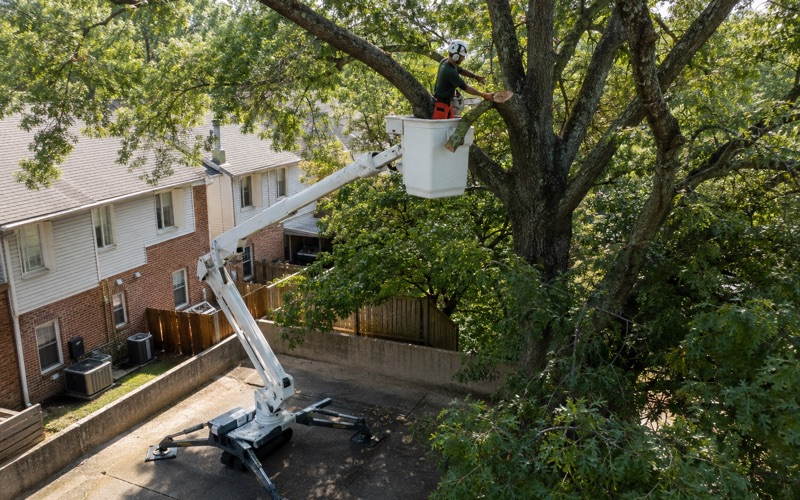
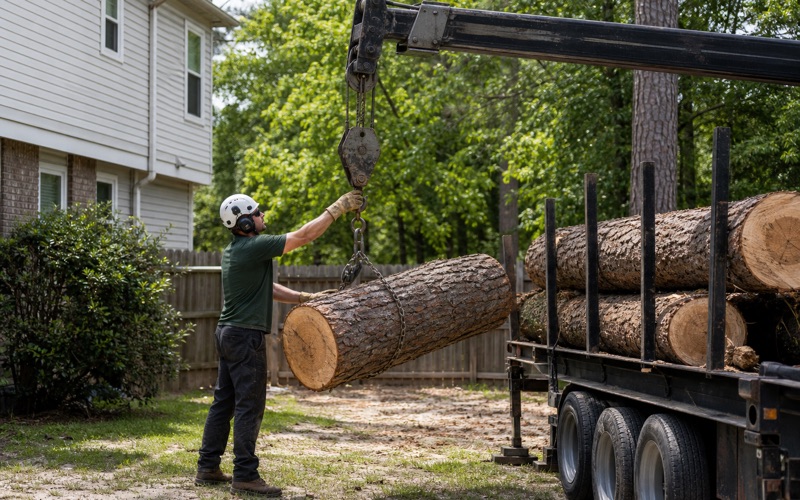
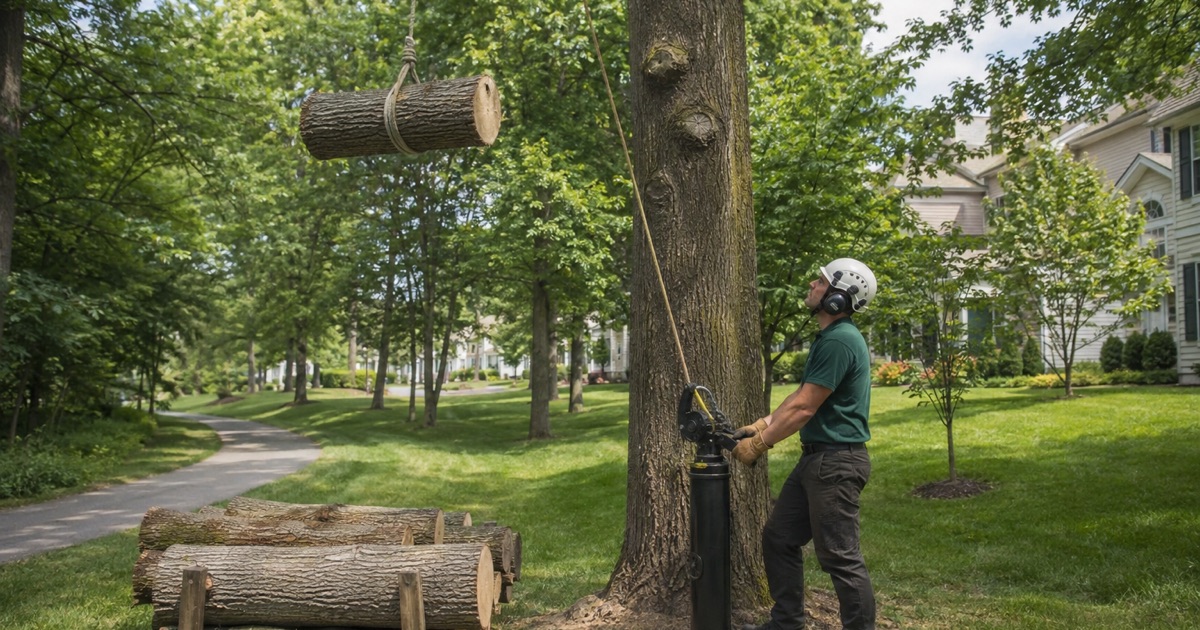
Detached single-family homes make up 39.5% of Columbia’s units and attached single-family another 25.4%, and the attached clusters in particular were laid out tightly against common open space. On ground like that there is frequently nowhere to put a whole tree, so it comes down in pieces.
We run crane-assisted removals where sections have to travel out over a roof, a fence line or a parking court instead of reaching the ground, and sectional dismantling with rigging where an aerial lift can be set. Lawn and hardscape protection matting goes down either way.
Storm work on a street of the same age
Columbia sits in NWS forecast zone MDZ506, Central and Southeast Howard, under the Baltimore/Washington forecast office. A destructive-tier Severe Thunderstorm Warning issued on August 10, 2026 for northern Howard County and southwestern Baltimore County named Columbia among the communities in its path, the destructive tier being triggered when radar indicates gusts of 80 mph or greater. More than 25,500 BGE customers lost power, and a tree was reported down onto a house in Columbia.
We respond to storm damage, fallen trees and trees resting on a structure within 24 hours. Where a limb is on a line, that is BGE’s call first — 1-800-685-0123 for a limb on a line, 1-877-778-2222 for a downed line — and BGE’s vegetation-management duty under COMAR 20.50.12.09 does not extend to hauling the wood away afterward. That part is ours.
Stumps, grindings, and what the grinder is cutting
Stump grinding effort varies materially depending on which part of Columbia you are standing in. Surface geology across the CDP samples as 53.3% Loch Raven and Oella schist, 14.3% Baltimore Gneiss, 8.8% Guilford Granite and 7.4% Baltimore Complex metagabbro, and schist weathers to a saprolite that a stump grinder works through far more easily than granite or metagabbro.
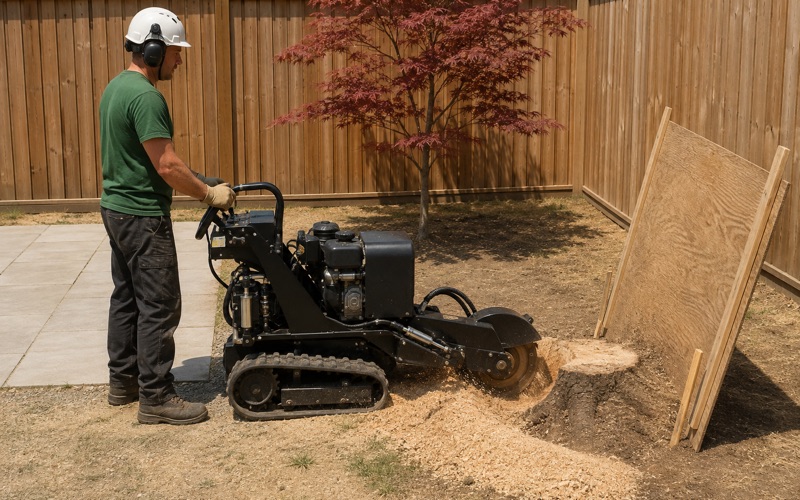
That is why the stump and the grindings are priced in the written scope up front instead of left as a variable line. Our compact tracked equipment passes a standard back-yard gate, so a stump behind an attached unit does not turn into a fence-panel removal, and the crew that walked the estimate is the crew doing the final rake-out.
- 20+ Years in Anne Arundel County
- Free On-Site Estimates
- 24-Hour Storm Response