Severn Tree Removal has been handling tree removal in Crofton for more than twenty years, and the first thing we settle on a job here is who actually has to sign off on it. That answer is less obvious in Crofton than almost anywhere else we work. Getting it wrong is what turns a two-day removal into a three-week wait, so we resolve it before we quote a date.
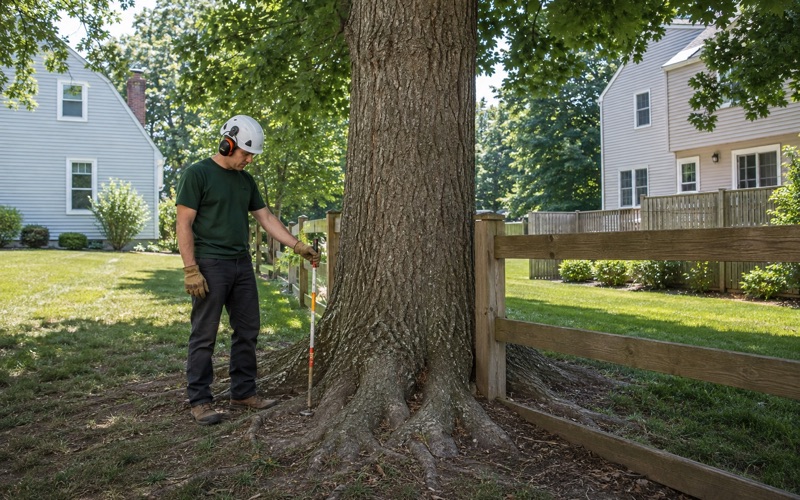
Every estimate is free and done on site. We walk the tree, measure the drop zone or decide there is not one, and write the scope down before a crew is booked — brush chipped, trunk rounds cut and stacked or hauled, stump ground, grindings raked out or removed. The number you are holding at the end of that visit is the number you pay, and a second look at a tree you are unsure about costs nothing either.
Storm damage runs on a 24-hour response, whether the tree is across a driveway, resting on a roof or hung up in a neighbor’s canopy. The same crew that gave the estimate does the work and the final rake-out, moving on compact tracked equipment sized to pass a standard back-yard gate.
Crofton’s “mayor” is not the person who approves the work
Crofton has a mayor, a town manager and a town hall phone number, and none of that adds up to a permit office. The community is genuinely organized around those roles, but the authority behind a tree permit sits somewhere else entirely, and homeowners here are often surprised by where.
A census-designated place, not a municipality
Crofton is a census-designated place. The 2024 Census Gazetteer file lists it as Crofton CDP — LSAD 57, land area 6.611 square miles, water area 0.000 square miles. That is a statistical boundary the Census Bureau draws, not a chartered municipality with its own council and its own code.
Address checks bear that out at street level. Points at 1576, 1600 and 1610 Crofton Parkway and at the Crofton Country Club all come back as Anne Arundel County with no municipal place attached. That is the same answer a county reviewer reaches when an application for one of those addresses lands on the desk.
What the Civic Association actually does
The original section of the community is a Special Community Benefit District governed by the Board of Directors of the Crofton Civic Association, which operates a town manager and a mayor. The mayor’s title here is honorary. The position carries no municipal authority, and the association has no permit authority of any kind.
That is not a knock on the organization; it is simply the wrong door for a permit. What the association does hold is a set of private covenants, which is a different instrument with a different consequence, and we come back to it further down this page.
Why we settle this before scheduling
Permit routing is something we handle before a crew is booked, because the counties and towns across this region answer differently and Crofton answers differently again. On a job here the question is never which municipal department. It is which county division, and whether the state also has a say.
Crofton was established in 1964 by the Crofton Corporation, on land assembled by the Crawford Corporation and anchored by the golf course that became the Crofton Country Club. Six decades of building outward from that original section means two houses a mile apart can sit under different private review bodies while sharing an identical public permit path.
Looking for tree removal closer to Catonsville? See Catonsville Tree Removal.
The county and state approvals that actually apply
Every public approval a Crofton removal might need comes from Anne Arundel County or from the State of Maryland. Three come up in practice. Most ordinary residential removals here trigger none of them, but knowing which is which is the difference between starting Monday and starting next month.
County permits and the forest conservation trigger
Building, grading and sediment control permits are issued by the Anne Arundel County Department of Inspections and Permits. Forest conservation review and development review sit with the county Office of Planning and Zoning, Development Division, which is where a larger clearing job gets a closer look.
The county’s Forest Conservation Regulations apply where a subdivision, grading permit or sediment control permit covers a site of 40,000 square feet or greater. A typical Crofton house lot is nowhere near that threshold, so a back-yard removal does not reach it. A multifamily grounds contract or a builder’s parcel can, and we flag that at the estimate rather than mid-job.
Roadside trees and the state’s permit
A tree whose trunk stands in a public right-of-way is a state matter. The Maryland Department of Natural Resources Forest Service issues the Roadside Tree Care Permit and licenses the Maryland Licensed Tree Expert who has to hold it. That requirement applies regardless of whether the road itself is county or state.
Where the rest of the coordination goes depends on the road. Trees in a state highway right-of-way involve the Maryland Department of Transportation State Highway Administration; trees in a county road right-of-way involve the Anne Arundel County Department of Public Works, Bureau of Highways. We establish which side of the property line a trunk sits on during the estimate, not on the morning of the job.
The Critical Area step that does not exist here
No part of Crofton falls within the Chesapeake Bay Critical Area. A query of the Maryland Critical Area service across the entire Crofton CDP boundary returns no features, and a point query at the community’s own internal point returns nothing either.
That is a real absence rather than a failed query. The same service returns a Resource Conservation Area polygon at Sandy Point State Park and a Federal Land polygon at the Annapolis City Dock, so it answers when there is something to answer with. There is no tidal frontage in Crofton to protect: the gazetteer records zero water area inside the boundary.
The practical consequence is that there is no Vegetation Management Plan step and no Critical Area buffer to design around on a Crofton lot. The county’s 40,000-square-foot forest conservation trigger and the state Roadside Tree Care Permit are the two regulatory questions that actually arise.
The covenant layer sitting on top
Above the public chain there is a private one, and it is the part homeowners most often find out about late. A covenant is a contract that runs with the deed and is enforced by a community body. It is not a permit, and the county does not check it before issuing one.
The Covenant Review Committee
The Crofton Civic Association references a Covenant Review Committee, to which home improvement projects and complaints are submitted for review. Most neighborhoods inside the Crofton Special Community Benefit District carry covenant restrictions of some kind.
A submission to that committee is a request to a private body under a private agreement. It grants nothing the county recognizes, and a county approval does not release a homeowner from the covenant. The two run in parallel, and on a job where both apply, both have to be satisfied.
The newer sections and their own associations
The neighborhoods built outward from the 1970s onward sit outside the Crofton Civic Association and answer to their own homeowners associations, each with its own covenant and architectural standards. The housing record shows how much of Crofton that is: 2,982 units were built between 1970 and 1979 and 3,048 between 1990 and 1999, against 1,403 built before 1960.
So the first practical question on a Crofton removal is which body, if any, holds the covenant on that specific address. We schedule around HOA boards, property managers and multifamily grounds staff as a matter of routine, and we would rather pin that down at the estimate than have a crew stood down at a gate.
Sequencing the private review with the public one
The private review is usually the slower of the two, because a committee meets on its own calendar while a county counter runs on business days. Where both apply, we get the covenant submission moving first and let any county work run alongside it rather than behind it.
Storm damage is a different situation. A tree already resting on a structure gets made safe first, and we photograph the condition thoroughly before anything is cut, so the record exists for whichever body asks about it afterward.
What the ground and the weather change about the work
Jurisdiction decides who signs. The site decides how the tree comes down, and Crofton’s mix of attached housing, wet soils and storm history makes that a real question rather than a formality.
Attached housing and the access problem
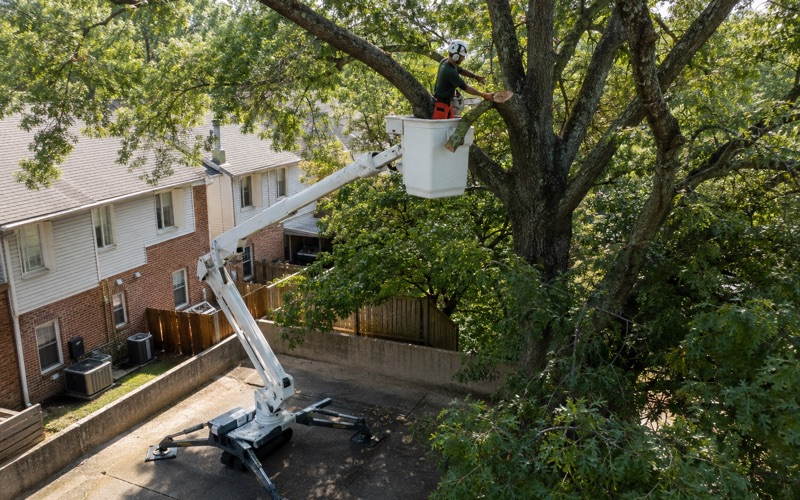
Attached housing is close to half the stock here — 4,983 single-family attached units against 4,965 detached, with 3,810 of the attached units owner-occupied. On a townhouse block, a rear tree is reached through a gate on a shared fence line, not by driving equipment around the side of the house.
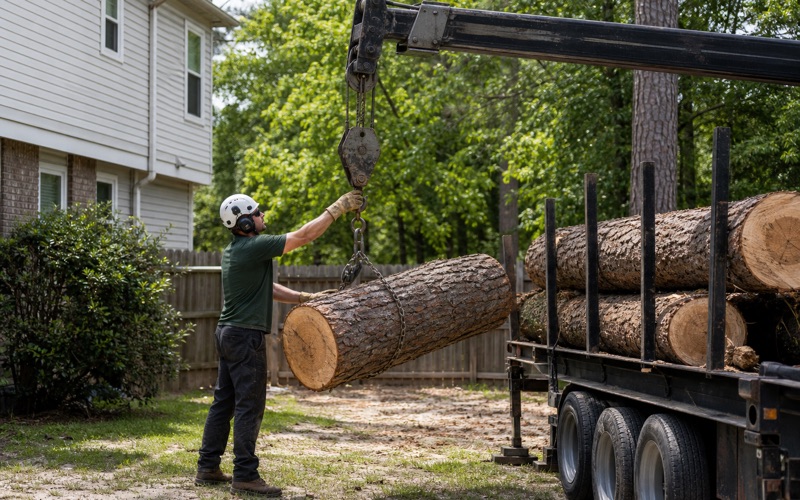
That is why our tracked machines are sized to pass a standard gate, and why sectional dismantling rather than felling is the normal method on those lots. Where there is no drop zone at all and no route in, a crane-assisted removal lifts the tree out over the roofline in pieces instead.
Soils, from the flat interior to the creek slopes
The center of the community maps as Adelphia-Holmdel-Urban land complex at 0 to 5 percent slopes, with Adelphia moderately well drained and Holmdel somewhat poorly drained. Shrewsbury loam at 0 to 2 percent and Fallsington sandy loams are mapped here as well, both on the wet end of the local set.
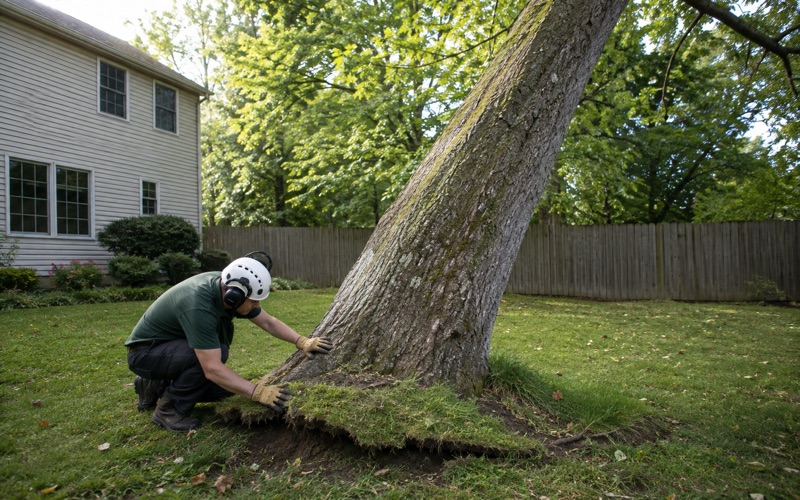
Wet ground matters twice over. A saturated root plate raises the windthrow risk on a tree that is still standing, and it is also the surface a stump grinder and an aerial lift have to work from. Lawn and hardscape protection matting goes down on every job, and on this ground it is doing real work rather than serving as a courtesy.
Along the stream corridors the soil map changes completely: Sassafras and Croom soils at 15 to 25 and 25 to 40 percent slopes, and Collington, Wist and Westphalia soils at 25 to 40 percent. A lot backing onto a creek is a different rigging problem from one on the flat interior, and we quote it as one.
Storm season on the highways and in the yards
Severe thunderstorm wind puts the same roads on the list year after year. A tree came down on MD 450 Defense Highway on July 1, 2021; downed trees blocked MD 424 Davidsonville Road near Bell Branch Road on July 12, 2022, with several trees and wires down in the 2000 block of MD 424; trees came down at MD 424 and MD 450 on August 10, 2022; several blew down in April 2023 including a large one near Reidel Road; and trees and wires came down near MD 450 and MD 3 Crain Highway on May 31, 2025.
Wires change the sequence completely. Anything touching electric distribution line clearance or a downed conductor goes to Baltimore Gas and Electric first, and we work the tree once the line is confirmed dead or cleared. Hail is a recurring report here too, ping-pong-ball size in July 2021 and quarter size in June 2022 and again in June 2023, which is worth a look at the upper canopy afterward.
Flooding in Crofton is inland stream flooding rather than tidal. Defense Highway closed near Huntwood Drive on July 29, 2017 and again on July 16, 2022, and closed between Hermitage Hills Drive and St. Stephens Church Road on June 14, 2021. The community sits in NWS public forecast zone MDZ014, forecast by the Baltimore/Washington office, and that zone is what we watch when we decide whether a crew rolls and which way it comes in.
- 20+ Years in Anne Arundel County
- Free On-Site Estimates
- 24-Hour Storm Response