Severn Tree Removal has been doing tree removal in Ellicott City and across this corner of Maryland for more than 20 years, and the first thing we tell an owner here is that the paperwork is not what they have been led to expect. The estimate is free, the scope is written down before a crew is booked, and permit routing is settled before a date goes on the calendar.
That last step matters more in this community than almost anywhere else we work. Five counties and four towns in our service area answer the same question differently, so we read the actual code for the address in front of us rather than repeating what a neighbor was told about theirs.
What follows is what genuinely changes about a removal here: the review that does not apply, the county program that does, and the ground our crews end up cutting over. None of it is guesswork, and none of it is a judgment call we ask you to take on trust; each piece is checked against the code section or the map that governs it.
The historic district does not gate tree work
The Ellicott City Historic District is real and so is its review, but that review is about buildings. Howard County Code Title 16, Subtitle 6 gives the Historic Preservation Commission authority over exterior work inside the district, and the list of activities it reaches is short and specific.
What section 16.603(a) actually lists
Section 16.603(a) names three things: construction, moving, demolition, repair or alteration of a structure affecting its exterior appearance; construction or alteration of parking areas; and installation or alteration of exterior signs. Those are the activities that draw a certificate of approval from the commission.
The word tree does not appear anywhere in that list. A porch rebuilt on a nineteenth-century storefront is on it; a declining oak in the side yard behind that storefront is not, and the distinction is written into the section rather than left to interpretation.
What section 16.603(c)(2) sets aside
The code does not leave it to inference either. Section 16.603(c) states that a certificate of approval is not required for tree clearing and removal, or for forest conservation plantings, street trees and other required landscaping, when the work is carried out in accordance with an approved subdivision plan, site development plan, forest conservation plan or grading plan.
So the exclusion sits in the code twice over. Tree work is absent from the list of covered activities, and it is named outright in the exclusions, which is the opposite of what owners in the district are usually told before they call us.
Booking a removal at a historic address
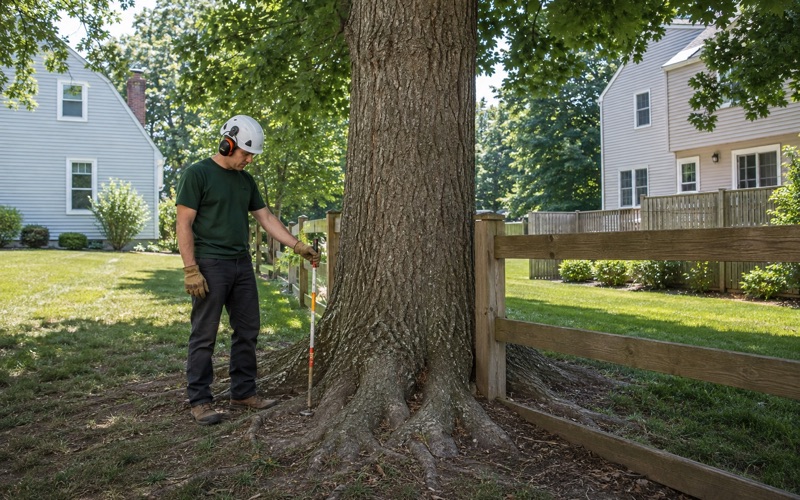
In practice a removal on or just off Main Street schedules the way any other removal does: an on-site look, a written scope, a date. Where a tree sits inside a project running under an approved plan, we work to that plan. Where it is simply an owner’s tree in an owner’s yard, the commission is not the body that answers the question.
The visit costs nothing, and neither does a second look at a tree you are unsure about. When a property manager or an HOA board wants the reasoning in hand before releasing the work, we put the code citation in the written scope alongside the price.
Looking for tree removal closer to Bowie? See Bowie Tree Removal.
The flood record produced a debris program, not a tree rule
The Patapsco River forms the eastern and northern boundary of the community, and the Tiber Branch runs through the district and cuts the valley Main Street sits in. The recorded floods run 1780, 1817, 1868, 1917, 1938, 1972, 2011, and then July 30, 2016 and May 27, 2018. What that record changed was county operations, not the review of a private tree.
Two inches of rain, or an hour above 30 mph
Howard County runs a standing stream debris removal program with published triggers. Any time the county records two inches of rain in 24 hours, or an hour of sustained winds above 30 mph, the program activates: 55 sites are inspected within three business days and cleared within 14 business days.
The Department of Public Works ran the first such action and pulled out 3,850 pounds of tree branches, logs, stumps, cinder blocks and other metal. Those are the same storms that put our own crews out on a 24-hour footing for fallen trees and trees resting on a structure.
Woody debris in a channel is a flood hazard
That program is why we treat cut wood near water differently here than we would in a flat subdivision. Brush stacked on a bank in this valley is not yard waste waiting on a pickup; it is material that moves in the next two-inch rain and lodges where the channel narrows.
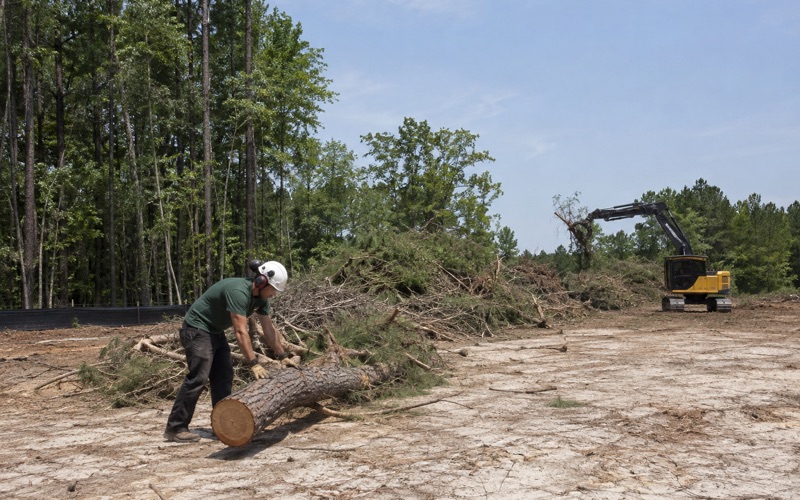
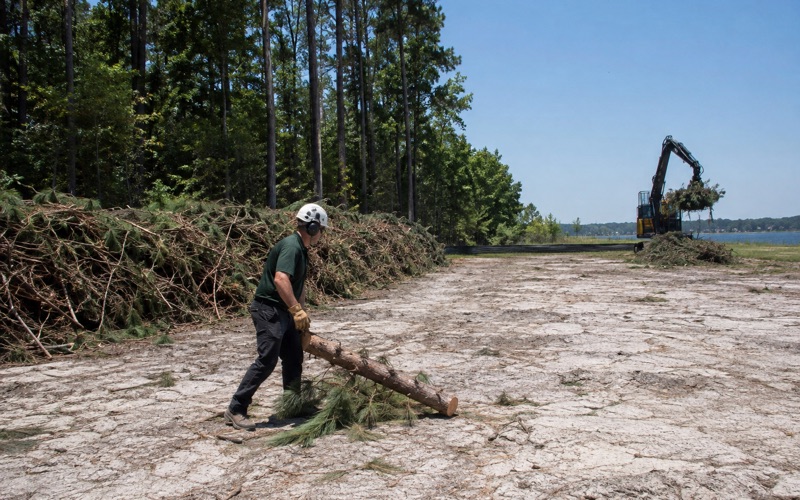
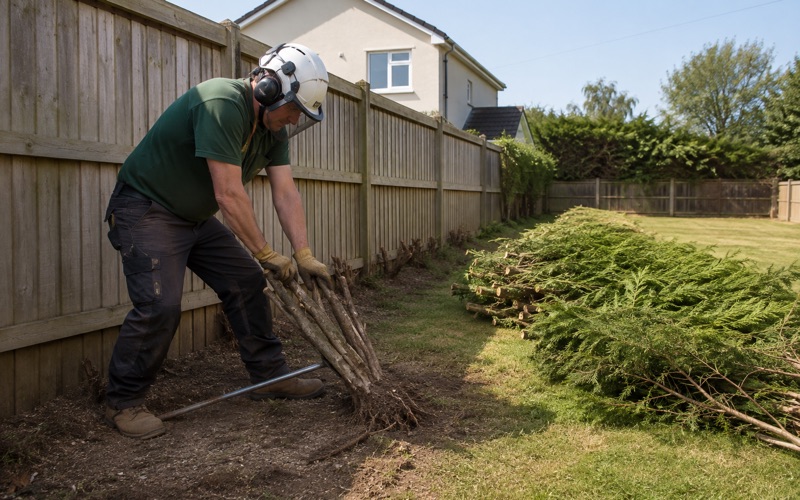
Every removal we quote carries its inclusions in writing — brush chipped, trunk rounds, stump and grindings all settled before a crew is booked. Nothing is left piled behind the house to be argued about later, and nothing is left where the water can find it.
Where the tree hangs over the channel
A stem leaning across the Tiber Branch has no drop zone, because the drop zone is the watercourse. Those come out in sectional dismantling, rigged and lowered piece by piece so the wood lands on ground a crew can carry it off.
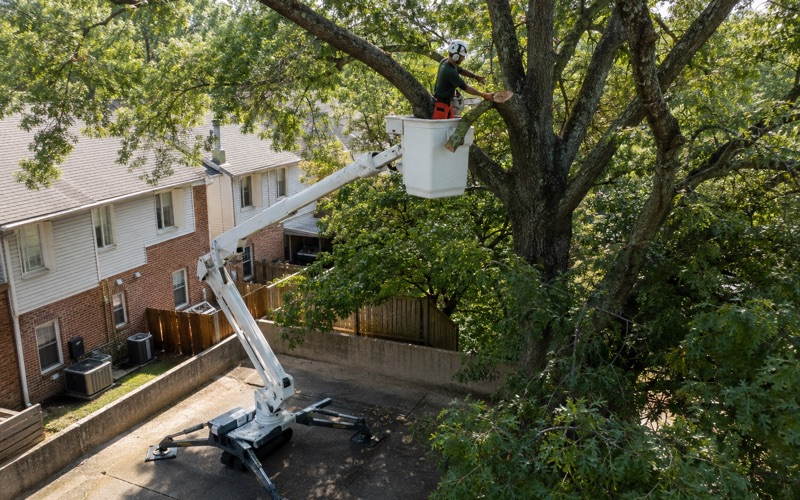
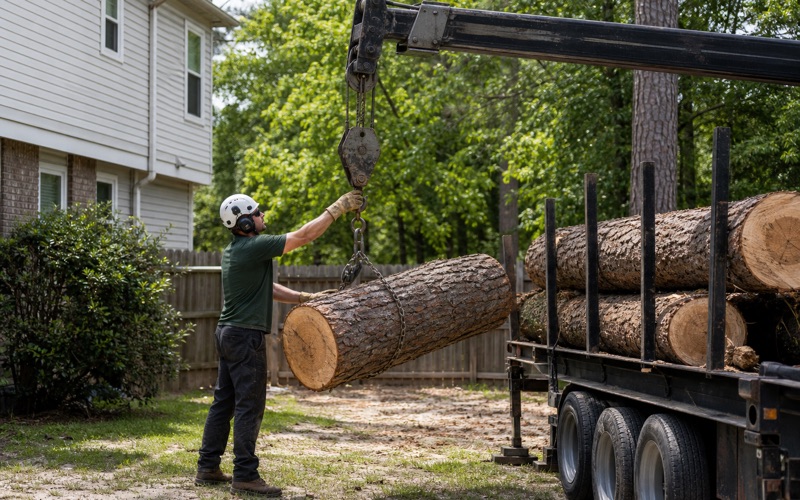
That is slower than felling and we say so at the estimate rather than after. Where a back yard has no room to work at all, a crane-assisted removal is usually cheaper than the alternative of taking a tree apart over a roof.
The approvals that do apply here
The exclusion inside the district does not make tree work here unregulated. The rules that bind follow two things instead: where the tree stands, and who is doing the cutting.
Roadside trees in the public right-of-way
A tree standing in the public road right-of-way needs a Roadside Tree Care Permit from the Maryland DNR Forest Service before it is cut or trimmed, under Natural Resources Article sections 5-401 through 5-411. That obligation falls on individuals, businesses, municipalities and utilities alike.
Along Frederick Road, MD 144 and the older lanes running off it, that catches more front-yard trees than an owner expects. We settle the right-of-way question at the estimate and route the permit before a date is set, not on the morning the truck arrives.
Working under a Licensed Tree Expert
Any person or firm doing tree work for hire in Maryland must hold, or work under the direction of, a Maryland Licensed Tree Expert, and all commercial roadside tree work has to be conducted under an LTE’s direction. That is worth asking about before anyone puts a rope in a tree.
Our pruning specifications follow ANSI A300 and our crews work to ANSI Z133 for safety practice. Crown reduction, crown raising and deadwooding are written as separate line items, so the job that shows up is the job that was priced.
Line clearance and the wood it leaves behind
Baltimore Gas and Electric handles vegetation management on its own distribution system across most of Howard County. What BGE does not do is haul: the utility states plainly that it cannot assist customers with disposal of tree debris and that final disposition of the material rests with the property or tree owner.
That gap is what we are usually called about once the power is back — the line is clear, the wire is up, and a driveway is under a pile of hardwood. We take that on as its own job, chipped and carted, at a price agreed before the crew rolls.
What the ground here does to the work
The last thing that changes a removal in this community sits underfoot. This is Piedmont ground on the west side of the Fall Line, and the surface is hard crystalline rock rather than deep sediment.
Granite and gabbro under the stumps
State mapping puts the surface at the community centroid on the Ellicott City Granodiorite, an igneous granite of Paleozoic age formed during the Taconic Orogeny and mapped only in Baltimore and Howard counties. The community stands on the pluton it was named for, and the ground nearby also spans the Baltimore Gabbro Complex, a Cambrian metagabbro, gabbro and amphibolite unit.
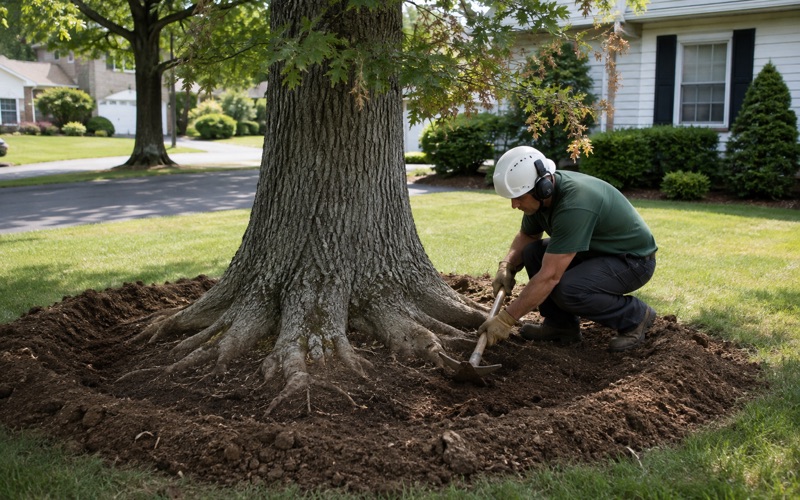
The practical consequence is rock. Stumps and root plates sit on shallow saprolite over unweathered stone, so a stump grinder reaches something it cannot cut sooner than it would east of the Fall Line, and we price grinding on what is actually under the root collar.
Made ground on the built-up flats
The mapped soil at the centroid is the Urban land-Udorthents complex, 0 to 8 percent slopes, hydrologic soil group D. Udorthents are made ground rather than a natural profile, which means fill of unknown origin, no reliable horizon and very slow infiltration.
We plan for that instead of assuming what a machine will find below the turf, and we plan for water that sits rather than drains. Compact tracked equipment sized to pass a standard back-yard gate keeps the ground pressure down, and protection matting goes over lawn and hardscape on every job.
The valley walls toward the Patapsco
On the valley side the mapped soil is Legore-Relay gravelly loams, 25 to 65 percent slopes, very stony, formed in loamy residuum weathered from gabbro and rated a severe erosion hazard. Slopes in that band are steep enough that rigging and lowering replace felling, and the stone in them is large enough to stop a grinder outright.
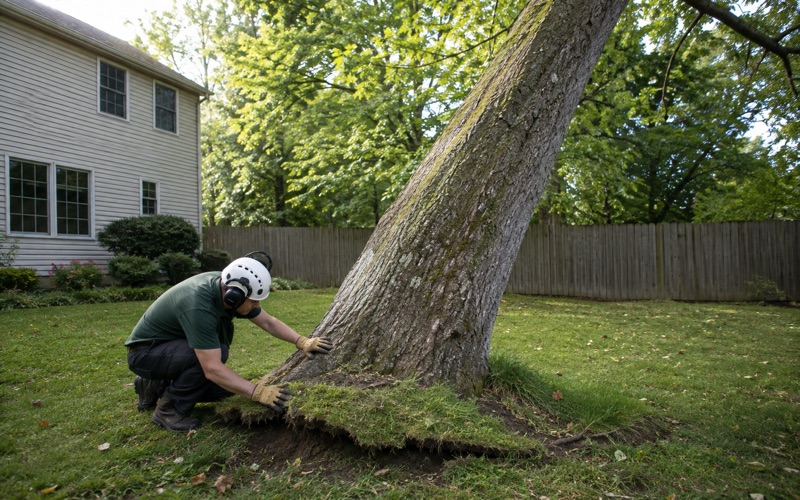
The Relay series runs 4 to 7 feet to hard unweathered gabbro and the Legore series meets bedrock commonly at 5 to 10 feet. A mature root plate on those walls is a wide shallow disc pinned on rock rather than a taproot, which is why a leaner on a slope gets taken apart from above.
Tulip poplar and early-succession wood
The county’s canopy assessment found tulip poplar dominating the surveyed overstory, with red maple, American beech, black walnut, red and white oak, black cherry, blackgum, sycamore and hickories behind it, and read that predominance as woodland still in early to middle succession. That is the county-wide reading, and it matches what we find standing in yards on this side of the Patapsco.
In a yard that reads as tall, fast-grown, comparatively weak-wooded stems rather than old slow-grown hardwood: co-dominant stems with included bark, and limb failure in the first heavy wet snow. We would far rather look at one of those standing than clear it off a roof.
- 20+ Years in Anne Arundel County
- Free On-Site Estimates
- 24-Hour Storm Response