Severn Tree Removal has been doing tree removal in Fort Meade for more than twenty years, and the single most useful thing we know about this place is procedural rather than horticultural: the person standing under the tree is almost never the person who can authorize taking it down. Every job here begins by establishing who signs.
That changes how we quote. A call about a leaning oak may come from a resident, from a community office, or from a garrison shop, and the three of them need three different documents. We write the scope down before a crew is booked, the estimate visit costs nothing, and we will come back a second time to look again at a tree somebody is unsure about.
We also arrive able to get to the work. Crews are credentialed ahead of the date, our tracked machines are sized to pass a standard back-yard gate, and where there is no drop zone to fell into we bring a crane instead of improvising one.
Nobody in Fort Meade family housing owns the tree
The census data here is unusual enough that it is worth stating plainly. ACS 2024 five-year table B25032 records 3,459 housing units in the Fort Meade CDP and 3,036 of them occupied, with zero owner-occupied units. All 3,036 occupied units are renter-occupied, and the table records no owner-occupied units in any structure category at all.
That is not a rounding artifact or a small-sample quirk. It is the structural fact of the place: family housing on the installation is privatized, so the landlord is a company and the resident holds a lease. Nobody living in these homes is in a position to hire a tree crew for the yard, and any contractor who suggests otherwise is describing a transaction that cannot happen.
For us it simplifies the sales conversation and complicates the scheduling one. There is exactly one decision-maker per job, we work out who it is on the first call, and everything after that is a contract question rather than a persuasion question.
What the housing stock tells us about the canopy
The same table breaks the units down by structure, and the mix explains a lot about what we find in the yards. There are 2,103 single-family attached units, 60.8 percent of the stock, and 602 detached, 17.4 percent. Attached rows put small setbacks and shared property lines between mature stems and roofs.
Age matters just as much. Some 1,637 units were built in 2000 or later, including 893 between 2010 and 2019, while 723 predate 1960 and 177 predate 1940. Around the newer communities we are usually dealing with planted street trees still inside their establishment window; around the older blocks we are dealing with full-grown canopy, co-dominant stems that were never subordinated, and included bark unions that have been quietly getting worse for sixty years.
Looking for tree removal closer to Jessup? See Tree Removal Services in Jessup.
Corvias, the garrison, and who actually signs
Corvias is the housing partner at Fort Meade, responsible for the design, build, finance, operation and maintenance of 2,628 homes and four community centers across six residential communities, plus the Reece Crossings apartment community on post. Lawn care, snow removal and 24-hour emergency maintenance are included in rent, and their Fort Meade office is reached at (410) 305-1258. Residential tree work in those communities is a Corvias decision and a Corvias contract.
Everything outside the housing footprint sits with the U.S. Army Garrison Fort George G. Meade Directorate of Public Works, at 4216 Roberts Avenue, phone 301-677-9141. The Directorate of Public Works comprises Master Planning, Operations and Maintenance, Business Operations Integration, Engineering, Housing and Environmental Divisions, and the Environmental Division is the one that matters when a removal touches installation forest rather than a lawn.
The scale of that second scope is easy to underestimate. The installation’s 5,200 acres currently include 1,200 acres of forest, 200 acres of wetland and 200 acres of stormwater detention facilities. A hazard tree on a wood line is a different job, a different specification and a different signature from the same species standing in a front yard four hundred feet away.
Where a resident’s question actually goes
When the question is really about a lease rather than a tree, the Fort Meade Housing Services Office within the Directorate of Public Works Housing Division handles housing counseling, lease review and landlord dispute mediation for service members. We say so rather than pretending we can settle it, because a crew quoting work it has no standing to perform wastes everybody’s week.
We are comfortable being told to wait while that gets sorted. Scheduling around institutional calendars, property managers and grounds departments is normal work for us, not an exception we grudgingly accommodate.
Working inside a controlled-access installation
Access is the first constraint on this site, not the last. Fort Meade is a controlled-access federal facility, and a crew without credentials cannot reach the job regardless of how urgent the tree is or how good the price was. We handle that ahead of the date, which is the same discipline we apply to permit routing off post, where five counties and four towns each answer a little differently.
The technical standards do not bend for the setting. Work is performed by Maryland Licensed Tree Experts, licensed through the Maryland Department of Natural Resources Forest Service for tree work done for hire in this state, with ISA Certified Arborist judgment behind the removal-versus-retention call. Pruning specifications follow ANSI A300, and crew practice follows ANSI Z133, whether the contract is signed by a housing partner or a garrison office.
Ground that behaves differently than it looks
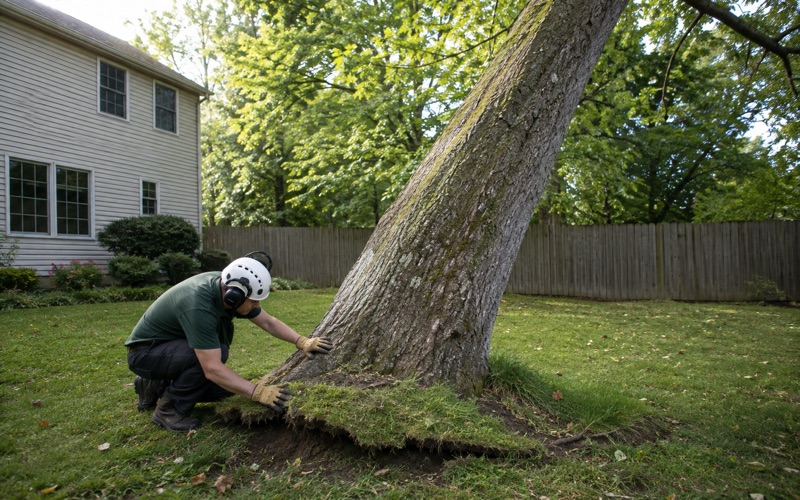
The soils here are droughty and disturbed, and both halves of that change the work. The CDP centroid maps as Patapsco-Fort Mott-Urban land complex on 5 to 15 percent slopes, with the Patapsco component somewhat excessively drained — sandy, fast-draining ground that stresses shallow-rooted trees through a dry summer and produces thin, wide root plates rather than deep anchorage. In the low ground, somewhat poorly drained Fallsington sandy loams and frequently flooded Zekiah and Issue soils are mapped instead.
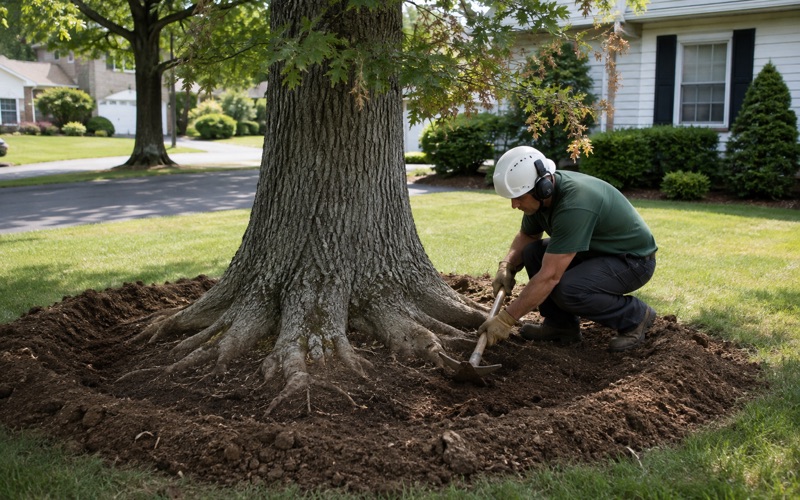
Made ground is mapped across the installation as well: Udorthents on refuse substratum at 0 to 50 percent slopes, Udorthents on reclaimed gravel pits, and Udorthents loamy on 0 to 5 and 5 to 15 percent slopes. Root plates on made ground do not fail the way textbook root plates fail, and a stump grinder working reclaimed fill can hit buried material a foot down. We price stump grinding on this ground with that possibility written into the scope rather than discovered on the day.
Water, and one rule that does not apply here
No part of the Fort Meade CDP lies in the Chesapeake Bay Critical Area. We checked the Maryland Critical Area service across the whole CDP boundary and it returns no features, against a control point at Sandy Point State Park that does return a Resource Conservation Area polygon. The water on this ground is the Little Patuxent and the Patuxent, both non-tidal here, so the buffer rules that shape our work along tidal shoreline elsewhere in Anne Arundel County simply are not part of the specification.
What the Little Patuxent does instead is flood. A portion of Fort Meade Road was washed out by Little Patuxent River flooding on June 4, 2018. Saturated low ground near that corridor is where we most often find a root plate that has let go without a storm strong enough to explain it, and it is also the ground where we plan our access route before the day rather than on it.
Protecting what we drive across
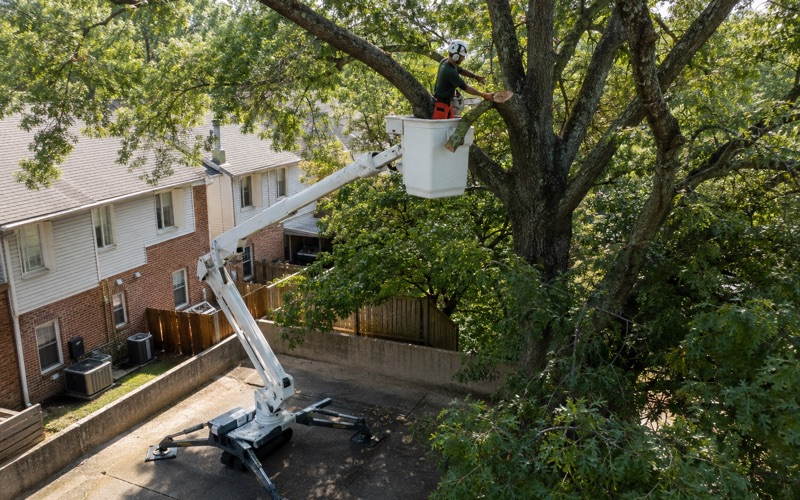
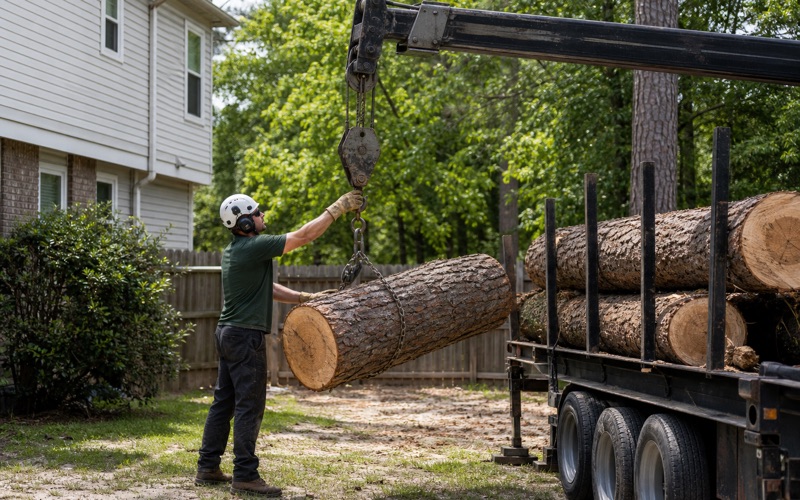
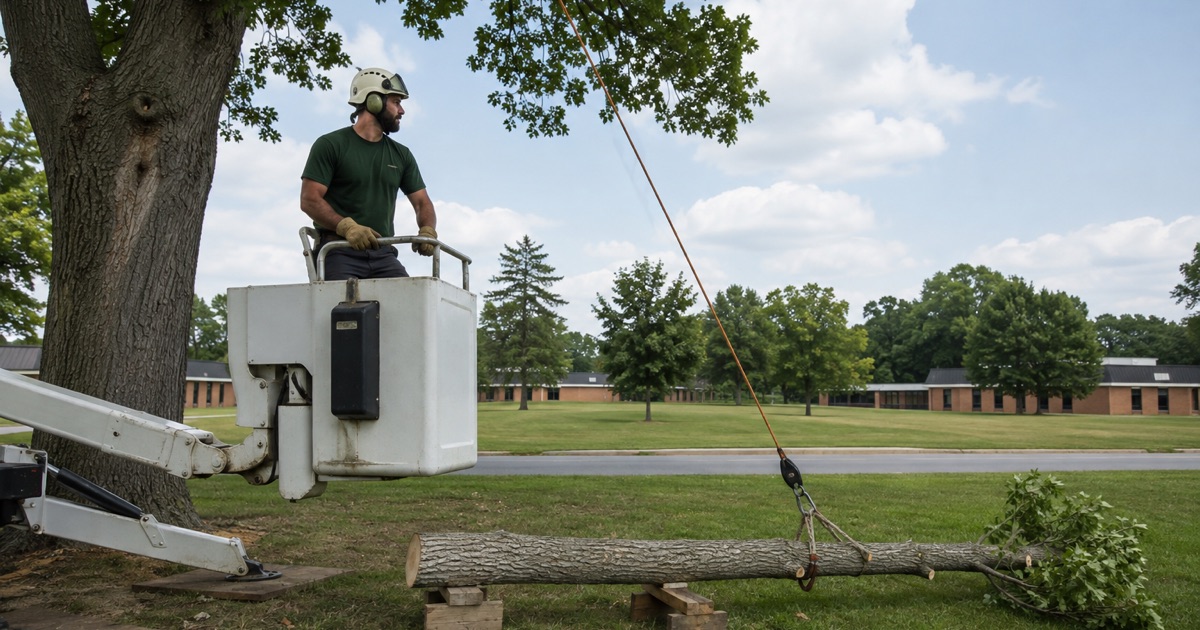
Every removal here is a sectional dismantle unless there is a genuine drop zone, and on attached-housing lots there usually is not. An aerial lift covers most of it; a crane covers the rest. Lawn and hardscape protection matting goes down on every job, because turf that belongs to a housing partner’s maintenance budget is not ours to rut.
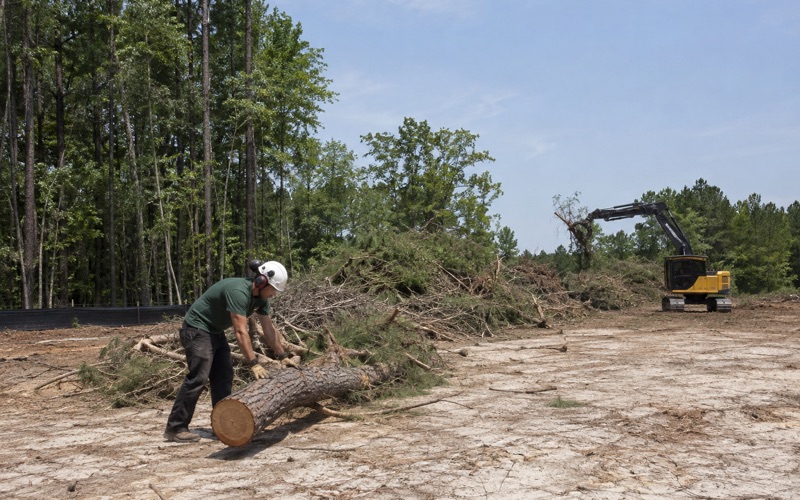
Our written inclusions settle the arguments before they start: brush chipped, trunk rounds accounted for, stump ground, grindings resolved one way or the other, all of it stated on the estimate. The crew that walked the site is the crew that shows up and the crew that does the final rake-out.
When a limb comes down here
The storm record on and around the installation is specific and dated. Multiple trees came down near Fort Meade on February 12, 2017, with trees blocking one lane of MD 175 at Disney Road, and a 58 mph gust was reported at Fort Meade on May 19, 2017. A tree came down on Bald Eagle Drive just south of MD 198 on June 21, 2016, and half-dollar-size hail fell on Reece Road near Wigle Road on June 18, 2025. Windthrow is not hypothetical in this canopy.
When it happens in family housing, the fastest route is the 24-hour emergency maintenance already included in the rent, or the garrison shop if the tree is on institutional ground. Residents do not need to find a contractor, and should not try to; the call that gets a crew moving is the one to the party that holds the contract.
Off the installation, the authority changes again
The edges are worth knowing because they are close. Trees in the MD 175, MD 198 and MD 32 state highway right-of-way fall to the Maryland Department of Transportation State Highway Administration, and the MD 175 interchange marks the boundary where the Baltimore-Washington Parkway becomes National Park Service land to the south. Downed conductors and line clearance off post are Baltimore Gas and Electric Company’s call, and nobody should be near a wire waiting for us to arrive.
On our side, storm work runs on a 24-hour response for fallen trees and for anything resting on a structure. We have worked this corridor’s storm season and its species for two decades, and the crews who handle a February blowdown here are the same ones doing deadwooding and crown work in July.
- 20+ Years in Anne Arundel County
- Free On-Site Estimates
- 24-Hour Storm Response