Severn Tree Removal has been taking down trees in Fulton and across the Fort Meade corridor for more than twenty years, and tree removal in Fulton reads differently from almost anywhere else we work. Nearly the whole community went up inside the last twenty-five years, and that single fact decides what is standing in the yard, who is allowed to cut it, and what the job costs.
Most calls from here turn out to be one of two very different jobs. Either a landscape tree set in when the house was finished has outgrown the spot it was given, or the large stem in question is out at the edge of the development pod, in woodland that may not belong to the owner asking about it.
We tell you which one you have before anything gets scheduled. The estimate is free, it happens on site, the scope goes in writing before a crew is booked, and the permission questions get routed first — five counties and four towns answer them differently, and this community answers differently again.
The housing here is new, and so is nearly everything growing over it
How old a neighborhood is sets how long anything in it has had to grow. Fulton is one of the youngest built environments in southern Howard County, and the census record on housing age is unusually lopsided even for a place developed this recently.
94.7% of the housing units were built in 2000 or later
American Community Survey figures put 94.7% of Fulton’s housing units in the 2000-or-later bracket, with 64.6% of them built between 2010 and 2019. Only 2.9% predates 1980, and nothing on the record was built before 1940.
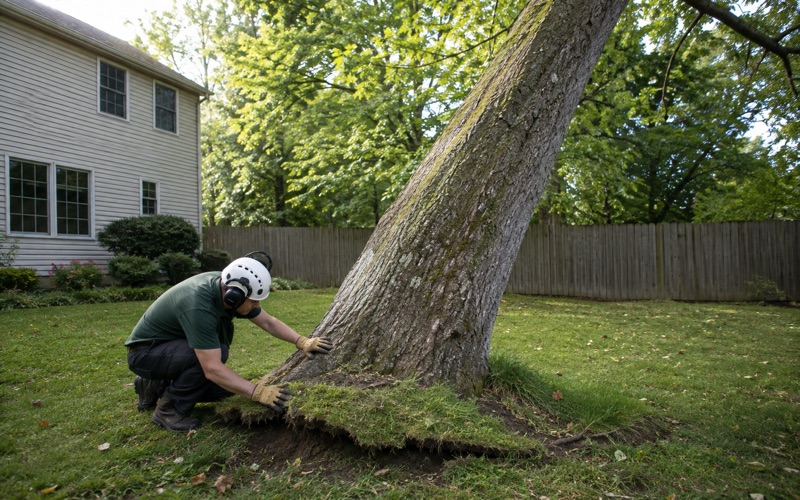
A tree planted when a house is finished is roughly the age of that house. Across most of this community that puts the woody material on a lawn under twenty-five years old, which is small enough that removal is rarely the right answer and structural pruning usually is.
What that leaves standing over the lawns
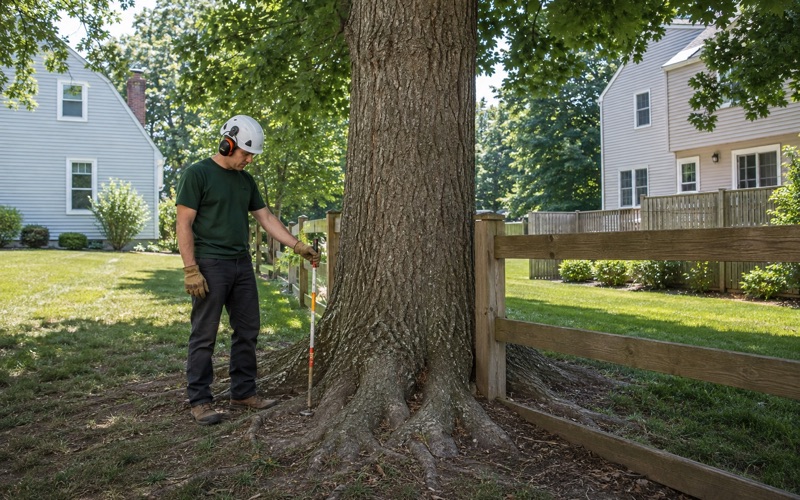
The big, decades-old hardwood most homeowners picture when they call a removal company is not standing in the middle of these pods at all. Trees that went in with the houses are still at a size where a crown reduction, a crown raise or a season of deadwooding does more for the property than taking the tree out would.
So when someone here describes a genuinely large tree, we ask where it is standing before we ask what is wrong with it. The answer usually moves the conversation to the boundary of the lot rather than the middle of it, and that changes the method, the price and the permissions all at once.
The older 2.9%, and the farm that was here first
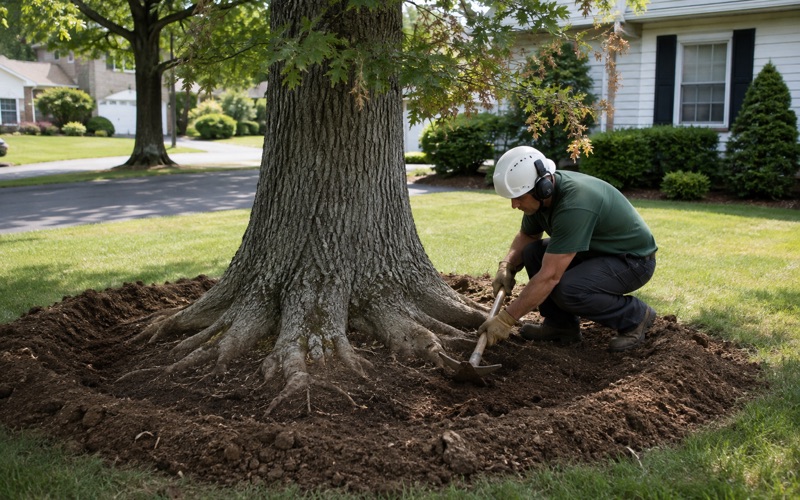
The small remainder of the housing stock — the 2.9% built before 1980 — sits outside the newer development, and those parcels are where we do meet a full-size specimen tree on an open lawn. Real root plate, real reach over a roof, and a diameter at breast height worth measuring before anything else gets decided.
Maple Lawn itself was laid out from 2004 on part of a 506-acre farm that had run free-range turkey operations since 1938. Field edges, lanes and windbreaks left from that period hold the oldest woody material in the community, and almost none of it ended up inside a back yard.
Looking for tree removal closer to Glenn Dale? See Tree Removal Services in Glenn Dale.
Retained hedgerow and the woodland at the pod edges
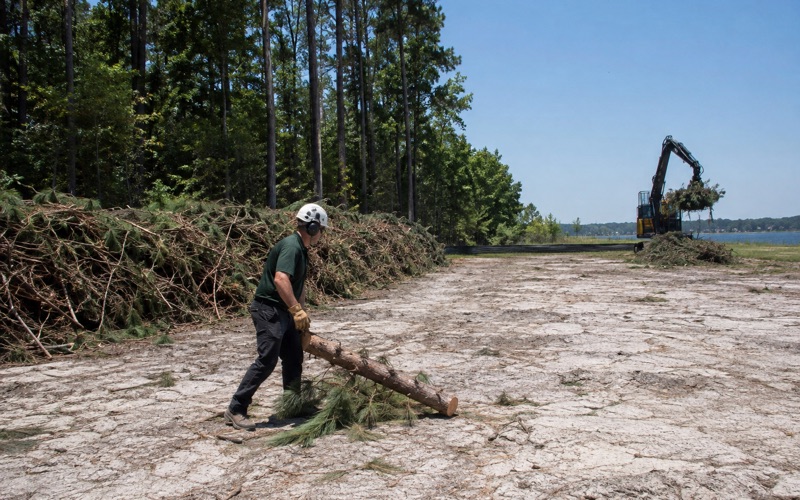
When farmland is subdivided, the trees that survive are the ones nobody had to move: the hedgerow along an old field line, and the block of woods the plan set aside. Both are common at the perimeter of Fulton’s development pods, and both are a different job from a yard removal.
A hedgerow tree grew in a line, not in the open
Stems that spent thirty or forty years in a row along a field edge come out drawn up and one-sided. Competition on both flanks pushes height ahead of taper, and the crown that survives leans toward whatever side got light — often the side now facing houses.
That shape is why we look for co-dominant stems and included bark on these before we look at anything else. A union that formed inside a crowded hedgerow is the failure point, and it is what turns a windthrow question into a cabling and bracing question, or into a sectional dismantling instead of a straight fell.
What is actually growing out there
The county’s canopy assessment found tulip poplar dominating the surveyed overstory, with red maple, American beech, black walnut, red and white oak, black cherry, blackgum, sycamore and hickories behind it, and read that mix as woodland in early to middle succession. In practice that means tall, fast-grown, comparatively weak-wooded stems.
It matches the ground they are in. The mapped soil is Glenelg loam formed in residuum weathered from mica schist, and the series’ native forest is red oak, white oak, hickory and tulip poplar, so the hardwood a crew meets on an undeveloped parcel here is oak-hickory with poplar through it.
Getting to it without crossing a lawn twice
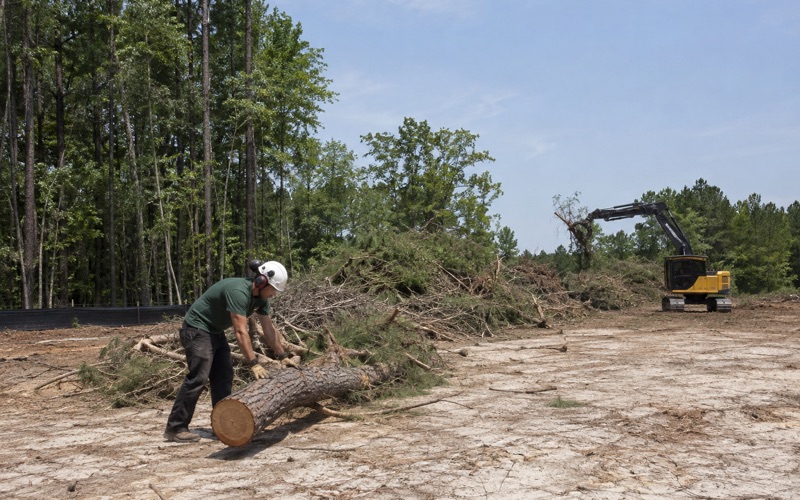
Pod-edge work rarely has a driveway behind it. We plan the approach during the estimate visit and run lawn and hardscape protection matting over everything the machines cross, because the route in is almost always somebody’s turf and somebody’s irrigation.
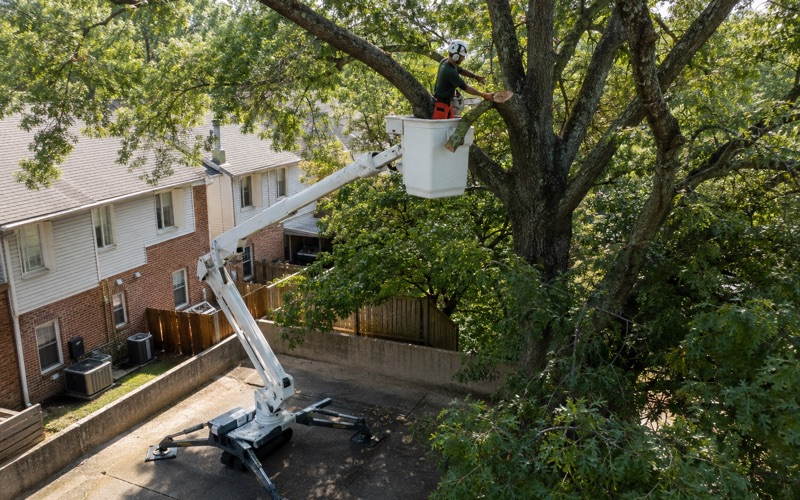
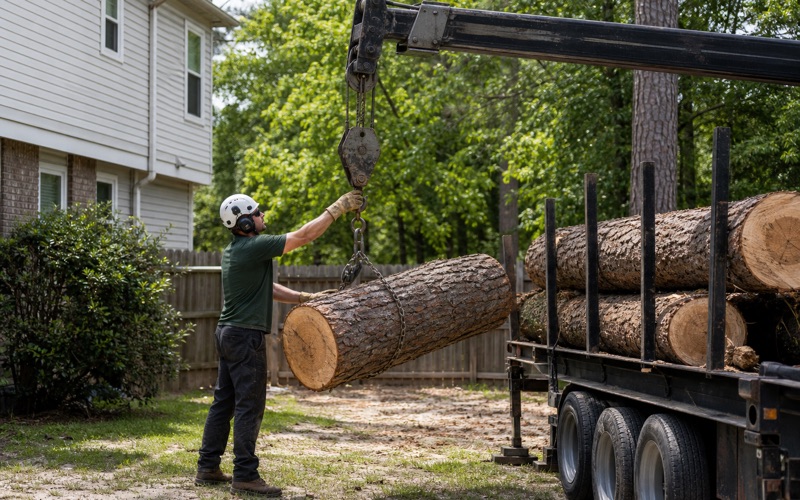
Where there is no drop zone to fell into — a fence line, a stormwater facility, a play area sitting right behind the trees — we price the removal crane-assisted and bring it down in pieces rather than manufacture room that is not there. Every part of it is worked to ANSI A300 and ANSI Z133.
When the large tree stands inside a forest conservation easement
This question settles more Fulton removals than any tree condition does. Howard County built most of this community under its forest conservation program, and woodland retained through that process often carries an obligation that outlives the construction by decades.
The county program, and the threshold it attaches to
Howard County Code Title 16, Subtitle 12 is the county’s forest conservation program, adopted under the Maryland Forest Conservation Act, and section 16.1202 sets the trigger at development of land of 40,000 square feet or greater. It is a land-development rule, not a homeowner rule.
That cuts both ways. A homeowner taking out one tree in a yard sits outside the county forest conservation plan requirement entirely; a subdivision that retained woods to satisfy the program does not, and the retention is recorded against the ground rather than against the builder.
Why a perimeter tree may not be yours to take out
Woodland retained at the edge of a Howard County subdivision may be held under a forest conservation easement recorded on the parcel. Where that is so, an adjoining owner cannot simply remove a stem standing in it, whatever the property line happens to do.
We treat easement status as unknown until the record says otherwise. It has to be confirmed property by property, and we do that check before a crew is scheduled rather than after a saw is already in the wood — which is also why our permit routing happens ahead of the calendar, not alongside it.
What the county counts as forest, and what it does not
Under the county’s Forest Conservation Act definitions, canopy is only forest at a minimum area of 10,000 square feet and a minimum width of 35 feet. A narrow screen of trees along a rear property line can fall short of both and not be forest in the county’s terms at all.
Countywide the 2022 assessment recorded 49.1% total tree canopy and 44.6% forest cover as of 2018, spread across 191,256 patches averaging 0.38 acres, and found land clearing for development responsible for most of the canopy that was lost. Small fragmented patches are the norm here, and reading which kind you are standing next to is part of what the estimate buys you.
Permits, roadside trees and what leaves the property
Two permissions come up on Fulton jobs that have nothing to do with the county forest program, and a third one that owners often expect does not reach this community at all. All three get answered before a date goes on the calendar, because the wrong assumption about any of them is the thing that stops a crew on the morning of the job.
A tree in the public road right-of-way needs its own permit
A tree standing in a public road right-of-way needs a Roadside Tree Care Permit from the Maryland DNR Forest Service before it is cut or trimmed, under Natural Resources Article sections 5-401 through 5-411. Individuals, businesses, municipalities and utilities are all held to the same requirement.
The street plantings along MD 216 Scaggsville Road and through the newer streets are exactly the population that rule was written for. Commercial roadside work also has to be directed by a Maryland Licensed Tree Expert, which is how we staff it, alongside ISA Certified Arborist judgment on anything we are asked to save instead.
The Chesapeake Bay Critical Area does not reach this community
Owners elsewhere in the region expect a Critical Area review, so it is worth stating plainly: the state Critical Area layer returns no feature at Fulton’s centroid. The identical query run at tidal control points at Fort McHenry and Fort Howard Park does return features, so the blank result here is a real finding and not a lookup that quietly failed.
There is no tidal water in the community — the Patuxent River forms its southern boundary — and that takes one layer of review off most jobs here. There is also no municipal tree permit to chase, because this is a census-designated place with no town government of its own; Howard County and the state are the authorities.
Line clearance, and who owns the wood afterward
Baltimore Gas and Electric handles vegetation management on its own distribution system across most of Howard County. BGE states that it cannot assist customers with disposing of tree debris, and that final disposition of the material is the responsibility of the property or tree owner.
That is the gap people fall into after a storm: the line gets cleared, and the wood is still lying in the yard. Our 24-hour response covers storm damage, fallen stems and trees resting on a structure, and the material goes with us when we leave.
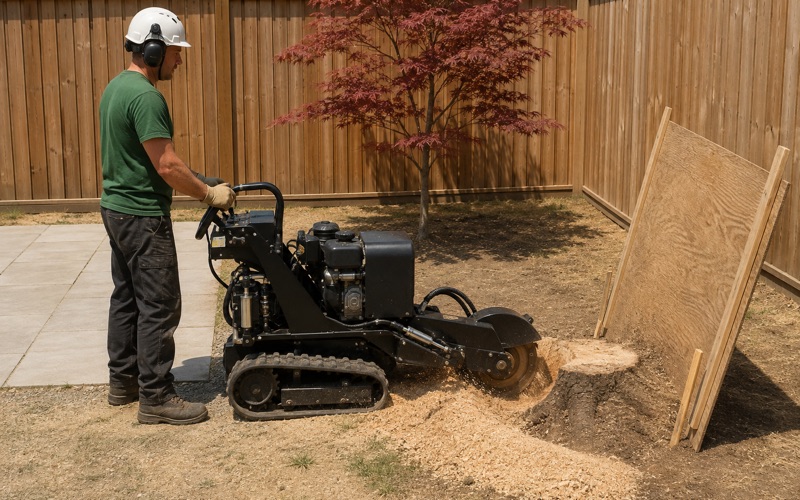
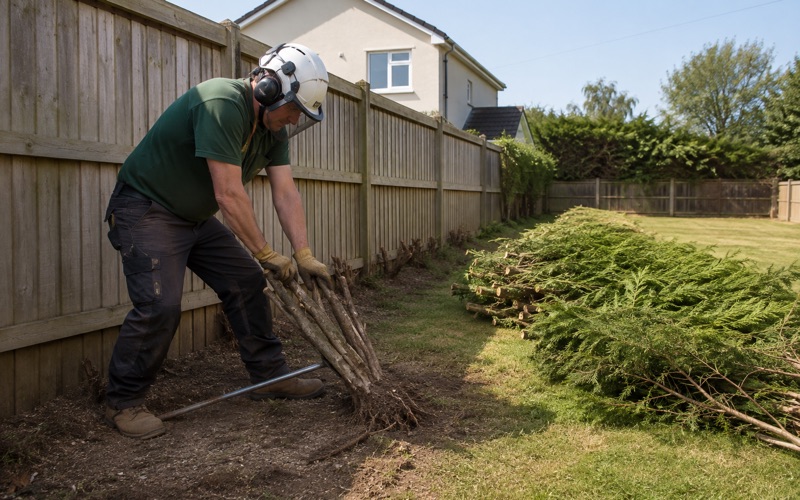
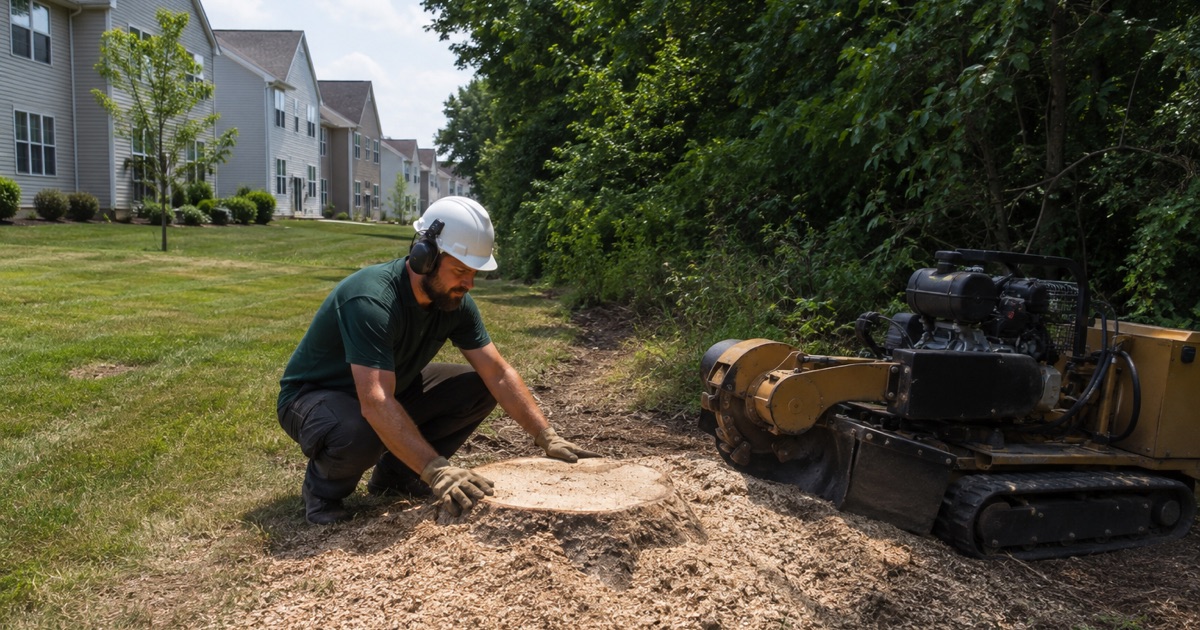
Every removal we quote says in writing what is included — brush chipped, trunk cut to rounds, and the stump and grindings settled up front instead of appearing later as an extra. The crew that walks the estimate is the crew that does the work and the final rake-out, which is what makes scheduling around an HOA board or a property manager workable here.
- 20+ Years in Anne Arundel County
- Free On-Site Estimates
- 24-Hour Storm Response