Severn Tree Removal has handled tree removal in Glen Burnie for more than twenty years, and a large share of that work is ordered by someone who does not live at the address. Property managers, on-site maintenance supervisors and grounds contractors call us about trees on buildings they answer for, and those jobs run on their approval chain and their calendar rather than one owner’s free Saturday. We built our quoting and scheduling around that instead of asking a manager to squeeze into a homeowner’s workflow.
We still spend plenty of days on detached lots here, and that work gets the same crew and the same written scope. What changes on a managed property is everything around the cut: who signs, who is billed, who tells the residents, and what the paperwork has to survive after the fact. Both kinds of customer get an estimate that is free, on-site and written down before a crew is booked.
Our inclusions are settled in that document rather than argued over at the end, with brush chipped, trunk rounds, stump and grindings each named and priced. After two decades across Anne Arundel County and the Fort Meade corridor, we know which of those lines a manager gets asked about later.
Close to three in ten households here answer to a manager
American Community Survey five-year estimates put 29.4% of Glen Burnie’s occupied units in buildings of five or more units, and 18.9% of the housing stock in buildings of 10 to 19 units, which is the garden-apartment format. Close to three in ten households here reach a property manager rather than an owner when a limb splits over a walkway. That is a different buyer with a different set of questions, and a tree company that only knows how to talk to owners gets half of them wrong.
Garden apartments and who orders the work
A 10-to-19-unit building usually has a maintenance supervisor who sees the problem first and a regional manager who holds the budget that fixes it. The person standing under the tree is rarely the person who can approve the spend, so an estimate has to travel upward without needing a translator. We write ours to be forwarded: plain scope, plain price, photographs of the tree it refers to.
On a property with several buildings we tag each tree to its own building and address rather than to the site as a whole. That lets a manager approve the two hazards that cannot wait and defer the rest to the next budget cycle without asking us to requote from scratch.
What that changes about the walk-through
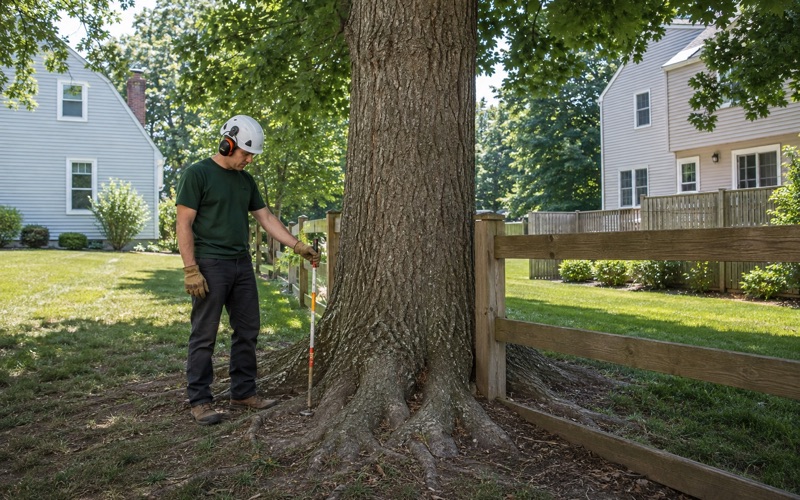
On an owner-occupied lot the decision gets made in the yard, usually in ten minutes. On managed multifamily the same visit is a records exercise, covering measured diameter at breast height, condition notes, whether the defect is included bark at a co-dominant union or simple deadwood, and what happens if nothing is done this year. We hand that over in writing because it will end up in a file, and it costs nothing; the estimate visit is free, as is a second look at a tree anyone is unsure about.
Looking for tree removal closer to Linthicum? See Linthicum Tree Removal.
What a property manager needs in a quote
The license number belongs on the contract
Maryland requires a Licensed Tree Expert to perform tree work for hire, exempts trees 20 feet tall or less, and requires a written contract carrying the license number. Those rules sit in COMAR 08.07.07, and Anne Arundel County states plainly that contracted tree removal or pruning may only be performed by a Maryland Licensed Tree Expert. We put the number on the contract as a matter of course.
A certificate of insurance goes over with it, because a manager cannot add a vendor to a file without one, and our pruning specifications are written to ANSI A300 with crews working to ANSI Z133. None of that is decoration on a property where a mistake lands on an owner’s policy rather than on a household’s.
Inclusions, itemized by building
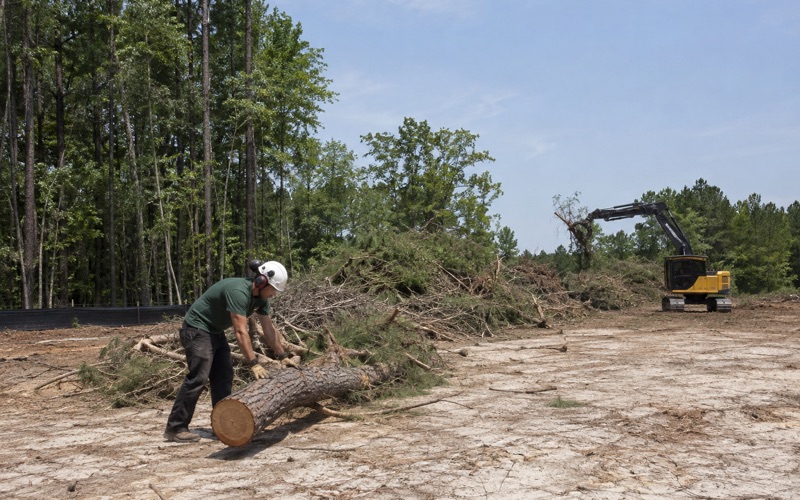
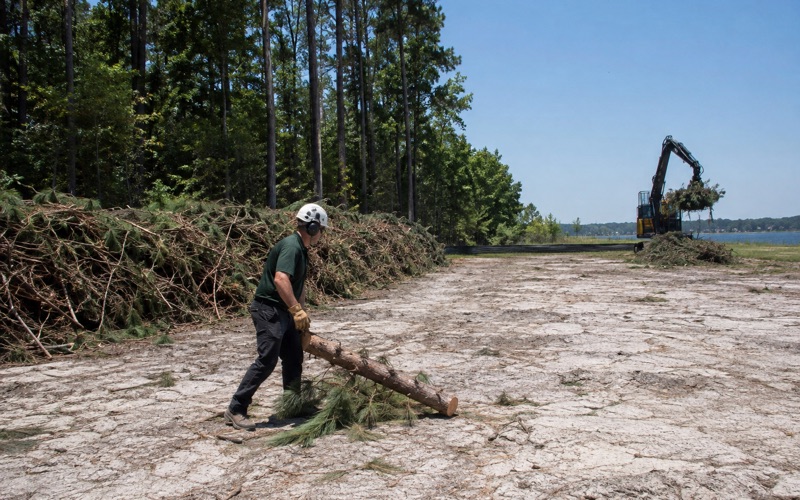
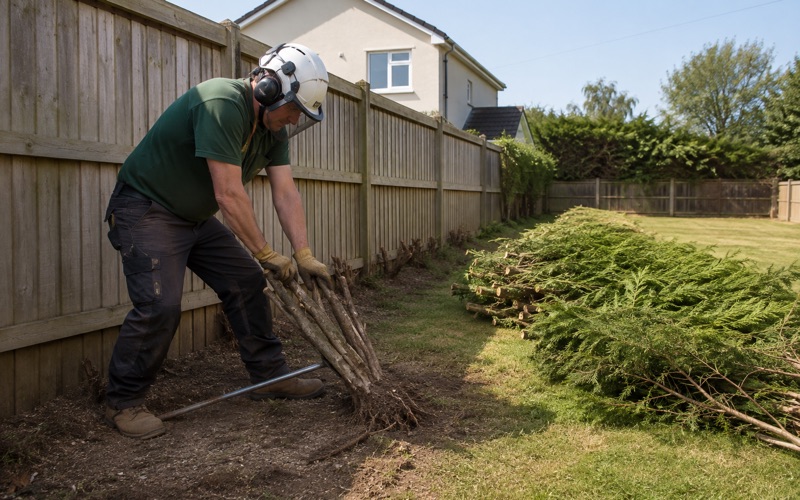
The line that causes trouble on a multifamily quote is the one nobody wrote down. We name what leaves the site and what stays: brush chipped, trunk rounds hauled or stacked where asked, stump ground to a stated depth, grindings removed or raked back into the hole. Each of those carries a price against the building it belongs to.
Where a manager wants crown reduction or crown raising over a parking bay instead of removal, we price it as its own line rather than folding it into a removal total. That keeps the comparison honest when the quote goes out to two other companies alongside ours.
Most of what we are asked to price on garden-apartment grounds is not a removal at all. Deadwooding above a walkway, crown thinning where a canopy has closed over a stairwell, and clearance cutting off a building face are the repeating items, and they are far easier to defend as a scheduled line in a maintenance budget than as an emergency after a limb has already landed. We quote them on the same visit as the hazards so a manager sees the whole property in one document.
Where the wood actually goes
Anne Arundel County curbside collection takes limbs under 4 feet long and 4 inches thick, in bundles under 40 pounds, and will not collect logs. BGE also states that it does not remove wood debris after a line-clearance cut, which is how a stack of rounds ends up beside a parking court with nobody responsible for it. Haul-away is part of our job here, not something a site’s own maintenance staff finishes on Monday.
Scheduling around parking and resident notice
A removal on a managed property carries one constraint a single house does not: the drop zone is full of other people’s cars. We set the date with the manager far enough ahead that notices can go on doors and the affected spaces can be coned off, then confirm the day before rather than arriving and hoping.
Clearing the space we need
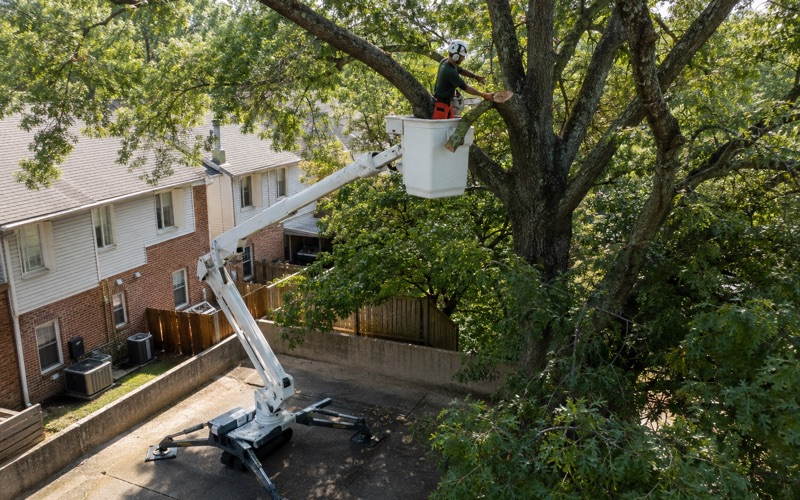
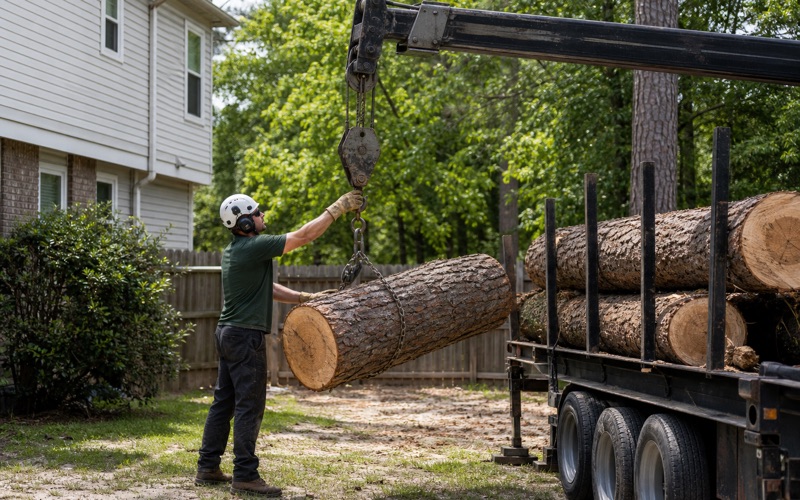
We tell a manager exactly what has to be empty and for how long, including the number of spaces, the width of the approach, and whether a dumpster or a mail kiosk sits inside the swing. Where there is no drop zone to fell into, which is ordinary in a court ringed by buildings, we take the tree apart in sections or bring a crane and lift the pieces out over the roofline. Sectional dismantling buys less disruption for more time, and on an occupied property that trade is usually worth making.
Resident notice is the manager’s to send, but it works better when it carries our hours rather than a guess. We give a window we can hold, and we call if weather moves it.
Lawns, walkways and the things residents park on
Protection matting goes down on every job to keep lawn and hardscape intact, and it matters more on a shared property where the turf belongs to a landscaping contract someone else holds. Rutted grass beside a garden building generates complaints for weeks after the tree itself is gone. We would rather spend twenty minutes on ground protection than leave a manager explaining the mess.
One mobilization, several buildings
The most expensive part of a small tree job is arriving. When a property has four trees spread across three buildings, doing them in a single visit rather than four saves that cost three times over and gives residents one disrupted morning instead of three.
Getting the machine to the tree
Small-lot residential land use dominates Glen Burnie, and on a multifamily site the equivalent constraint is the gate or the gap between two buildings. Machine width, not engine power, decides whether a stump grinder reaches the back of a courtyard at all, which is why we run compact tracked equipment sized to pass a standard back-yard gate. We measure that access during the estimate so the crew is not discovering it on the morning of the job.
What sits under the stump
Soil sampled at nine points across Glen Burnie returns the Patapsco-Fort Mott-Urban land complex at four of them, a deep and somewhat excessively drained sand that grinds easily but gives a large tree a wide, shallow root plate rather than a deep anchor. Two of the nine points return urban land and one returns loamy Udorthents, which is to say made ground and fill.
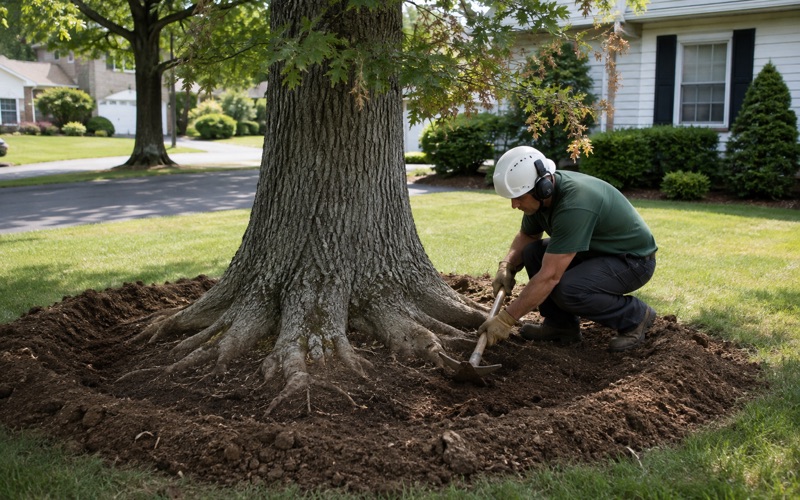
Fill can hide rubble, an old foundation or a buried utility line directly under a stump, so we locate before we grind instead of finding it with the wheel. One of the nine points falls in a poorly drained Fallsington complex, a reminder that wet pockets exist inside an otherwise sandy town and change what can be driven across a lawn.
Trees that should not be climbed
Emerald ash borer has been in Maryland since 2003 and kills a large ash within roughly three years, and dead ash goes brittle quickly. A standing dead ash over a parking area is a bucket or crane job rather than a climbing job, and we say so on the estimate instead of sending someone up it.
Permits before the calendar
We route permits before scheduling, because the counties and towns in this region answer differently and a manager should not learn that on the scheduled morning. The Chesapeake Bay Critical Area does reach Glen Burnie, concentrated on the northeast side near the tidal heads of Marley Creek, Furnace Creek and Sawmill Creek, and inside the buffer Anne Arundel County requires an approved Vegetation Management Plan before any vegetation is removed, dead trees included. The county specifically rebuts the belief that stems under 4 inches are exempt, and its forestry program takes questions at (410) 222-7441.
A tree standing in the public right-of-way is a separate question again, answered by the Maryland Department of Natural Resources Forest Service through a Roadside Tree Care Permit that carries a 25 dollar project fee. The test turns on where the trunk stands rather than where the canopy reaches, so a tree inside the property line that leans out over the roadway is not a roadside tree, and one in the strip between sidewalk and curb usually is. We sort that out at the estimate, since it decides who is allowed to authorize the work.
Whether a given address sits inside that band depends on the parcel rather than on the town, and checking it is part of the work we do before a crew is booked. From the walk-through through the final rake-out it is the same crew on site, and when a storm puts a tree on a building we respond within 24 hours.
- 20+ Years in Anne Arundel County
- Free On-Site Estimates
- 24-Hour Storm Response