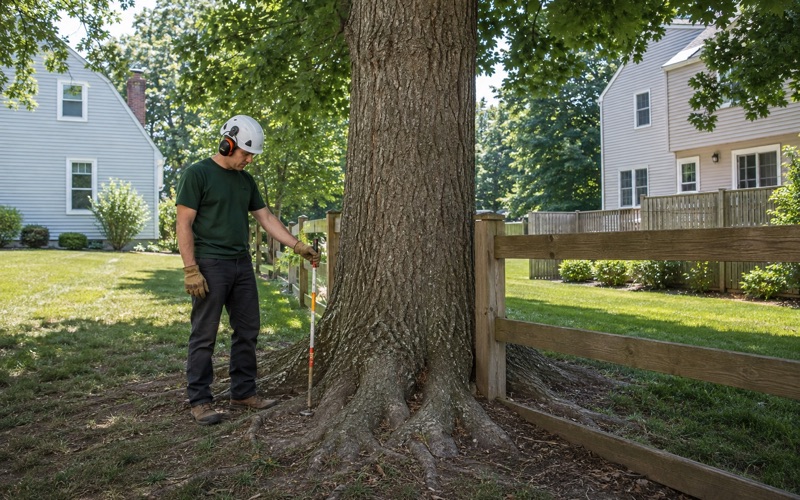
Severn Tree Removal has been taking trees down across this part of Maryland for more than twenty years, and tree removal in Glenn Dale is work we price standing in the yard rather than over the phone. The estimate visit costs nothing, and so does a second look at a tree you are unsure about.
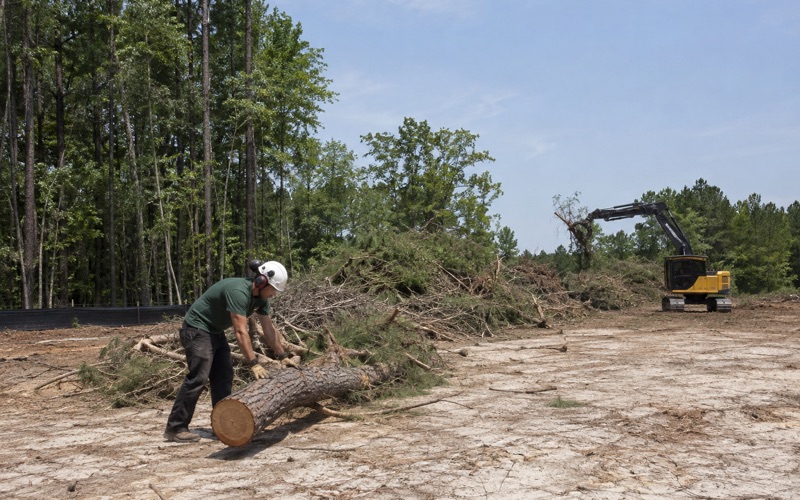
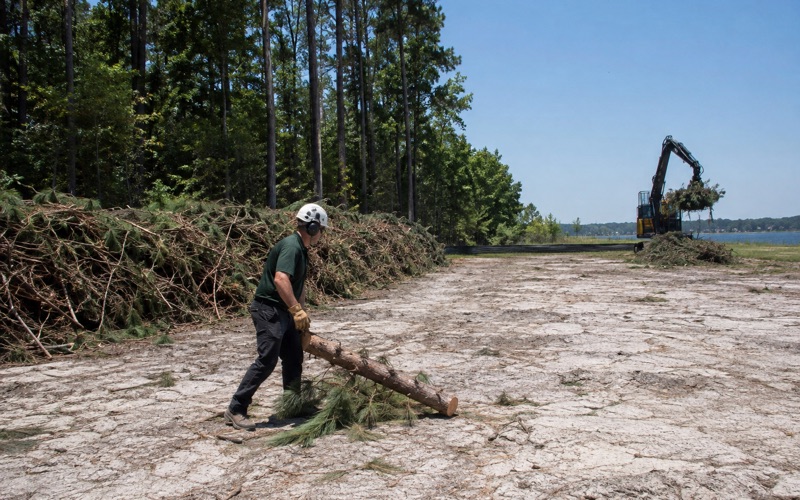
What we write down at that visit is the scope the crew arrives with. Brush chipped on site, trunk wood cut to rounds and stacked or hauled, the stump ground, and the grindings settled one way or the other before anyone signs. Storm calls get a response inside 24 hours, whether the tree is across a driveway or leaning on a roof.
The reason a quote written here does not match one written a few miles west comes out of the ground itself. This soil digs and grinds faster than most of what our crews work in, and the same looseness that spares the equipment gives a root plate noticeably less to hold.
The ground here is marine sand, not river clay
Plenty of Maryland tree work is priced on the assumption of heavy Cretaceous river clay, and that assumption is wrong in Glenn Dale. The community sits on the Atlantic Coastal Plain, and the geologic mapping shows something else entirely at the surface.
Unit Kmo, the Monmouth Formation
State geology maps the surface unit here as Kmo, the Monmouth Formation, grouped with the Brightseat and Hornerstown formations. The major rock is sand and glauconite sand, with iron cement and some clay as secondary material, laid down as marine shelf and shallow marine deposits.
This is greensand country. The topography that came with it is described as gently to moderately rolling, which is why siting a machine here is rarely an argument about grade.
57.4% sand against 4.9% clay
The mapped soil at the center of the community is the Russett-Christiana complex on 2 to 5 percent slopes, formed in loamy fluviomarine deposits. The surface texture is a fine sandy loam: 57.4% sand, 37.7% silt and only 4.9% clay, moderately well drained, hydrologic soil group C, with a moderate erosion hazard.
Those two fractions do most of the work on this page. A surface that is well over half sand and barely five percent clay cuts easily and holds poorly, and both halves show up in a day’s work.
What the map unit does not settle
A map unit describes a landscape, not a particular yard. Two thirds of the housing stock here, 66.9%, went up in 1980 or later and 22.2% in the 1990s alone, so a great many back yards sit on graded and backfilled subdivision ground rather than an undisturbed profile.
So we probe before committing a machine to a spot. Where fill is deep or drainage was rerouted during construction, the sand under the sod behaves differently from the sand fifty feet away.
Ornamentals have always done well on this ground. The USDA Plant Introduction Station on Old Pond Road, built in 1920, is where Benjamin Y. Morrison’s hybridizing program produced the 454 Glenn Dale azaleas, and a mature ornamental beside a driveway is a very different removal from a shade tree in open lawn.
Looking for tree removal closer to Arnold? See Arnold Tree Removal.
Grinding runs fast; holding does not
Sandy ground is generous to equipment and stingy with support. Both halves of that get built into how we schedule the work and how we write it up.
Why the stump grinder moves quickly
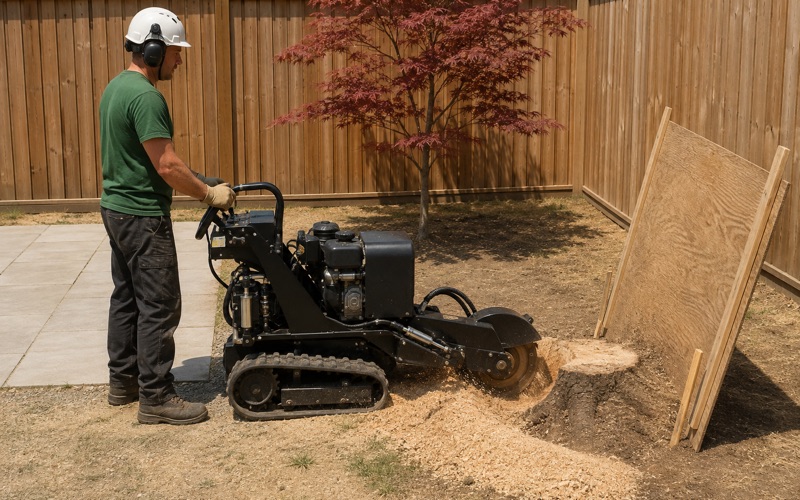
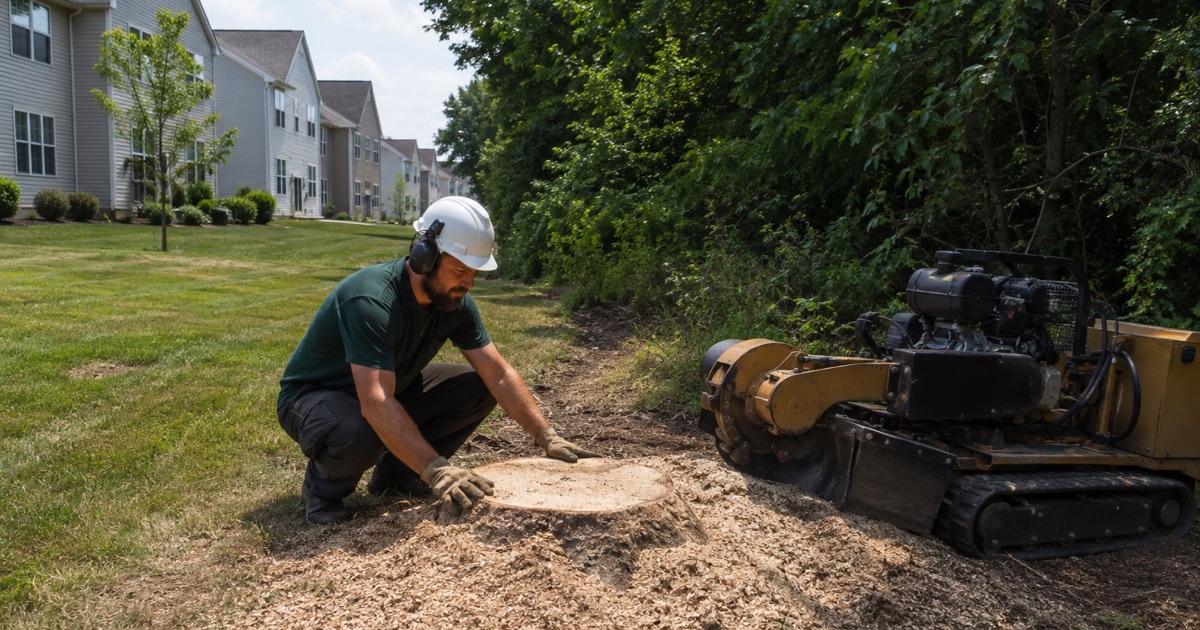
A fine sandy loam surface cuts with far less resistance than a tight clay, so grinding time on a stump of a given diameter is usually shorter here than our crews would allow elsewhere. The wheel loads less and the machine is not fighting a compacted plate the whole way down.
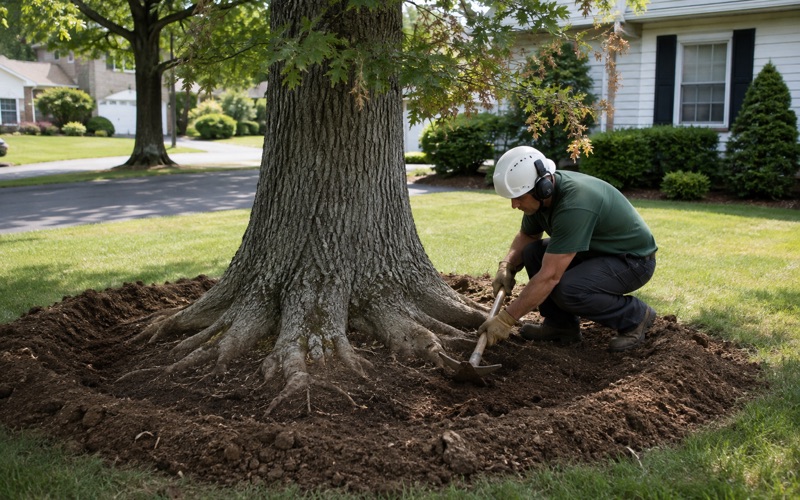
Digging behaves the same way. Root collar excavation with an air spade, slow going in heavy soil, opens up quickly in this profile when we need to see what a trunk flare is doing below grade.
Depth, backfill and settlement
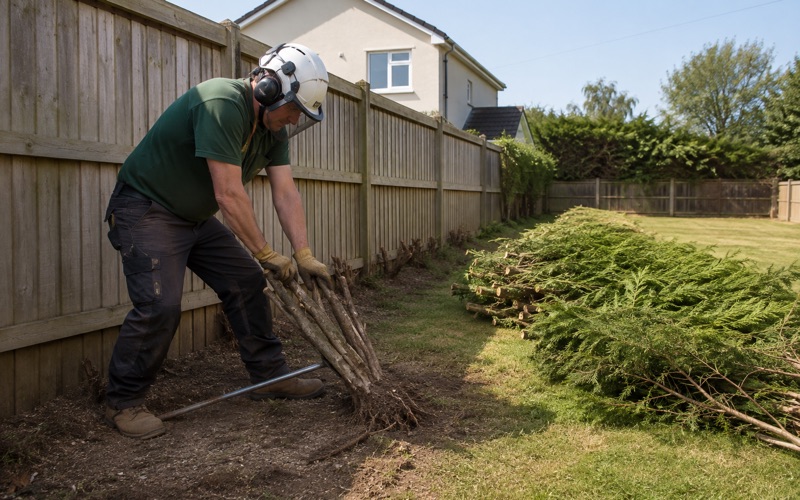
We grind below grade rather than flush, because a stump shaved level is a trip hazard that reappears as the wood decays. Grindings backfill the hole cleanly in sand, but they also settle further over the first season than most homeowners expect.
That is why the estimate states which it will be: grindings raked out and the hole topped with soil, or grindings left in place with the settlement explained up front. Deciding it at the end of the day, with a pile already on the lawn, is how a clean job ends badly.
Getting the machine to the stump
Most of what we remove here is behind a house. Roughly 76.5% of housing units in Glenn Dale are single-family detached and 87.8% of occupied units are owner-occupied, so access normally runs through a side gate or a driveway and the homeowner is the one deciding in the yard.
Our tracked equipment is sized to pass a standard back-yard gate, and lawn and hardscape matting goes down on every job. On a loose sandy surface that matting is not decoration, since a loaded machine will rut ground like this in one pass.
A root plate has less to hold in loose sand
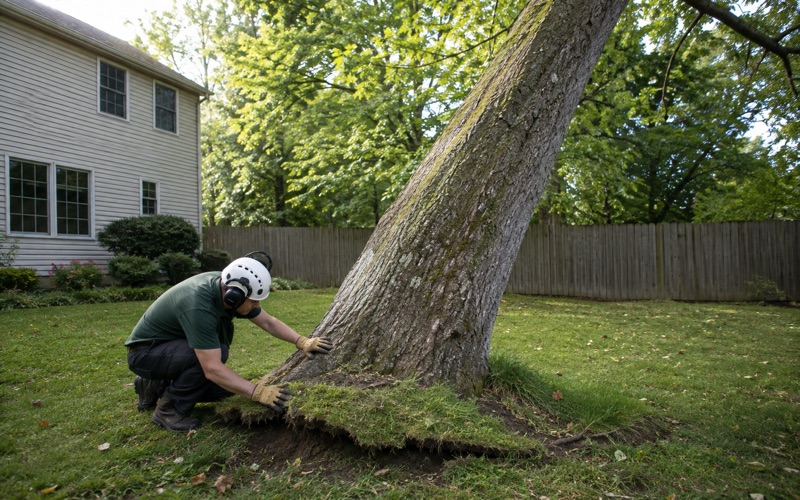
The other side of easy digging is weak anchorage. Roots hold a tree upright by binding a mass of soil, and a soil that is 57.4% sand and 4.9% clay binds less firmly than a heavy one does.
The shape of the plate, not the size of the tree
A root plate in this profile tends to run wide and shallow, spreading through the loose surface and slowing where it meets the tighter subsoil. That makes the critical root zone easy to damage and easy to underestimate, since a driveway or an addition may have cut a quarter of it years ago.
We look for that history before quoting. A tree that lost roots on one side to a trench is a different risk from an identical tree that never did, whatever its diameter at breast height.
Saturated ground plus wind
Glenn Dale sits in National Weather Service forecast zone MDZ013, Prince Georges, under the Baltimore/Washington forecast office. What concerns us is not a windy afternoon on its own but wind arriving after enough rain to saturate a sandy surface over a slower subsoil, when the plate is holding at its weakest.
That is the setup behind most of the windthrow we get called to, and it is why trees that stood through worse gusts on dry ground come over in a moderate storm on soaked ground. If a limb lands on a service conductor, that call goes to the electric utility first and nothing happens until the line is confirmed de-energized. Prince George’s County is not served by one company: Pepco reports covering most of the county while BGE’s territory takes in parts of it, so the name on your bill is the number to dial.
Reading a leaner before it moves
A lean that developed over decades is a different thing from one that appeared last week. We look for fresh evidence: soil heaved or cracked opposite the lean, a trunk flare lifting out of the turf, a gap opening at the root collar.
Structure in the crown counts just as much. Included bark between co-dominant stems, heavy deadwood or a canopy throwing epicormic shoots after an old topping cut all change the recommendation, and sometimes that is cabling and bracing rather than removal.
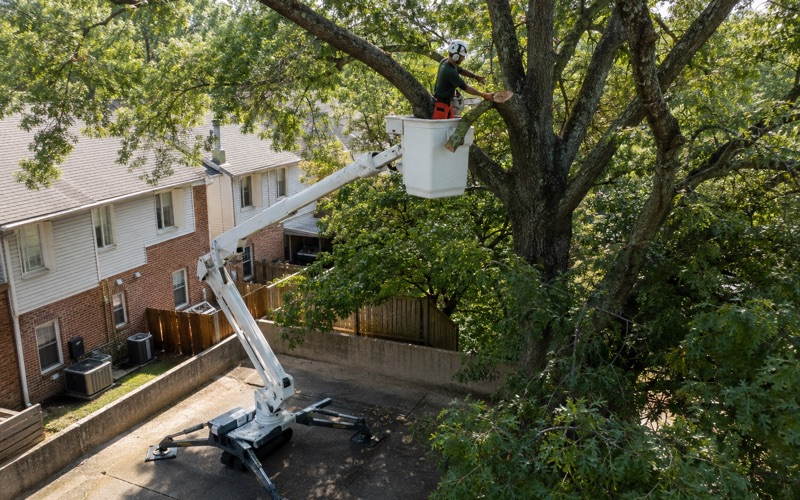
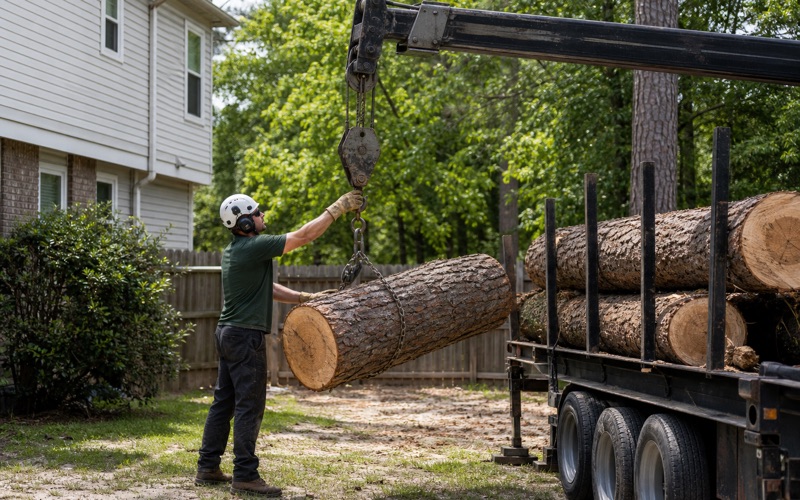
Where a shed, a pool or a neighbor’s fence sits exactly where the tree wants to go, we take it down in pieces by sectional dismantling from an aerial lift, or bring a crane when the pieces are too large to rig out over a house. Crews work to ANSI A300 for the cuts and ANSI Z133 for the safety practices, and the same people who wrote the estimate do the final rake-out.
Who signs off on tree work in Glenn Dale
Glenn Dale is an unincorporated area and census-designated place in Prince George’s County, so there is no municipal government, no city tree permit and no city arborist. Every regulatory question here is a county or a state question, and we route the permitting before scheduling rather than after.
One layer that does not reach this community is worth naming outright. A Chesapeake Bay Critical Area point query at the center of Glenn Dale returns no feature at all, while the identical query at a Fort McHenry control point returns an Intensely Developed Area feature, so the blank result is a real finding rather than a query that failed.
County woodland conservation is triggered by an application
The county’s woodland and wildlife habitat conservation rules sit in Subtitle 25, Division 2 of the county code and attach to applications under the building, subdivision and zoning ordinances, through a Type 1 or Type 2 Tree Conservation Plan or a Letter of Exemption. A homeowner deciding to take down a yard tree is not making such an application.
A Standard Letter of Exemption is issued where a lot or parcel is under 40,000 square feet or carries under 10,000 square feet of woodland, and a numbered exemption covers cumulative disturbance of under 5,000 square feet of woodland across five years. The county defines a specimen tree at 30 inches diameter at breast height or more, or 75% or more of the diameter at breast height of the current champion of that species.
The canopy division, and what it exempts
Division 3 of the same subtitle sets tree canopy coverage requirements, reaching building and grading permits that propose 5,000 square feet or greater of gross floor area or disturbance. Its exemptions are explicit, and one of them is any permit pertaining to an existing single-family detached home.
With 74.2% of occupied units here being owner-occupied single-family detached houses, that exemption covers very nearly the whole of residential Glenn Dale. We say so plainly rather than let a homeowner assume a canopy obligation the code text lifts off them.
Frontage trees and the state routes
The public right-of-way is the exception that catches people out. Trimming, planting or removing a tree there needs no county Letter of Exemption, but it does need a permit under the Maryland Roadside Tree Care Law, administered by the Maryland Department of Natural Resources Forest Service.
Maryland Route 450, Route 193 and Route 564 all run through the community as state routes, so frontage trees raise the question often. All commercial roadside tree work must be conducted under the direction of a Licensed Tree Expert, and we obtain the Roadside Tree Care Permit before a date goes on the calendar.
Licensing, and the contract that carries the number
A person may not engage in the work or business of a tree expert in Maryland without a license issued by the Department, though an employee working under the supervision of a Licensed Tree Expert needs none in their own name. The requirement sits in the Natural Resources Article and in COMAR 08.07.07.
The part worth checking as a customer is the paperwork. A licensed tree expert must enter into a written contract with the client clearly conveying the licensee’s name, license number, business entity name, address and phone number, and any bid you accept in Glenn Dale should show all of it.
- 20+ Years in Anne Arundel County
- Free On-Site Estimates
- 24-Hour Storm Response