Severn Tree Removal has handled tree removal in Ilchester for more than 20 years, and a growing share of the work here comes down to one species: the ornamental pear that went in along a driveway or a front walk when the subdivision was new. Those trees have reached the age where they come apart in ordinary summer storms, and Maryland’s rules about selling them change on January 15, 2026.
We work as Maryland Licensed Tree Experts, so every removal we quote arrives as a written contract carrying that license number, with the scope set down before a crew is booked. The estimate visit costs nothing, and neither does a second look at a tree you are unsure about.
What follows is the practical version of all of it: what the prohibition covers, why this particular planting generation fails at the fork rather than the trunk, and what taking one down on an Ilchester lot actually involves. None of it is urgent in the way a sales pitch is urgent, but a pear that splits on its own schedule tends to pick the worst week of the year to do it.
What the Callery pear prohibition changes on January 15, 2026
Callery pear, sold for decades as Bradford and under a dozen other cultivar names, is prohibited for sale in Maryland from January 15, 2026. It is a nursery-trade rule: it governs what a grower or a garden center may offer for sale from that date forward.
The tree already standing in your yard
The prohibition does not reach a pear that is already in the ground. Nothing in it obliges a homeowner to take one down, and a mature pear on a front lawn does not become a violation when the date passes. Whether it stays is a structural question about that specific tree, and that is the question we are actually called out to answer.
What the date does change is the second half of the conversation. Once a pear comes out, the replacement will not be another one, so we talk about what goes back into the hole at the estimate rather than after the stump is ground.
Why there are so many of them here
Callery pear was planted heavily in subdivisions built through the 1990s and 2000s. It grew fast, flowered early, held a uniform shape a builder could line a whole street with, and shrugged off the compacted fill left behind after grading. Every one of those traits is a reason it is now the tree we get the most calls about.
Because they were planted as a set, they also fail as a set. On a street where the same builder put the same tree in front of thirty houses in the same season, we tend to get two or three calls off one storm, and the neighbors who watched it happen call in the spring.
Looking for tree removal closer to Savage? See Savage Tree Removal.
The planting generation that is reaching failure age
Ilchester’s housing sits squarely in that window: 26.5% of units here were built during the 1980s and 33.4% during the 1990s, and the yard trees went in at planting size alongside the houses. Three decades on, a nursery pear that left the lot at two inches of diameter at breast height is carrying a full crown on a structure that was settled in its first ten years.
Nothing about that is neglect on the owner’s part. The tree was sold as a finished landscape item and put in by a crew that moved on to the next lot, and the fault it carries is one you cannot prune out of a mature specimen, only manage or remove.
Included bark, and why the union splits
Callery pear tends to branch into co-dominant stems, two or more leaders of near-equal size rising from one point rather than a single trunk with subordinate limbs. Where those stems press together, bark folds down into the joint instead of wood, and that included bark leaves a union that looks solid from the outside while almost no fiber connects the two halves.
Each season the stems thicken, the folded seam works like a wedge driving them apart, and when the union goes it goes all at once, usually under a squall line with the crown in full leaf. What lands is not a branch but half the tree, and it arrives on whatever is directly underneath.
What a failing union looks like from the ground
The tells are a narrow V where the leaders meet, a vertical seam or crack running down from it, a ridge of swollen tissue on the outside of the fork, and one leader sitting visibly lower than it did last summer. Old topping cuts are a second warning, because the dense epicormic shoots they push out are weakly attached and pile weight exactly where the tree can least carry it.
Assessing a pear before the next storm
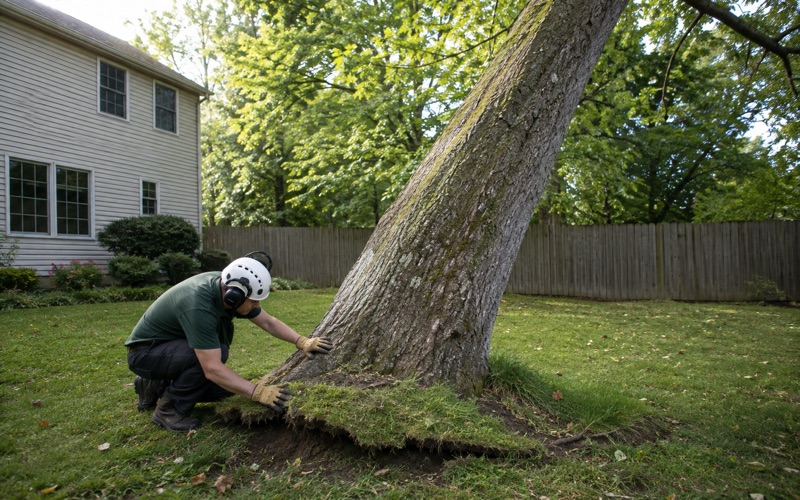
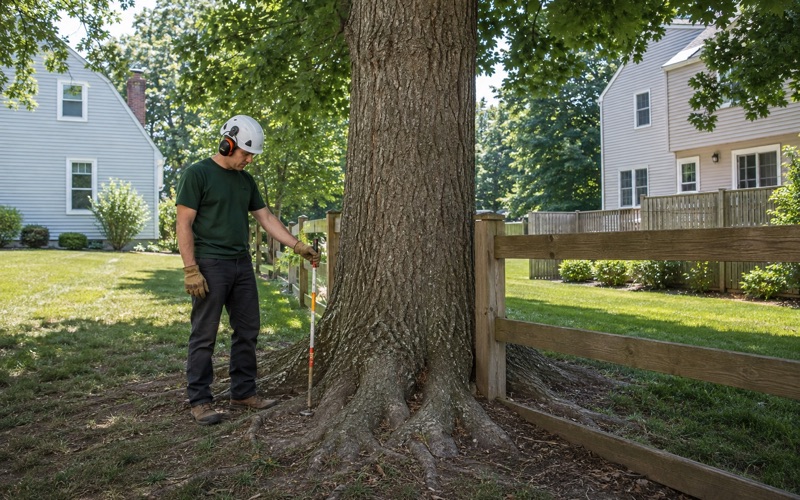
We start at the union rather than the canopy. We measure diameter at breast height, sound the seam, check whether the crack extends below the fork and into the trunk, and read the root plate for the raised or cracked ring on the tension side that says windthrow has already begun.
Reduction and support, where the tree is worth keeping
Where the union is still sound and the tree is otherwise healthy, a crown reduction cut to ANSI A300 lowers both sail area and leverage without stripping the canopy, and cabling and bracing can supplement a union we judge marginal. Neither is a repair, because included bark does not knit, so we tell you plainly which one you are buying: a few more years, or a structure we would stand under.
While we are on the property we look at the rest of what is standing, because a pear rarely arrived alone. Deadwooding an oak over the same driveway, or raising a crown off a roofline, is usually cheaper folded into a visit that is already booked than as a separate call in November.
When removal is the honest answer
Once a seam has opened, a leader has shifted, or the failure zone sits over a bedroom, a gas meter or the spot where a car parks every night, we say so and quote the removal. Ilchester falls in NWS forecast zone MDZ506, Central and Southeast Howard, and the storms that track through it are the loading these unions fail under; when one lets go on a roof or across a driveway, we respond within 24 hours.
If a limb has come down onto a service line, that part is not ours to touch: Baltimore Gas and Electric handles vegetation on its own distribution circuits and takes a limb-on-line report at 1-800-685-0123, with a downed line going to 1-877-778-2222. BGE is not responsible for clearing the wood afterward, which is the half we pick up once the circuit is safe.
Taking one down on an Ilchester lot
Access, and the ground underneath
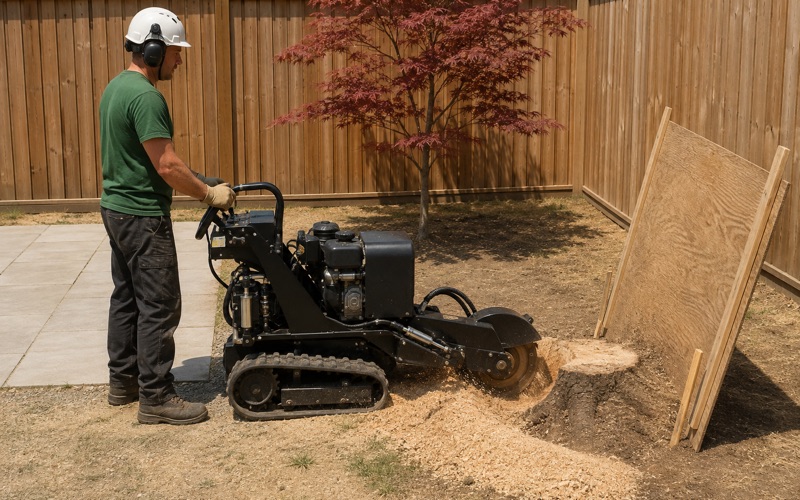
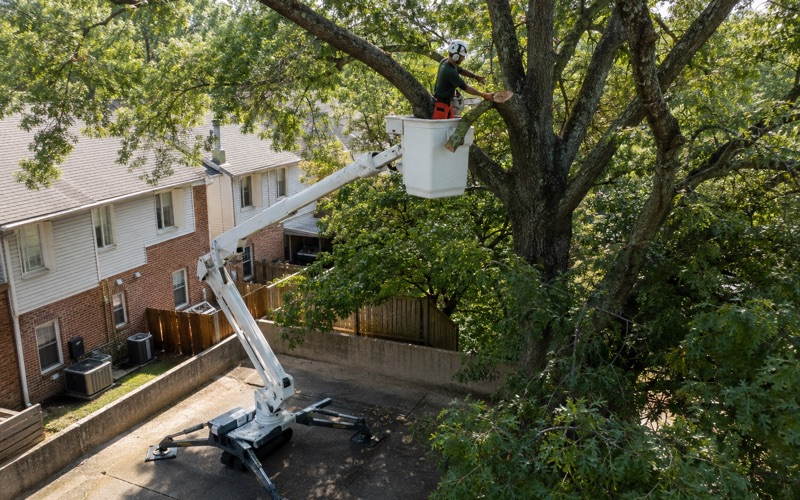
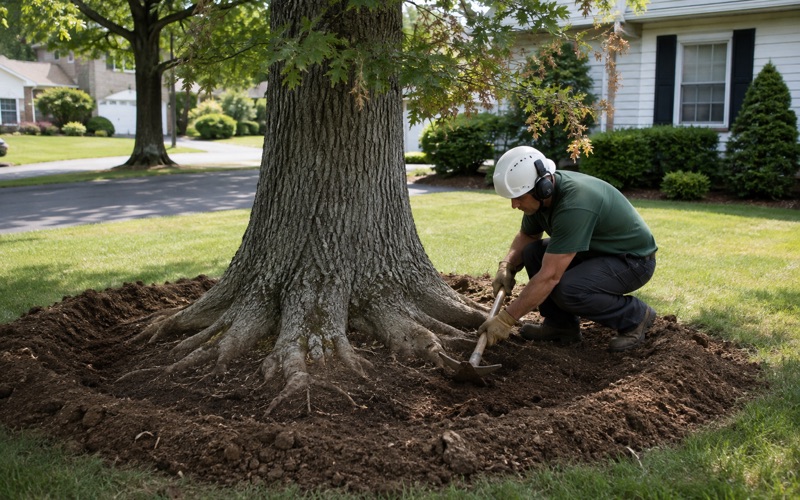
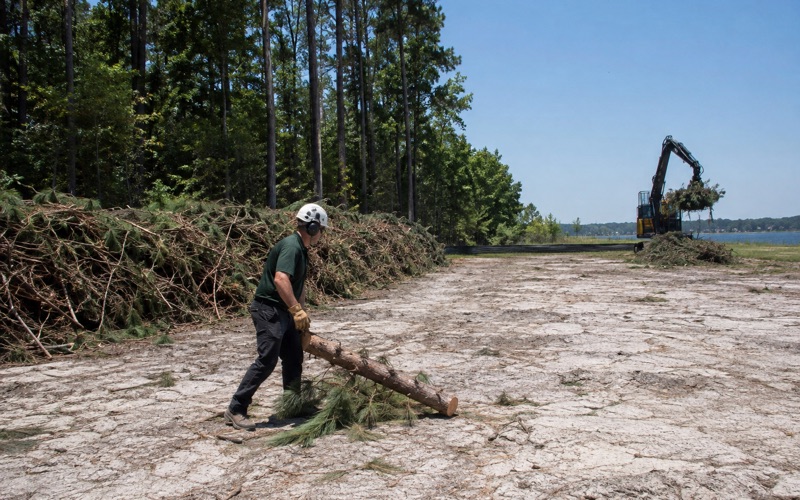
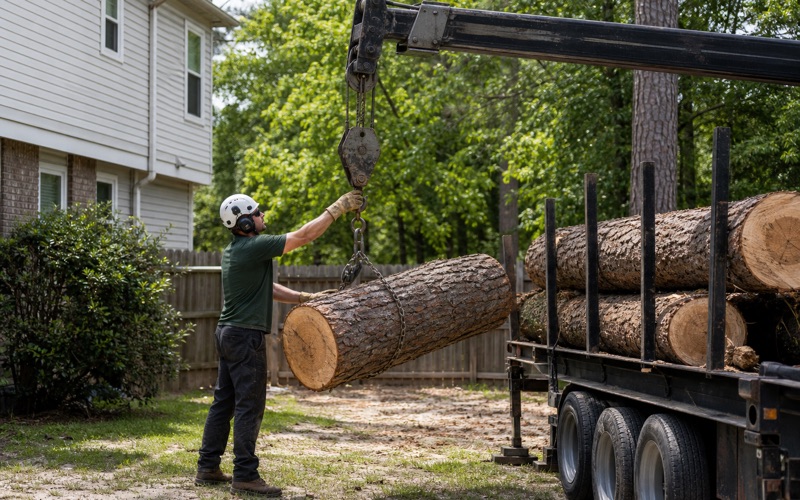
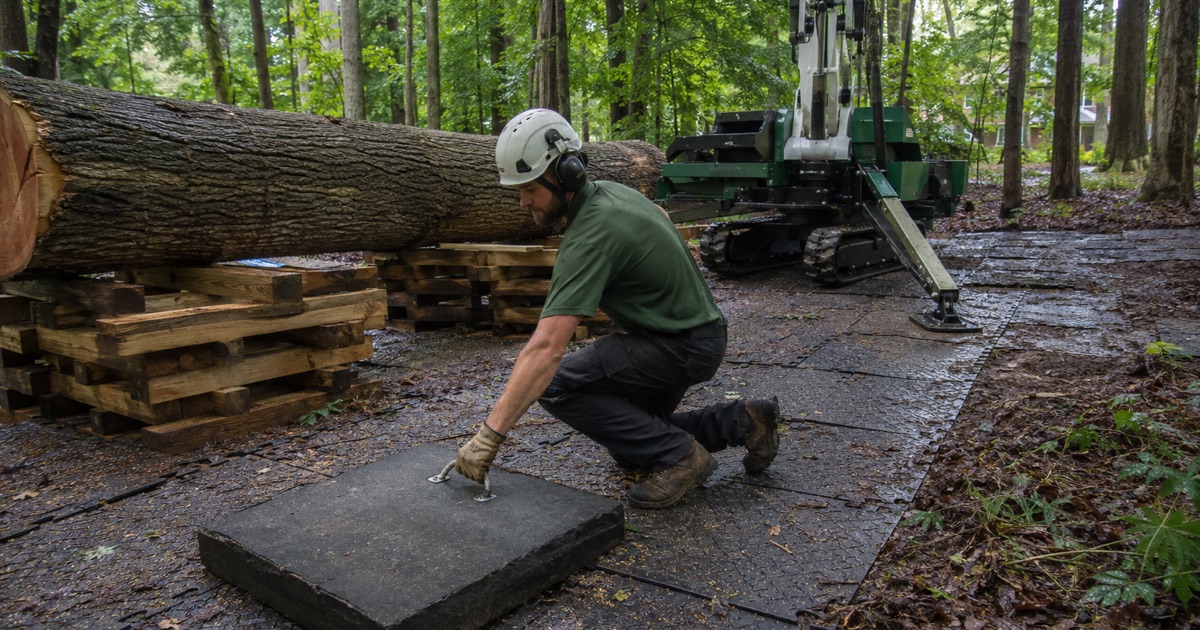
The Patapsco river gorge forms the northern edge of the community and drops steeply, so slope rather than distance governs access on the streets that fall toward the river. On a steep private drive we will often stage the chipper from the street and carry the wood out, and we run compact tracked equipment sized to pass a standard back-yard gate. Where there is no drop zone to fell into, the tree comes down by sectional dismantling or on a crane, and lawn and hardscape protection matting goes down on every job.
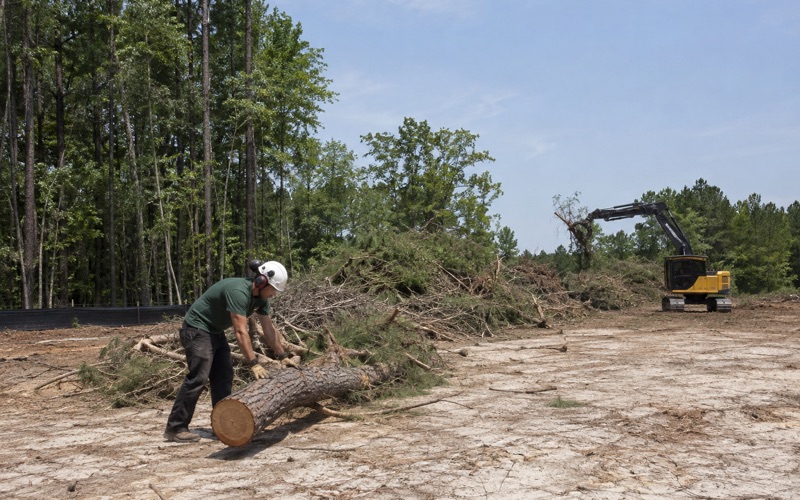
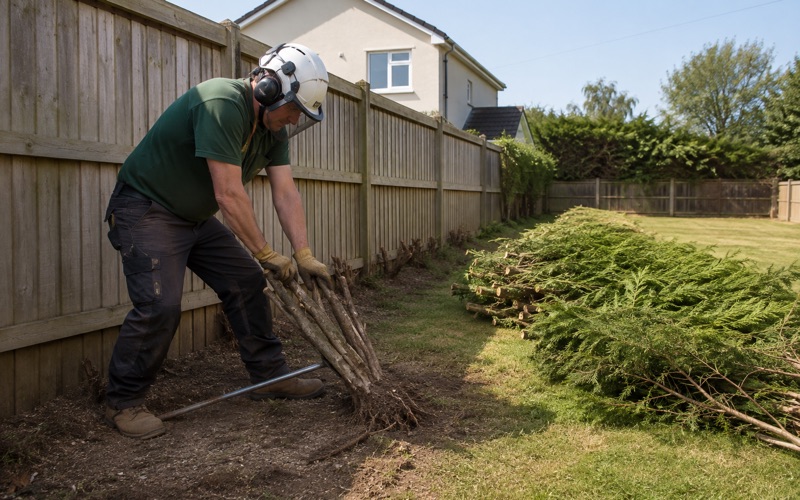
The rock matters as much as the slope. Surface geology across the community samples as 60.3% Baltimore Complex metagabbro, gabbro and amphibolite, a hard, dense mafic rock, and where it sits shallow a stump grinder reaches stone before it reaches the bottom of the root plate. Pear root plates run wide and shallow rather than deep, which helps, and we put the grind depth, the brush chipping, the trunk rounds and where the grindings end up in writing before the crew is scheduled.
That written scope is the part customers tell us they were missing from other quotes. It is also what makes the work legible to an HOA board or a property manager who has to approve it, and we schedule around those meetings rather than asking a manager to approve a job described in a sentence.
Who signs off, and when nobody has to
Howard County exempts development activity on a single lot smaller than 40,000 square feet from its forest conservation program, provided the area is not already covered by an approved Forest Conservation Plan, so an ordinary back-yard removal here does not touch it. The wrinkle is local: Ilchester’s subdivisions date from exactly the era when the county began platting forest conservation easements over subdivision open space, and a recorded easement along a rear lot line or on common ground is the restriction most likely to apply to your tree.
Position decides the rest. The Roadside Tree Law turns on where the trunk stands in the public right-of-way rather than on who planted the tree, and work on a roadside tree requires a Roadside Tree Care Permit from the Maryland Department of Natural Resources Forest Service. A dead tree in the county right-of-way is Howard County’s own, handled by the Bureau of Highways Tree Division at 410-313-7450, whose stump grinding “may take up to a year, depending on the current workload and backlog.” We sort out which category a tree falls into before booking, because the answer is different across the counties and towns we work in.
What goes back in
All of Ilchester sits within the Piedmont Plateau Province, on the upland side of the fall line, which widens the replanting list rather than narrowing it. Northern red oak, flagged as rare down in the coastal plain, is a locally appropriate species here, and it is the kind of trade we suggest: something slower, longer-lived and built around a single dominant leader instead of a fork waiting to open. Structure at planting is the whole point, because the union that fails at thirty years is the one nobody corrected at three.
Planting one is a different job from removing a pear, but the two decisions belong in the same visit. We will mark where the new tree can go clear of the old root plate, the drive and the utility drop, and put that on the same written estimate as the removal, with the same crew seeing it through from the first walk-around to the final rake-out.
- 20+ Years in Anne Arundel County
- Free On-Site Estimates
- 24-Hour Storm Response