Severn Tree Removal has handled tree removal in Jessup for more than 20 years, and the work here is priced differently from the first walk-through. The trees that need our attention are rarely standing behind a house. They are on institutional grounds, on the graded margins of distribution buildings, and along road frontage where a state or federal agency owns the trunk.
That shapes everything downstream: the equipment we bring, the sign-off we need before a saw runs, and who receives the estimate. A homeowner can decide on the spot. A facilities manager, a state grounds office or a market authority works to a schedule, a purchase order, and a window when the site is quiet enough to close a lane.
We estimate free, on site, and we put the scope in writing before anyone is booked: what comes down, what gets chipped, where the trunk rounds go, and whether the stump and the grindings are ours to settle. On a commercial parcel that written scope is the whole negotiation.
Why the removal-sized wood stands outside the subdivisions
The housing stock here is young, and the numbers are not close. Of 1,586 housing units, 50.7% were built in 2000 or later and only 21.9% predate 1980; 716 of them went up between 2010 and 2019 alone. A neighborhood that new has not had the decades it takes to grow a removal-sized tree.
That does not make Jessup an office park with a few houses attached. There are 664 single-family detached homes and 328 attached homes here, and we work on them regularly. But the residential calls are young-canopy calls: a builder-era ornamental that outgrew its spot, a storm-split leader, a stem with included bark that needs a decision before it fails, rather than a 36-inch trunk leaning over a roof.
What a young canopy actually asks for
Most of what we do on the residential side of Jessup is structural rather than removal: crown reduction on a tree planted too close to a driveway, deadwooding before a limb finds a windshield, cabling and bracing where co-dominant stems are pulling apart at a weak union. When a tree does come out, it comes out small, and the cost sits in the stump and the access instead of the rigging.
The grounds nobody owns individually
Nearly half of Jessup households rent, 695 of 1,586 occupied units, and 267 units sit in structures of 10 to 19 units. Trees on that ground are common-area trees, which means the person who notices the problem is seldom the person who can approve the work. We schedule around HOA boards, property managers and multifamily grounds staff as a matter of course, and we write the estimate so it still reads clearly after it is forwarded to a board that meets once a month.
Where the diameter is
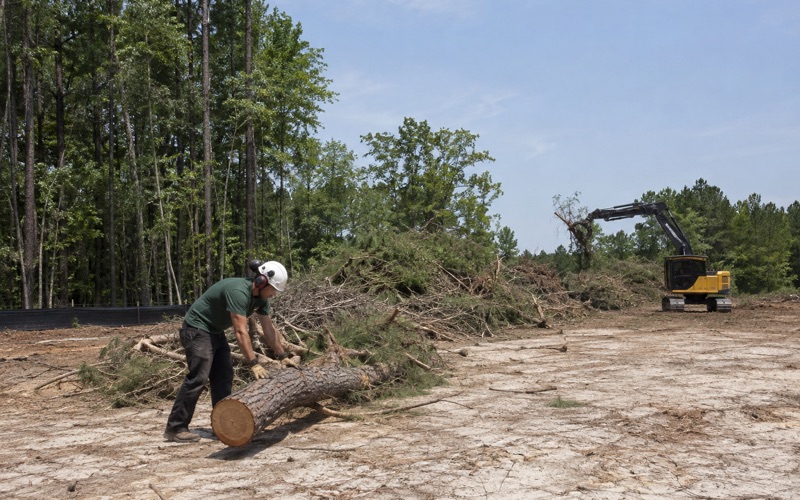
The trees with real diameter at breast height in Jessup stand on land that was never subdivided: the state correctional complex, the wholesale market campus, the institutional parcels, and the strips of woods the highways were cut through. Those are the removals that need a crane or a full sectional dismantle, which is why our equipment list here runs heavier than the housing profile alone would suggest.
Looking for tree removal closer to Elkridge? See Elkridge Tree Removal.
Institutional grounds run on a calendar we do not set
Trees on the grounds of the state correctional complex are the responsibility of the Maryland Department of Public Safety and Correctional Services, and both Jessup Correctional Institution on House of Correction Road and Dorsey Run Correctional Facility on Toulson Road sit on the Anne Arundel County side of the community. A removal inside a secure perimeter is a scheduling problem before it is a tree problem: cleared crew, escorted access, tools counted in and counted out, and a work window that does not move because the forecast did.
The Maryland Food Center Authority, an independent state agency, owns and operates the Maryland Wholesale Produce and Seafood Markets in the Food Center on the Howard County side, where two buildings cover 330,000 square feet of terminal space. Grounds work there answers to the authority, and the binding constraint is traffic. A terminal market moves trucks at hours when a residential street is still asleep, so the drop zone we can hold at 6:00 a.m. is not the drop zone we can hold at midday.
One crew, one written standard
Every institutional client asks a version of the same question: who is actually cutting, and to what standard. Our removals and pruning follow ANSI A300 for the work and ANSI Z133 for how the crew operates around it, so the specification is written down rather than left to the climber on the day. A Maryland Licensed Tree Expert scopes the job, and the crew that walked the site with you is the crew that rakes it out.
Sizing the method to the site
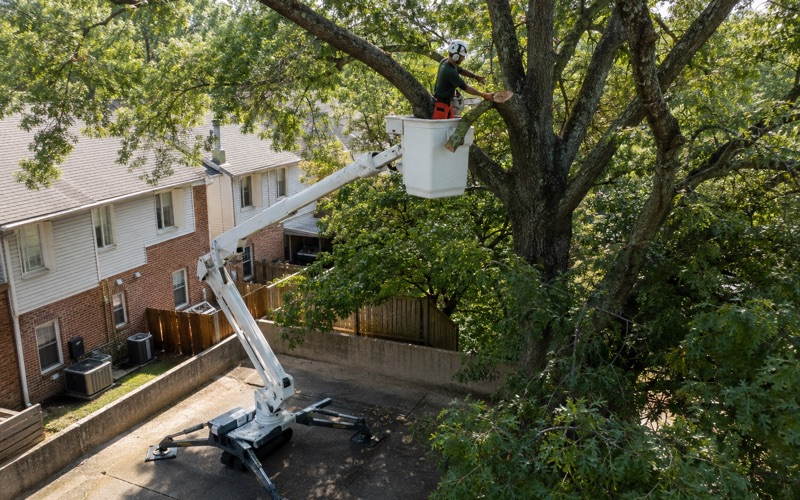
Institutional ground usually gives us room, which changes the method rather than removing the difficulty. Where there is a genuine drop zone we fell. Where a tree overhangs a fence line, a roof, a fuel tank or a secured yard, we dismantle it sectionally from an aerial lift, or bring a crane and take it out in picks. Lawn and hardscape protection matting goes down on every job, and on a maintained state lawn that is the difference between a finished job and a repair bill.
Warehouse frontage and the right-of-way question
The US 1 and I-95 belt through Jessup is warehouse and distribution ground, and the trees that matter on those parcels are usually at the edge: the screening row on a property line, the survivors in the graded strip between a truck court and the road, the volunteers that seeded into a swale. Dorsey Run Road frontage is the clean example. A tree there can stand on the tenant parcel, on the landlord parcel, or in public right-of-way, and the answer decides who is even allowed to authorize the cut.
That distinction is Maryland law, not paperwork for its own sake. A tree whose trunk stands in a public right-of-way requires a Roadside Tree Care Permit from the Maryland Department of Natural Resources Forest Service, and the same agency licenses the tree experts permitted to work on those trees under COMAR 08.07.07. We pull the permit before scheduling, not after a crew is standing at the curb with a road closed.
One interchange, two road owners
The MD 175 interchange with the Baltimore-Washington Parkway sits inside Jessup, and it is the jurisdictional boundary on that road. South of it the Parkway is maintained by the National Park Service. North of it the road becomes MD 295 under the Maryland State Highway Administration, which also carries MD 175 and MD 32. A roadside tree on the Parkway therefore has a different owner depending on which side of a single Jessup interchange it stands on, and we settle that before we promise a date.
Edge trees and what the wind finds
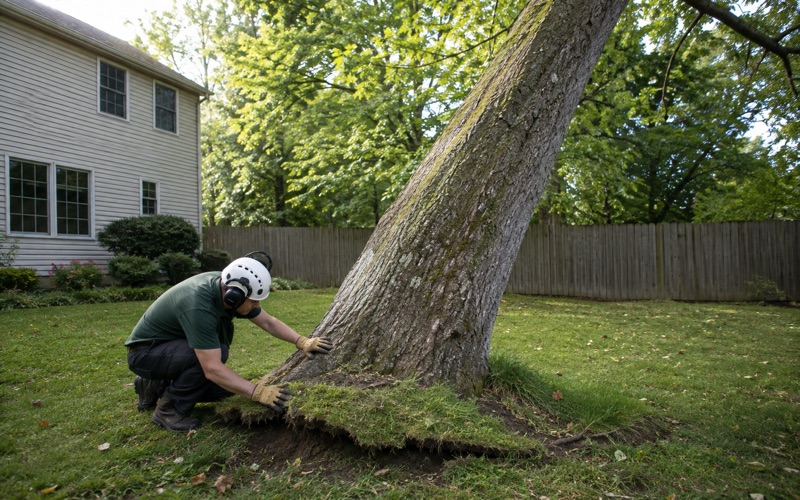
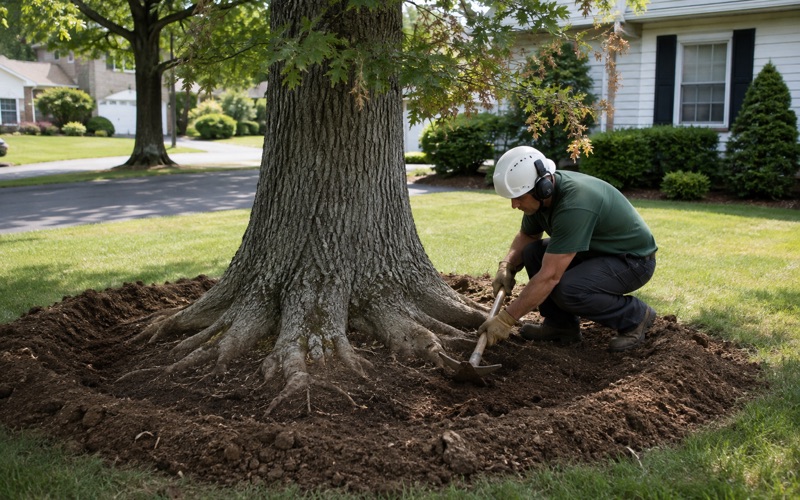
A tree that grew inside a stand and then had the stand cleared away from it has a crown built for shelter it no longer has, and a root plate that a grading operation may have cut into on the road side. That combination is what makes windthrow along a frontage strip so much more common than its trunk diameter suggests. We look at the critical root zone and what has been done to it, not only at the crown, before calling a tree sound.
Storm nights land on the highways
Severe thunderstorm wind is the recurring driver here, and it lands on the road network rather than on the subdivisions. A tree came down on MD 175 Jessup Road near Old Jessup Road on June 10, 2021, and on August 4, 2022 trees blew down in Jessup, including one that blocked all lanes of southbound MD 295. On June 30, 2023 trees and wires came down near US 1 Washington Boulevard and Kit Kat Road, and wires change the order of operations: Baltimore Gas and Electric clears the conductor first, and we cut second. Our storm line answers within 24 hours for a fallen tree or a tree resting on a structure.
Quoting a commercial parcel is not quoting a lot
Jessup straddles the Anne Arundel and Howard county line, and the split decides which permit counter, which forest conservation program and which inspector a job answers to. Addresses on House of Correction Road, Toulson Road and Jessup Road fall in Anne Arundel County. Conowingo Avenue, Oceano Avenue and Dorsey Run Road fall in Howard County, in the Savage election district. We route the paperwork before scheduling, because the two counties answer differently.
On the Anne Arundel side, building, grading and sediment control permits go through the Department of Inspections and Permits, and the county forest conservation regulations attach where a subdivision, grading permit or sediment control permit covers a site of 40,000 square feet or greater, a threshold a warehouse pad clears easily and a parking-island replacement does not. Forest conservation and development review sit with the Office of Planning and Zoning, Development Division. On the Howard side, building and grading permits run through Inspections, Licenses and Permits, while the Department of Planning and Zoning handles forest conservation review, including the five-year forward Declaration of Intent used for exemptions.
One review this community does not carry: no part of Jessup lies in the Chesapeake Bay Critical Area. A few miles east that adds a layer to the approval; here it does not.
The forecast splits here too
The National Weather Service zone boundary runs through the community as well. The Jessup census designated place internal point falls in zone MDZ014, Anne Arundel, while points a mile or two north and west that the same lookup labels Jessup fall in zone MDZ506, Central and Southeast Howard. A wind or winter headline can be issued for one half of Jessup and not the other, so we watch both rather than the one the address happens to sit in.
What the ground does to the price
The soils here are the coarsest and stoniest in our service area. Legore silt loam, 8 to 15 percent slopes, stony, is mapped inside Jessup, and stone costs stump grinder teeth, so grinding on that ground is priced differently than grinding a clean loam. Along the stream bottoms, frequently flooded Codorus and Hatboro soils stay soft well after a wet week, which decides whether a machine can reach a stump in March or has to wait for the ground to firm.
What the estimate has to survive
We quote on site at no charge, and a second look at a tree you are unsure about costs nothing either. The written scope names each tree by location, states who holds the permit and who owns the trunk, and settles brush, trunk rounds, stump and grindings up front. On a commercial parcel that document is what a facilities manager forwards for approval, so we write it to be understood by someone who will never walk the site.
- 20+ Years in Anne Arundel County
- Free On-Site Estimates
- 24-Hour Storm Response