Severn Tree Removal handles tree removal in Lansdowne, and after more than twenty years of tree work across this region we have learned that the trees standing in a Lansdowne yard are not the trees standing ten miles inland. The species mix here is a coastal one, and it changes what comes down, how it comes down, and what is worth putting back in its place.
Every removal we quote begins with a free on-site estimate and a scope written down before a crew is booked, so the wood, the brush, the stump and the grindings are all agreed in advance. That part of how we work is the same at every address; what changes from one address to the next is the tree itself.
We hold the licensing Maryland law requires for this work, we handle permit routing ahead of scheduling, and we answer storm calls within 24 hours. What follows is the part that belongs to Lansdowne specifically: the ground under it, the species that suit that ground, and the ones that were planted here regardless.
Which trees belong on this side of the Fall Line
The Atlantic Seaboard Fall Line runs through this part of Maryland and separates two genuinely different pieces of country. Lansdowne sits on the seaward side of it, and that single fact governs more of our work here than any other local condition.
The 96.6 percent that settles it
Sampled across the community, 96.6% of the Lansdowne CDP falls within the Atlantic Coastal Plain Province and only 3.4% within the Piedmont Plateau Province. That is not a close call, and it is why we approach a Lansdowne property as a coastal-plain job rather than a generic Baltimore-area one.
A Piedmont yard a short drive to the northwest has a different native species list, different rooting behavior and different failure patterns. Homeowners here often receive advice built for that other side of the line, which is one of the ordinary ways a tree that was never suited to its site ends up needing us.
Ground with no rock in it
Surface geology inside the CDP samples as 56.9% Cenozoic lowland deposits of silt, clay and sand, and 42.5% Cretaceous Patuxent, Arundel Clay and Patapsco formations. There is no shallow crystalline rock anywhere under this community.
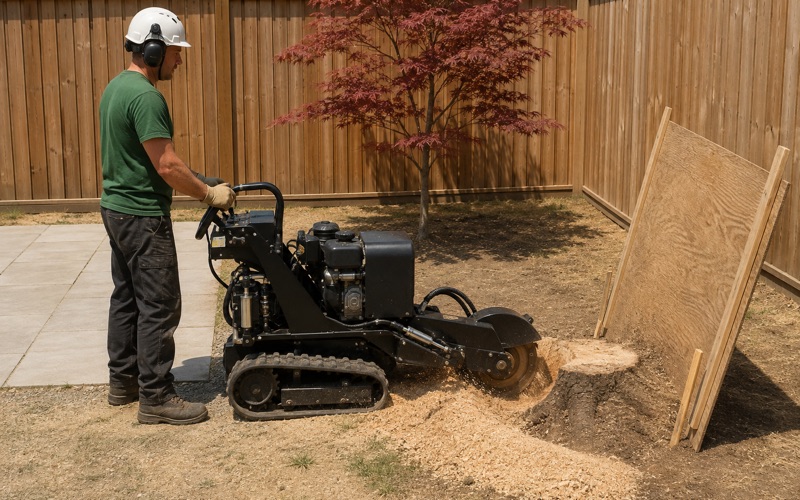
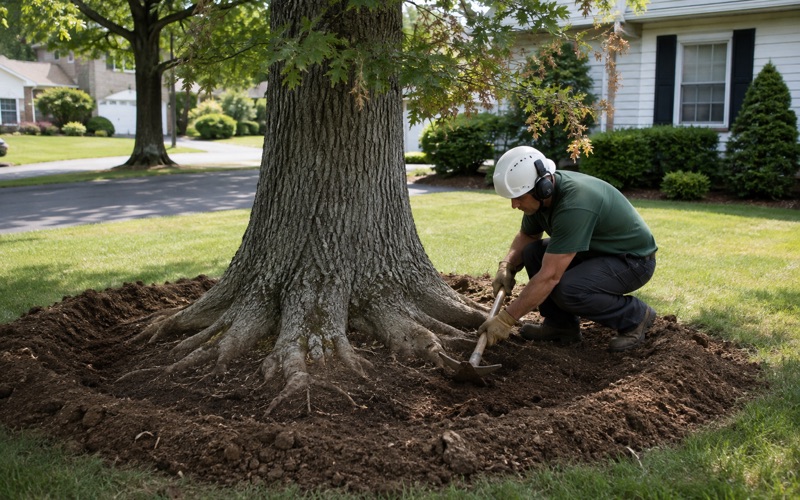
For stump grinding that is straightforwardly good news, since the stump grinder works through soft, unconsolidated material without meeting anything that stops it. For a standing tree it cuts the other way, because roots spread broad and shallow rather than anchoring deep.
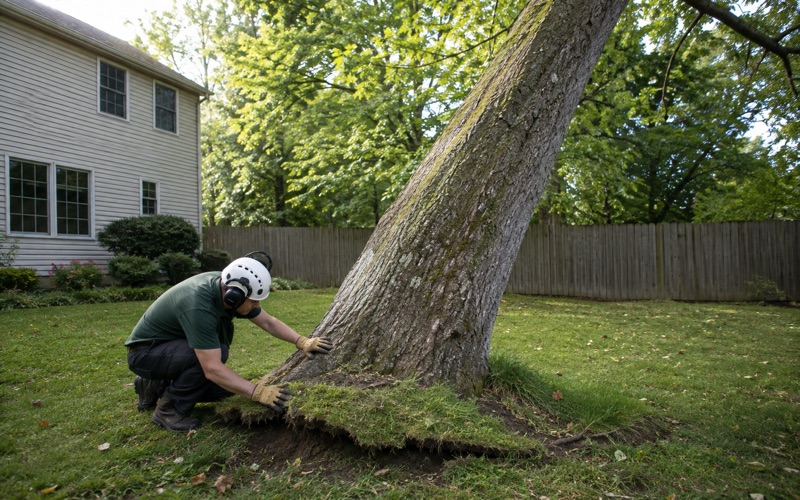
The result is a wide, plate-shaped root system that can lift as a single unit once the ground is saturated. Windthrow in Lansdowne is far more often a root plate rolling out of wet soil than a trunk snapping at height.
Housing age and what was planted alongside it
84.1% of Lansdowne housing units were built in 1979 or earlier and 52.1% before 1960, with 30.1% going up in the 1950s and 21.6% in the 1960s. Only 3.2% date from 2000 or later.
Most of the trees we are called out to are therefore yard trees planted with those houses, now sixty or seventy years on and at or past the size the original planting anticipated. Mature is not the same thing as sound, and a tree that has simply outgrown its spot is one of the most common removals we write up here.
Looking for tree removal closer to Arbutus? See Arbutus Tree Removal.
Loblolly pine here, northern red oak inland
Once you know which province a property sits in, the plausible species list follows from it. The two trees that make that point most clearly in Lansdowne are loblolly pine and northern red oak, and they make it in opposite directions.
Loblolly pine is at home
Loblolly pine is locally native on the coastal plain, so a loblolly in a Lansdowne yard is growing where it belongs rather than where somebody forced it. It reaches real size, holds a tall straight stem, and carries most of its crown weight high.
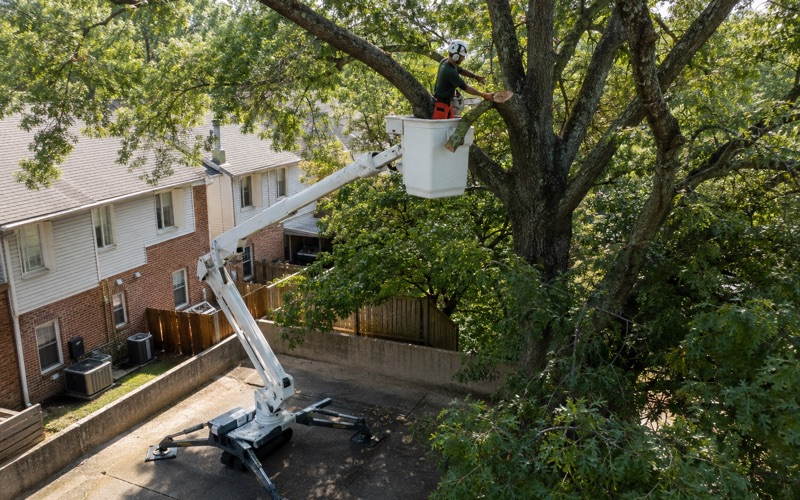
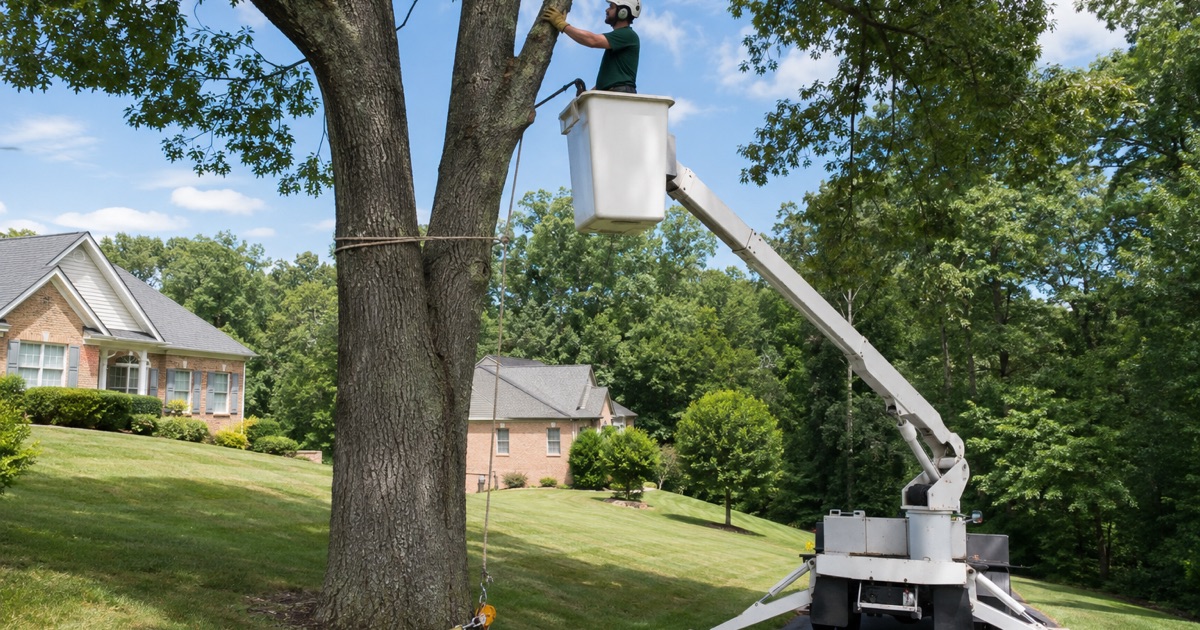
That shape decides the removal method far more than the diameter does. A tall pine with a narrow crown and a heavy top over a roofline is a sectional dismantling job, taken down in controlled pieces from an aerial lift, not something anyone should be felling in one piece.
Northern red oak is the rare one
Northern red oak is flagged as rare in the coastal plain, which surprises people who think of it as a default Maryland shade tree. It is a default — inland, above the Fall Line, in the Piedmont ground it actually prefers.
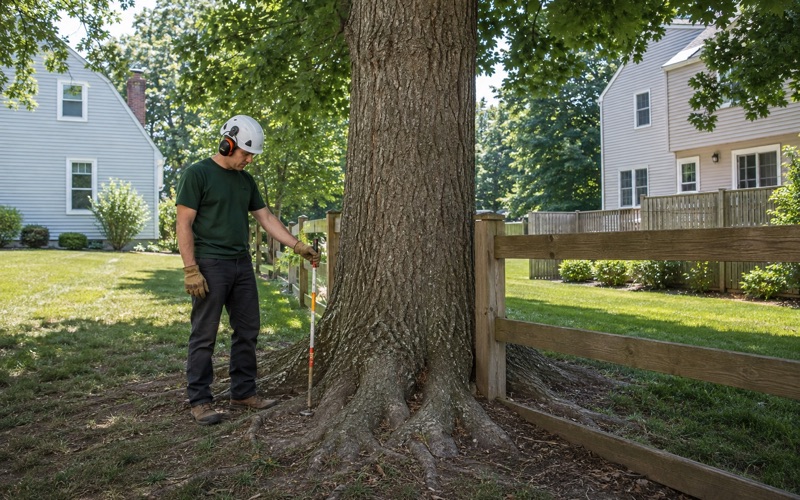
On this side it is uncommon enough that when we find one we look hard before recommending anything drastic. A specimen tree that is rare for its province gets measured at diameter at breast height and assessed for defect, and crown reduction or cabling and bracing get considered before removal is on the table at all.
Reading a mixed yard
Very few Lansdowne properties are a clean native stand. Six decades of planting means the ground under a house can be pure coastal plain while half the canopy above it arrived from a nursery lot with no opinion about provinces.
Our estimate names what is actually standing, tree by tree, and says which of it the site supports over the long run. That is the difference between a price for hauling wood away and advice you can act on more than once.
What the species set changes about the work
Species is not trivia on a removal quote. It drives the rigging, the debris volume, the stump, and every part of the question of what should go back into the gap afterward.
Pines come down in short pieces
Pine wood is lighter than oak by volume, but the stems are long, and a long piece swinging on a rigging line carries leverage a short heavy one does not. We take pine tops in short, frequent cuts, which is slower on paper and much safer in a yard with a fence, a shed and a driveway inside the fall radius.
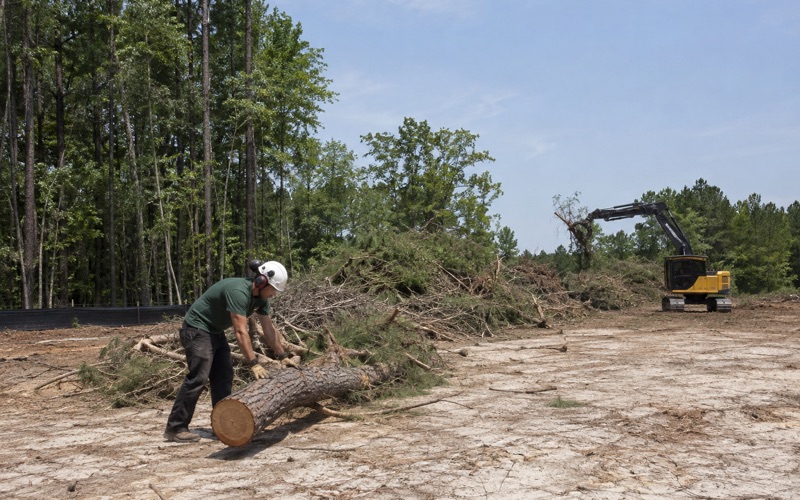
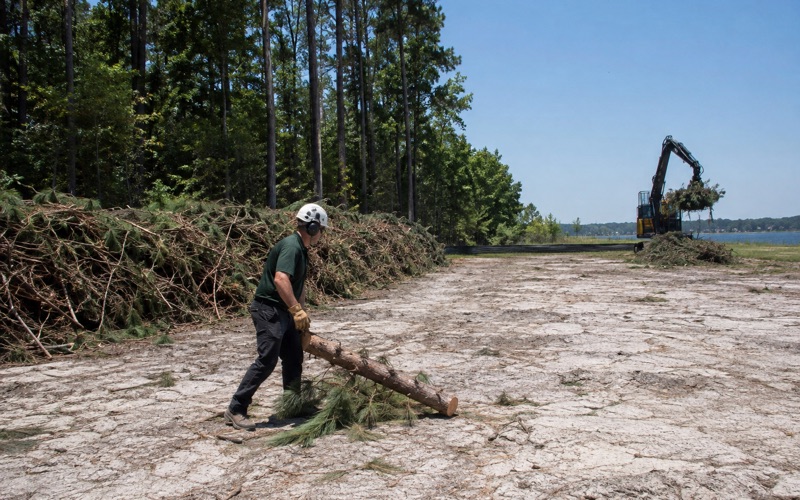
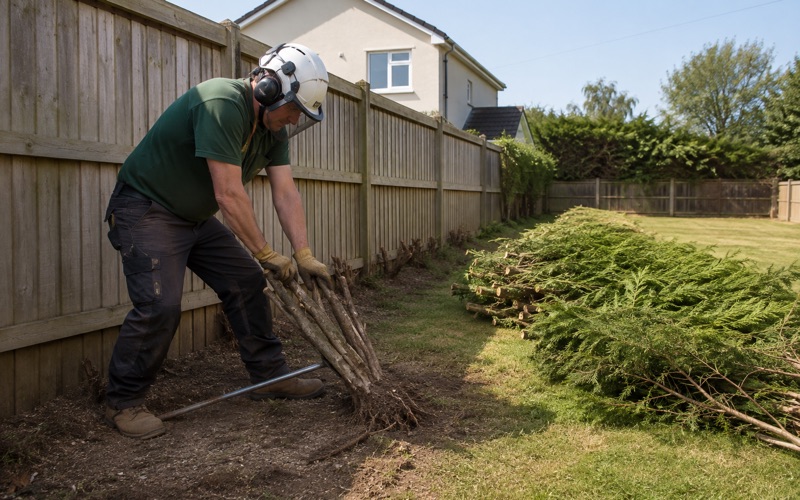
Pine also throws a large volume of brush relative to its trunk wood, which is exactly the sort of thing homeowners get surprised by after the crew leaves. Our written inclusions name the chipping, the trunk rounds, the stump and the grindings before the job is booked, so what is left on the lawn is a decision rather than a discovery.
Hardwoods, defects and the critical root zone
Oaks and the other hardwoods here carry their weight out sideways over the same shallow, wide root system the geology encourages. Co-dominant stems with included bark are a defect we look for specifically, because that union fails in wind long before sound wood does.
When a hardwood is staying, we work to ANSI A300 and Z133 and protect the critical root zone instead of driving equipment across it, with lawn and hardscape matting on every job. On badly compacted ground, an air spade, root collar excavation and soil decompaction tell us more about a declining tree than the crown ever will.
Ash, Bradford pear, and what not to plant back
Emerald ash borer has been established in Maryland since 2003 and kills a large ash within about three years, leaving brittle standing deadwood. A dead ash is a removal to schedule rather than defer, and how long it has been standing dead changes the method we use to take it apart.
Callery pear, the Bradford pear planted heavily in 1990s and 2000s subdivisions, is prohibited for sale in Maryland from January 15, 2026. When a removal opens a hole in a Lansdowne canopy, that is the natural moment to choose a replacement the coastal plain genuinely supports.
Licensing, permits and who owns the tree at the curb
Maryland regulates tree work more tightly than most states, and a Lansdowne property sits under state licensing and county programs at the same time. We route the permitting before scheduling rather than after, because the answers differ by jurisdiction and finding out late costs a booked crew.
The license and the written contract
Maryland Natural Resources Article section 5-417(a)(1) requires a Licensed Tree Expert license to do tree work for hire. Trees twenty feet tall or less are exempted under section 5-415(c)(2)(iii), along with loggers and underground-utility installers, and section 5-417(a)(2) allows a crew working under a Licensed Tree Expert’s supervision to work without individual licenses.
COMAR 08.07.07.03D requires a written contract carrying that license number. Ask any contractor for it, because one who cannot put a Licensed Tree Expert number on paper is telling you something, and that same written document is where your scope and inclusions live.
Roadside trees and the county right-of-way
The Roadside Tree Law turns on where the trunk stands within the public right-of-way, not on who planted the tree. A Maryland Department of Natural Resources Forest Service Roadside Tree Care Permit is required before removing, trimming or caring for a roadside tree, penalties run to $2,000 and $5,000, and section 5-406(d) bars a county from issuing a building permit until that permit is obtained.
The Baltimore County Bureau of Highways removes dead and storm-damaged trees and broken limbs from county roads and roadsides by work order, applying the same criteria the state does; requests go to highways@baltimorecountymd.gov or 410-887-3560. Whether a tree stands inside the county right-of-way is determined when the work order application is started, and clearing fallen trees and debris from private property stays the owner’s responsibility.
Lines, storms and the free second look
Baltimore Gas and Electric holds vegetation-management duties under COMAR 20.50.12.09 on its own distribution circuits and is not responsible for removing wood debris. Report a downed line to 1-877-778-2222 and a limb resting on a line to 1-800-685-0123, and keep people away from it until the utility has cleared it.
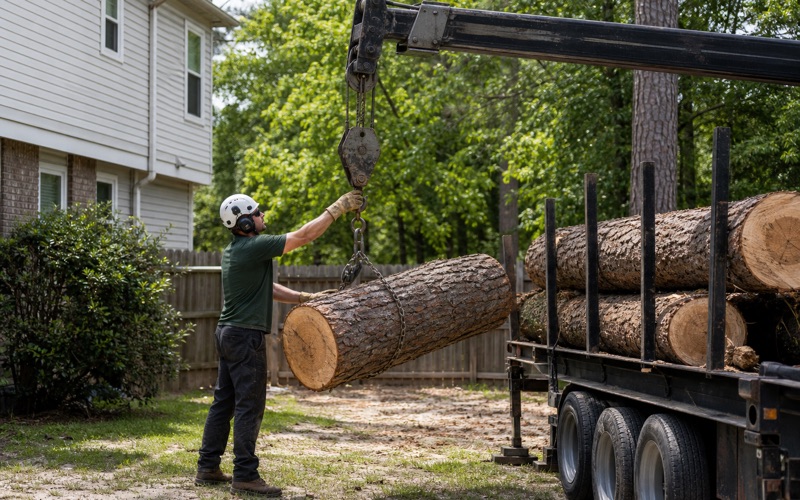
We answer storm damage, fallen trees and trees resting on a structure within 24 hours, with crane-assisted removal where a yard offers no drop zone to fell into. Lansdowne sits in NWS forecast zone MDZ011, Southern Baltimore, under the Baltimore/Washington forecast office, which is the zone worth watching when a squall line is tracking in.
The estimate visit costs nothing, and neither does a second look at a tree you are unsure about. The crew that walks the property with you is the crew that finishes the rake-out.
- 20+ Years in Anne Arundel County
- Free On-Site Estimates
- 24-Hour Storm Response