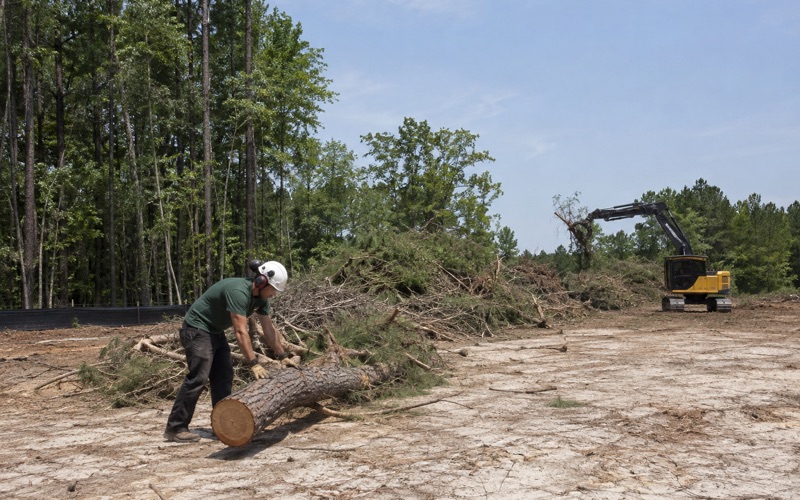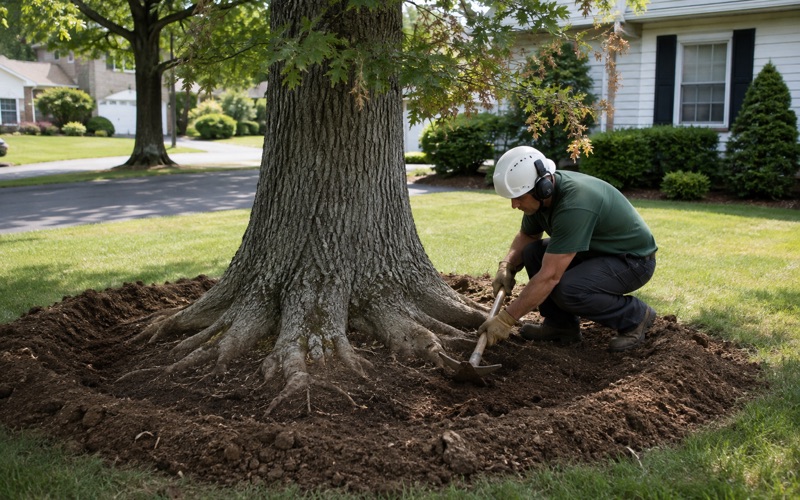
Severn Tree Removal takes on tree removal in Laurel, Maryland, and we have been running crews across this corridor for more than twenty years. Nearly every call opens on the same question, and it is a permit question. Owners want to know who has to sign off before a tree in their own back yard comes down.
For Laurel the answer is that the city itself does not require anything. We went through the City of Laurel Code of Ordinances before we wrote a word of this page, because the answer changes at every municipal line in this region and guessing is how a crew ends up idle on a Tuesday morning.
What is left after that is a short list of things that genuinely do bind here: state licensing, a state permit for anything standing in the road right-of-way, city ownership of the trees along the curb, and a forest conservation program the city administers itself rather than handing to the county. We sort all of it out before a date goes on the calendar, and the estimate visit costs nothing.
No city permit for a tree in a Laurel back yard
What the Code of Ordinances actually contains
The city’s Code of Ordinances has no chapter devoted to trees. Chapters 1 through 18 carry the ordinary municipal subjects, and nowhere among them is a removal application, a fee schedule, a diameter threshold or a review of any kind aimed at a private property owner taking down a tree.
That is unusual enough in this part of Maryland that we do not take it on trust from one reading. It is also the single most useful fact a Laurel owner can have, because it removes weeks from a project that in a neighboring jurisdiction would start with paperwork.
Section 14-3 is the one standalone tree provision
The only freestanding tree provision in those chapters is section 14-3, Trimming of hedges, shrubs and trees. It reads on hedges “composed of hawthorne, buckthorne, osage orange, or other shrubs or trees containing thorns or spines planted along the line of any street in the city,” and requires them trimmed so the branches do not extend to or over the inside portion of the pavement. The citation printed beneath it is Code 1970, section 13-4.
Read what that is: a sidewalk clearance rule for thorny hedges, carried forward from a code more than fifty years old. It says nothing about removal, nothing about trunk size, nothing about replacement planting. A rule that narrow is worth quoting exactly, because paraphrasing it is how it turns into a permit that does not exist.
What does govern the work instead
Licensing does. Anyone doing tree work for hire in Maryland must hold a Maryland Licensed Tree Expert license or work under the supervision of someone who holds one, and the written contract has to carry that licensee’s name, license number, business name, address and phone. The code of ethics behind the license is COMAR 08.07.07, and the fee schedule sits in the Natural Resources Article.
The tree’s own location governs too, and so does whether a development application is in play. Those are two different questions from a homeowner’s, and we take them in turn below.
Looking for tree removal closer to South Laurel? See Tree Removal Services in South Laurel.
The city runs its own forest conservation program
Where the 40,000 square foot trigger bites
Forest conservation in Laurel lives in the city’s Unified Land Development Code, Chapter 20, Article V, running from section 20-41.1 through 20-41.20. Section 20-41.3 sets who it reaches: a person “making application for a subdivision, project plan, site plan, development plan, grading or sediment control approval on units of land forty thousand (40,000) square feet or greater.”
That is an application trigger, not a chainsaw trigger, and the distinction decides most of the calls we get. An owner who has concluded a leaning oak has to go has applied for nothing, so Article V never reaches the job at all.
Declarations of intent, exemptions and the fee
Article V exempts residential construction on single lots not exceeding 20,000 square feet of forest, and dwelling-house construction for the owner or a family member at that same 20,000 square foot threshold. A Declaration of Intent is filed with the city’s Department of Community Planning and Business Services rather than with the county, runs five years, and carries a noncompliance fee of $1.50 per square foot of forest cut or cleared.
That fee is the number that makes the filing worth doing carefully on a commercial parcel or a subdivision. On a quarter-acre yard it never enters the conversation.
Why we work from the city code
Prince George’s County’s Subtitle 25 woodland conservation and tree canopy ordinances are administered by the county planning department for land outside a municipality that runs its own program. Laurel has held its own planning, zoning and subdivision authority over roughly 4.3 square miles since it was incorporated in 1870 and reincorporated in 1890, and its Planning Commission was created by ordinance in 1960.
Our reading of the two codes together is that the program sitting in front of a development application inside the city limits is the city’s own Article V, and that is where we route the filing. We will say plainly that we reached that conclusion by reading both codes rather than by obtaining a written instrument that settles the boundary, so on a large commercial site we confirm with the city before scheduling rather than assuming it.
What Laurel property does to the work
Townhouse rows and gate width
This is not primarily a detached-house market, and our equipment list follows from that. Single-family attached rows make up 28.9% of the housing stock against 20.7% detached, so reaching a rear yard through a standard gate between two townhouses is a routine condition here rather than an occasional obstacle.
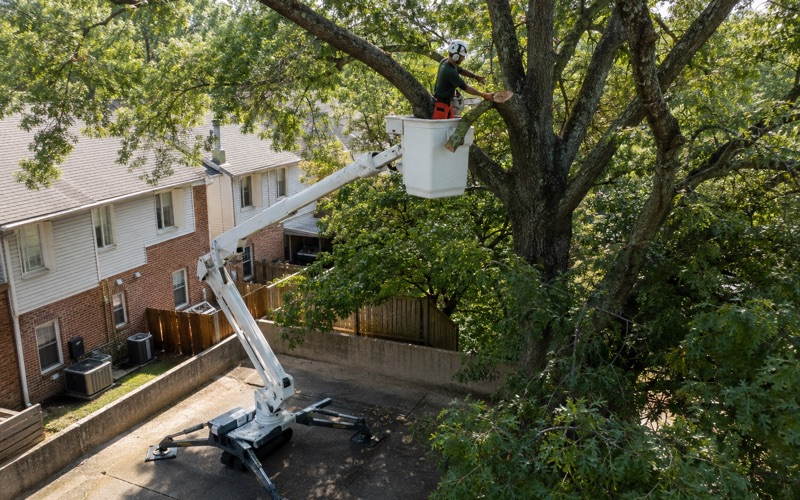
Our compact tracked machines are sized to pass a standard back-yard gate for exactly this reason. Where nothing will fit at all, the answer is sectional dismantling on rope or a crane pick over the roofline, and we price that at the estimate instead of discovering it on the morning of the job.
Rented stock and managed grounds
55.8% of the city’s 12,476 occupied units are rented, and 45.8% of all housing units sit in buildings of five or more. Only 18.9% of occupied units are owner-occupied single-family detached houses. A large share of the tree work here is therefore bought by a property manager on a maintenance cycle rather than by an owner the week after a storm.
We build schedules around that reality: HOA board calendars, grounds contracts and multifamily access windows, with the scope written down before a crew is booked. The same crew that walks the property at the estimate is the crew that shows up.
Slope, gravel and the Arundel Clay
The mapped soil at the city centroid is the Croom-Urban land complex on 5 to 15 percent slopes, formed in gravelly fluviomarine deposits, well drained, with a loam surface at 18.4% clay. Its erosion hazard is rated severe and it falls in hydrologic soil group C. Gravelly and well drained means footing holds up in wet weather better than it would on a clay flat; the slope is what limits where a crane or a chipper can safely set up.
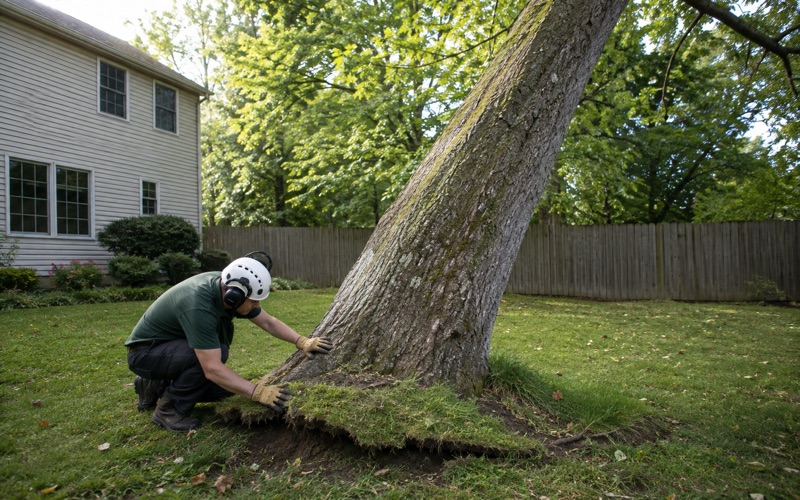
The surface geology here is unit Kp, whose formations are the Patuxent, the Arundel Clay and the Patapsco. Where the Arundel Clay comes near the surface, subsoil is heavy and holds water, roots stay shallow and wide, and the common storm failure becomes a whole root plate lifting out of saturated ground rather than a clean trunk break.
The age of the canopy
37.7% of the housing stock predates 1980 and 6.0% dates from 1939 or earlier, concentrated in the old mill-town core on the Patuxent. The largest single cohort, though, is the 1980s at 27.3%.
That matters for what we are actually asked to cut. Much of the yard canopy in Laurel is subdivision planting now around forty years old rather than old-growth remnant, which is the age at which co-dominant stems with included bark begin to come apart and crown reduction or cabling and bracing becomes a real alternative to removal.
What a Laurel owner actually needs to do
Establish whose tree it is
Start by working out whether the tree belongs to you. The city’s own guidance is that a street tree planted in the easement beside a city street is owned and maintained by the City even where it grows on ground the homeowner holds title to, and that residents may not prune or remove one.
The city contracts the removal of diseased, dead and hazardous trees in that right-of-way itself, and states that such work is subject to state permit requirements. Public Works takes those calls at 301-725-0088. Trees on your own property are yours to deal with.
Anything in the road right-of-way needs a state permit
A tree whose trunk stands in a public road right-of-way needs a Roadside Tree Care Permit from the Maryland DNR Forest Service before it is cut or trimmed, under Natural Resources Article sections 5-401 through 5-411, and all commercial roadside work has to be conducted under the direction of a Licensed Tree Expert. Along the older streets around the Main Street core, that catches more front-yard trees than owners expect.
We handle permit routing before scheduling rather than on the day. Five counties and four towns in our service area answer this question differently, and the only way to keep that from costing a customer a rescheduled crew is to settle it in advance.
Lines, and who to call
Pepco, not BGE, is the electric distribution utility in Laurel, so a limb resting on a service drop or a downed conductor is a Pepco call before it is ours. Pepco runs its vegetation management on a four-year cycle to reduce outages, reviewing public right-of-way trees with the municipality and taking private trees up directly with the property owner.
We do not work energized conductors. Crews work to ANSI Z133, and we stand off a tree in contact with a line until the utility has cleared it, then take the removal from there.
One rule that does not apply here
Waterfront rules are worth ruling out explicitly, because they bind a short drive away. No part of the city centroid falls within the Chesapeake Bay Critical Area: a point query there returns nothing at all, while the identical query at a Fort McHenry control point returns an Intensely Developed Area record, so the empty answer is a real finding and not a failed lookup.
The Patuxent is non-tidal where it runs past the city. The buffer and shoreline provisions that shape tree work on tidal water elsewhere in Maryland do not reach a yard in Laurel, which is one fewer approval between an estimate and a start date.
What you get in writing
Our estimate visit is free, and so is a second look at a tree you are unsure about. What comes out of it is a written scope: what comes down, whether the brush is chipped on site, where the trunk rounds end up, and whether the stump and the grindings are included or left in place. Lawn and hardscape protection matting goes down on every job.
Storm work moves ahead of the calendar. Fallen trees, trees resting on a structure and hangers over an occupied space get a 24-hour response, because a tree already on a roof is not a job that waits for a routing slot. Pruning is written to ANSI A300 whether the work is crown raising over a driveway or deadwooding a mature yard tree, and we would rather tell you a tree can be kept than sell you a removal it does not need.
- 20+ Years in Anne Arundel County
- Free On-Site Estimates
- 24-Hour Storm Response