Severn Tree Removal has handled tree removal in Linthicum for more than 20 years, and a job here starts with a question that has nothing to do with the tree itself: which set of rules the address falls under. Two answers decide the sequence of the work on this side of Anne Arundel County, and both get settled before we quote a number.
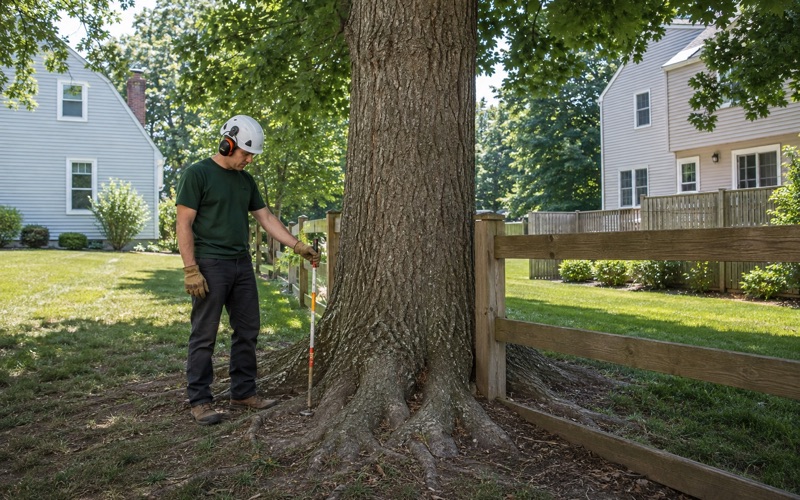
Every estimate is free and done on site. We walk the property, look at the tree from the ground and from the drop zone we would actually use, and put the scope in writing — brush chipped, trunk rounds, the stump and the grindings all settled on paper before a crew is booked.
Permit routing is our work rather than yours, and we do it ahead of scheduling because the counties and towns we cover answer differently from one another. A single Linthicum address can sit under a county rule, a state rule and a federal one at the same time, and none of them announces itself.
Linthicum and Linthicum Heights are one community
If your mail says Linthicum Heights and your deed says Linthicum, nothing is wrong. The U.S. Postal Service designates the place Linthicum Heights under ZIP code 21090, while the Census Bureau carries it as the Linthicum census-designated place; they are two names for one unincorporated community in Anne Arundel County, sitting directly north of Baltimore-Washington International Thurgood Marshall Airport.
The doubled name is a nuisance on paperwork rather than a curiosity. An estimate written to Linthicum Heights and a county record filed for Linthicum describe the same parcel, and we make sure the address on the contract matches the form the county’s own records use so nothing stalls at review.
There is no town hall to call
Because the community is unincorporated, there is no municipal permit counter, and every approval runs through the county or the state. Vegetation questions go to the Anne Arundel County Department of Inspections and Permits Forestry Program at (410) 222-7441 or forestry@aacounty.org; police coverage is the Northern District station on Hammonds Lane in Brooklyn Park, and fire and EMS come from Company 32 at 309 Camp Meade Road South.
The license that belongs on the contract
Maryland requires a Licensed Tree Expert for tree work performed for hire, with an exemption only for trees 20 feet tall or less, and COMAR 08.07.07 makes a written contract carrying that license number mandatory. Crew members working under a licensed expert’s supervision do not each need their own license, but the number belongs on your paperwork either way. Anne Arundel County states the same thing from its side: contracted removal or pruning is work for a Maryland Licensed Tree Expert.
We write to ANSI A300 for pruning specifications and work to ANSI Z133 for crew safety, which is what keeps a crown reduction an actual reduction rather than a topping cut. Those standards are also the vocabulary a county reviewer and an ISA Certified Arborist both read, so a scope written in them survives a second opinion.
Looking for tree removal closer to Maryland City? See Tree Removal in Maryland City.
The Critical Area reaches only the northern tidal edge
The Chesapeake Bay Critical Area is not a blanket county designation; it attaches through the 1,000-foot band landward of tidal water and tidal wetlands. Linthicum’s only tidal frontage is at its northern boundary, on the tidal Patapsco, so the obligation lands along that edge rather than across the community as a whole. Most of Linthicum — the postwar subdivisions through the middle, the commercial strip, the streets nearest the airport — sits outside the band entirely.
All three Critical Area classes appear here
Where the designation does reach, all three classes are present: intensely developed, limited development and resource conservation. The class governs how much clearing is allowed and what has to be replanted, so two neighbors a few hundred feet apart near the northern edge can be working under different requirements on the same species of tree.
The drainage explains the shape of it
Linthicum drains entirely to the Patapsco River, split between the Patapsco Non-Tidal and Patapsco Tidal watersheds, and its named subwatersheds are Stoney Run, Cabin Branch, Holly Creek and the Patapsco Mainstem. The tidal half is the northern half, which is why the regulated frontage sits where it does. No mapped bog protection area falls inside the community, so that layer never enters the conversation here.
Why the distinction is worth getting right
Treating the whole community as regulated adds review time and cost to jobs that never needed it, and assuming a lot is clear is how a crew ends up cutting inside a buffer without approval. Both errors are common enough around here that we check instead of assuming, on every address.
Establishing whether your lot is inside it, and what changes if it is
Nobody should be guessing at this from a phone map. We check the address against the Maryland iMAP Critical Areas service and confirm it with the county before a date goes on the calendar, because the answer changes the order the work happens in rather than just the price.
The band is measured from tidal water and tidal wetlands, so distance from the shoreline is the whole test. On a lot near the northern edge, that distance is the difference between a removal we schedule for next week and one that waits on county review.
Confirming it lot by lot
Critical Area status follows the parcel, not the street name, and it is confirmed lot by lot. A property on the north side of a road can fall inside the band while the one across from it does not, and the county’s Office of Planning and Zoning is the office that settles which is which. The forestry program answers the vegetation half of the same question.
What changes inside the band
Inside the buffer, removal is reviewed before it happens, and that includes dead trees — the county is explicit that a standing dead stem is not automatically clear to take. It also rebuts the common assumption that stems under four inches are exempt from review. In practice that means a written removal plan approved by the county before saws come out, which is why we ask about the tidal edge on the first call rather than on the morning of the job.
What does not apply to a yard tree
County forest conservation requirements under Article 17 Subtitle 3 attach when a subdivision, a grading permit or a sediment control permit is proposed on a site of 40,000 square feet or more, which is a development threshold and not a homeowner one. A state Roadside Tree Care Permit is a separate matter and covers trees in the public right-of-way, where the test is the location of the trunk rather than the reach of the canopy — a tree overhanging the road from inside your property line is not a roadside tree.
Booking the work, from the ground up to the BWI ceiling
What the ground gives us
Soils here are dominated by the Sassafras series; a sample spread across the community returned Sassafras-Urban land complex on both gentle and 5 to 15 percent slopes at most points, and Sassafras is a well drained, fine-loamy soil. For this trade that is close to a best case: it holds a root plate firmly, digs predictably, and does not turn to soup under a stump grinder after rain. The exception is the stream corridors, where frequently flooded Zekiah and Issue soils appear and saturated ground decides what equipment can be brought in at all.
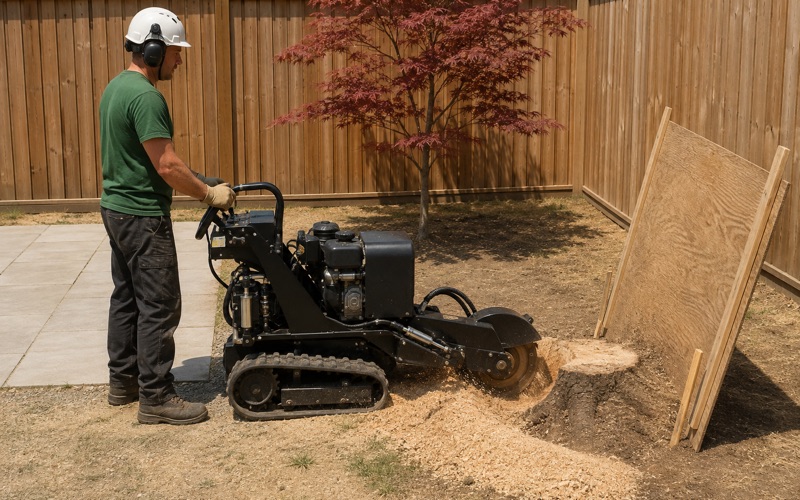
Grade is still a live consideration even though the housing pattern is open, because roughly half the mapped soil units carry 5 to 15 percent slopes and that governs where a crane or a chipper can be set. Compact tracked machines sized to pass a standard back-yard gate handle most of what those slopes allow, and lawn and hardscape protection matting goes down on every job.
The trees these lots are actually carrying
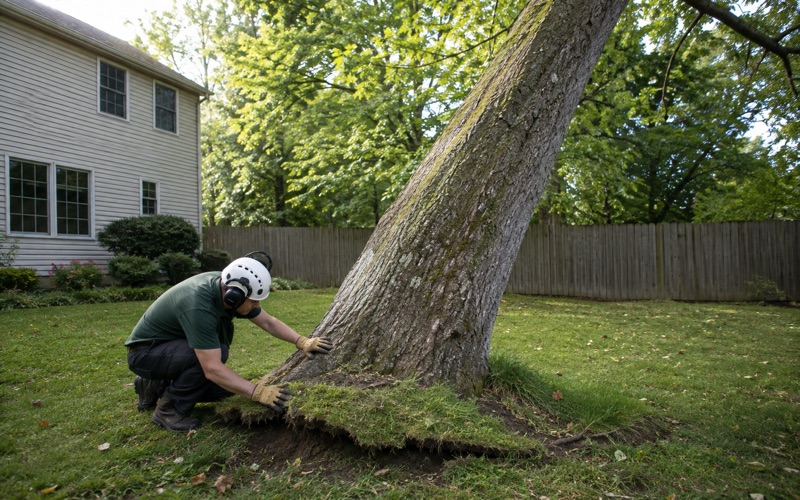
71.1% of Linthicum’s housing was built before 1980 and 37.9% of it went up in the 1950s alone, so the yard canopy on most lots was planted around houses now 65 to 75 years old. That is the age at which oaks and tulip poplars on a quarter-acre lot outgrow the room they were given, and it is why so much of our work here is crown reduction, deadwooding and sectional dismantling rather than a straight fell into open ground. Emerald ash borer has been in Maryland since 2003 and leaves a large ash brittle within about three years, which moves an ash from a pruning conversation to a removal one quickly.
The airport is a working constraint
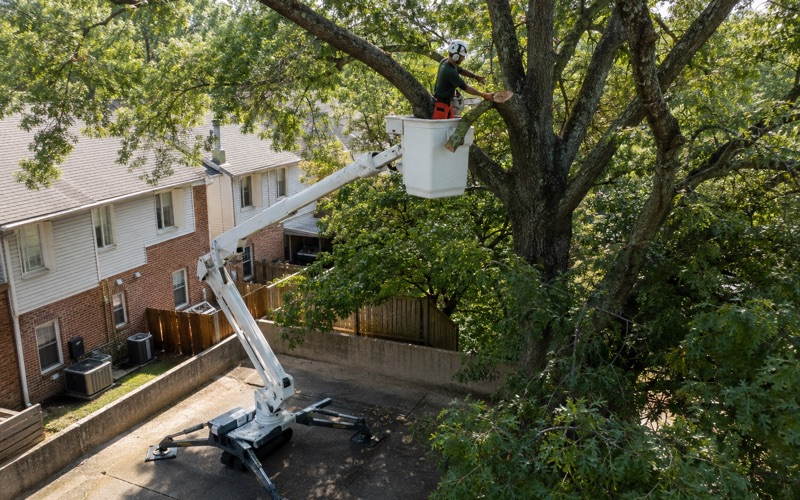
Linthicum’s southern edge is airport land, and that is a scheduling fact rather than local color. Under Part 77 an imaginary surface rises at 100 to 1 for 20,000 feet from the nearest point of the nearest runway, so within a few thousand feet of a runway it stands only tens of feet above the ground, and a crane or aerial lift set for a large removal can reach it. Whether a particular setup requires FAA notice on Form 7460-1 is decided by the Part 77 criteria and the FAA’s own study rather than by a rule of thumb, and that notice is filed 45 days ahead.
Storm work bends the timing. Where immediate work is required by an emergency involving essential public services, public health or public safety, the 45-day requirement is waived and the completed form follows within 5 days, which is what keeps our 24-hour response to fallen trees and trees resting on a structure workable this close to the runways.
What the storm season actually sends
Linthicum sits in National Weather Service public forecast zone MDZ014, which covers all of Anne Arundel County and is forecast from the Baltimore/Washington office, so a wind product issued for the zone does not distinguish this community from its surroundings. The local storm record is led by summer convective severe-thunderstorm wind and tornadoes rather than by hurricane remnants and nor’easters, which means damage tends to arrive fast, in a narrow track, and with little warning. Trees carrying co-dominant stems and included bark are the ones that fail in that kind of wind, and they are worth a look before the season rather than after.
Cleanup, because the county will not take it
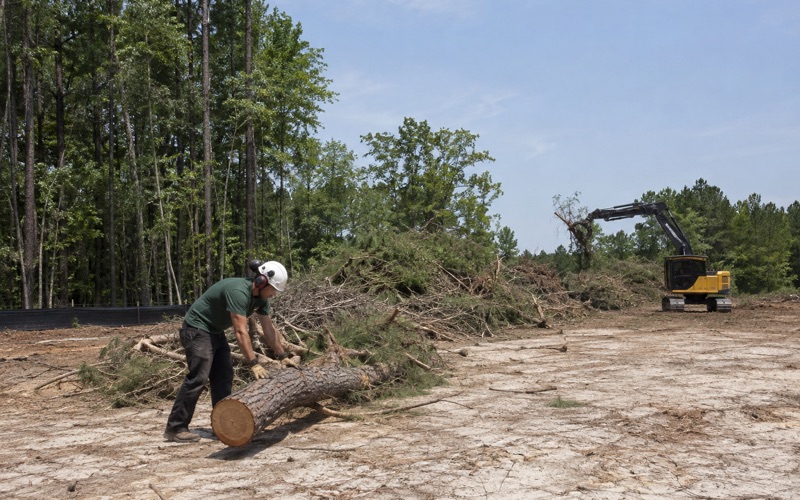
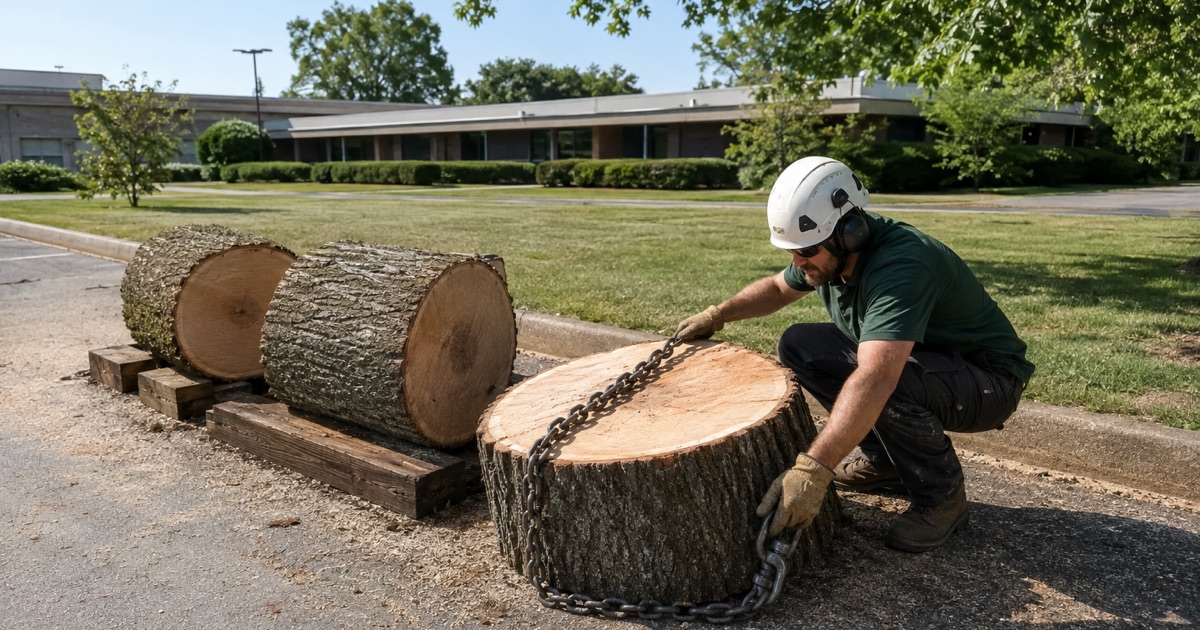
County curbside collection takes limbs under 4 feet long and 4 inches thick, in bundles under 40 pounds, and it does not collect logs. BGE also states that it is not responsible for removing wood debris after a line-clearance cut, so a utility trim can leave a pile that stays yours. Report a downed line to BGE at 1-877-778-2222 and a limb resting on a line at 1-800-685-0123 before anyone goes near it. Our written inclusions settle chipping, trunk rounds, the stump and the grindings up front, and the same crew that walked the estimate is the one doing the final rake-out.
- 20+ Years in Anne Arundel County
- Free On-Site Estimates
- 24-Hour Storm Response