Severn Tree Removal has been dropping, reducing and hauling out trees in Maryland City for more than 20 years, and every job here starts the same way: a free on-site estimate with the full scope written down before a crew is booked. That written scope covers the parts most quotes leave vague, including brush chipped, trunk rounds cut and stacked or hauled off, and the stump ground with the grindings settled up front, so the number does not move once the saws are running.
We work the Fort Meade corridor constantly, and two questions decide how a removal here gets scheduled: who holds authority over the tree, and whether the ground under it will carry a machine on the day we come. Neither is answered by what is printed on the mailbox, and we answer both before quoting rather than after.
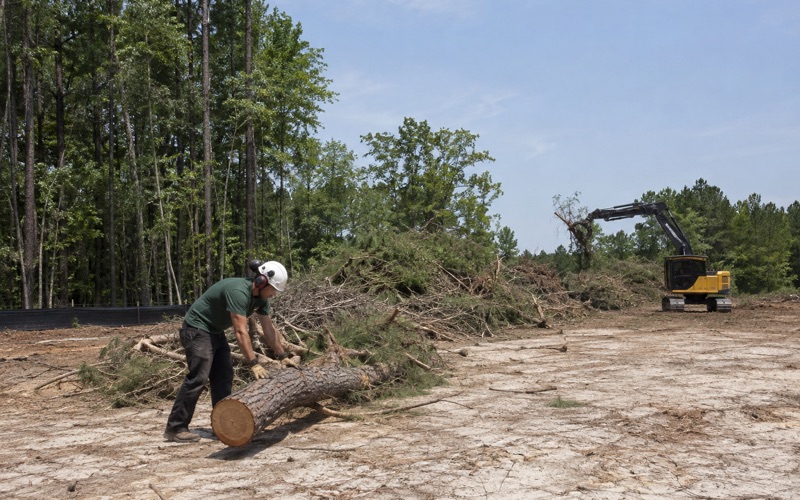
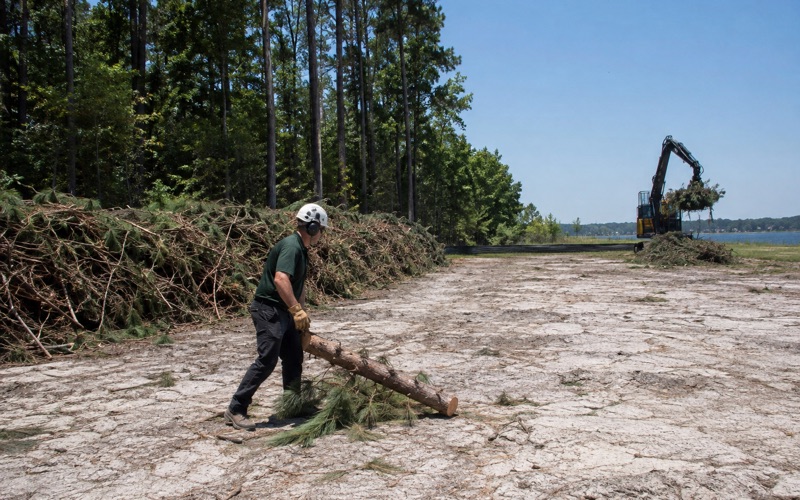
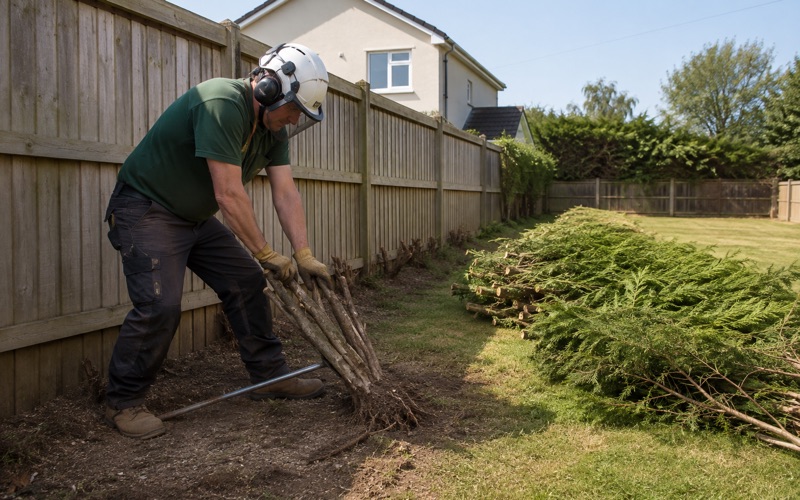
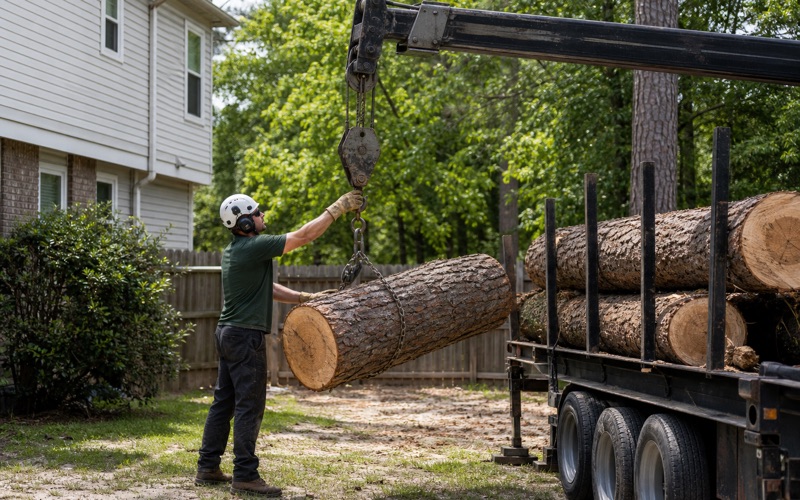
Our crews run compact tracked equipment sized to pass a standard back-yard gate, put lawn and hardscape matting down on every job, and bring a crane in where a tree has no drop zone to fell into. Storm damage gets a 24-hour response, and the same crew that walked the property at the estimate is the one that finishes the rake-out.
A Laurel address on an Anne Arundel County job
Every property here carries a Laurel, MD 20724 mailing address, and has since 1963, when the Postal Service attached that Laurel designation to a wide band of western Anne Arundel County. The incorporated municipality the ZIP is named for sits across the line in the neighboring county, while Maryland City itself is a census-designated place with no municipal government of its own; so is Russett, the 613-acre planned community inside the same boundary whose first phase went up in 1992. Look up 3323 Corridor Marketplace or 3300 Laurel Fort Meade Road and the answer comes back identically every time: Anne Arundel County, no incorporated place.
That distinction stops being trivia the moment a permit is involved, because the wrong jurisdiction means the wrong office, the wrong form and a delayed start. It also catches out contractors from outside the corridor, who read the mailing address and file with a municipality that has no say over the tree.
Who signs off on the work
Grading and sediment control permits come from the Anne Arundel County Department of Inspections and Permits. Where a subdivision, grading permit or sediment control permit covers a site of 40,000 square feet or greater, county Forest Conservation Regulations apply and the review runs through the Development Division of the Office of Planning and Zoning, which is the piece that matters on commercial parcels and multifamily grounds rather than on a single back-yard removal.
Those county regulations carry the Forest Conservation Act down to the parcel, which is why the threshold question on a larger site is never simply how many trees are coming out. Retention areas, a specimen tree flagged by its diameter at breast height, and a Declaration of Intent filed for a qualifying property all shape the plan before a saw is started, and on a development or grading job we get that settled while the estimate is still being written.
A tree whose trunk stands in a public right-of-way is a different animal again, and needs a Roadside Tree Care Permit from the Maryland Department of Natural Resources Forest Service, the same agency that licenses Maryland Licensed Tree Experts. We route that paperwork before we schedule, because the counties and towns we work in each answer differently and a crew standing idle on permit day is nobody’s idea of a fixed price.
Right-of-way that changes hands mid-corridor
Trees standing in the right-of-way of MD 198, MD 175 or MD 32 belong to the Maryland Department of Transportation State Highway Administration, while trees along county roads fall to the Anne Arundel County Department of Public Works, Bureau of Highways. The Baltimore-Washington Parkway frontage south of the MD 175 interchange is maintained by the National Park Service, and the State Highway Administration picks it up north of that interchange, which puts federal parkway land on one side of a single junction and state right-of-way on the other.
Anything touching or threatening an electric distribution line goes to Baltimore Gas and Electric before we touch it, and inside Russett the community association’s covenant and common-area standards apply on top of everything above. We make those calls so a homeowner does not have to.
Looking for tree removal closer to Ilchester? See Tree Removal Services in Ilchester.
Little Patuxent flooding is riverine, not tidal
The Little Patuxent River runs along the western side of the community, and what floods here is fresh water arriving from upstream rather than anything pushed in from the bay. The gauge at Savage has cleared its 10-foot flood stage more than once: it peaked at 15.06 feet on June 3, 2018, with flooding on Brock Bridge Road and Laurel Fort Meade Road, and reached 12.27 feet on December 15, 2018, with water approaching Brock Bridge Road and the fields off Bald Eagle Drive.
Those dates matter to a removal schedule because the ground stays soft long after the water drops. We plan access around that instead of discovering it with a loaded truck.
When a job sits close to the river we stage off pavement, mat the travel path in, and move rounds out in smaller loads rather than sending a heavy truck across ground that looks dry on top. It costs an extra hour and it is the difference between a lawn we rake out and a lawn we owe somebody.
Saturated ground and what it does to equipment
Codorus and Hatboro soils, mapped frequently flooded, and Comus and Codorus soils, mapped occasionally flooded, run along that floodplain. A wheeled chipper or a stump grinder will not travel that ground after a rain, and forcing one across it leaves ruts that cost more to repair than the tree cost to take down.
Away from the river the picture changes, with the center of the community mapping as Christiana-Sassafras-Urban land complex on 5 to 15 percent slopes and Russett-Christiana-Hambrook complexes through much of the rest. Christiana is moderately well drained and Sassafras is well drained, which is why one address dries out in two days and another a few streets over still will not carry a machine.
Fill ground under some root plates
Parts of the community sit on former gravel-pit ground, with “Pits, gravel” and Udorthents on reclaimed gravel pits both mapped inside the boundary. That means fill and disturbed profiles rather than an intact soil horizon under some root plates, and a root plate anchored in fill behaves differently in a wind event than one grown into undisturbed subsoil.
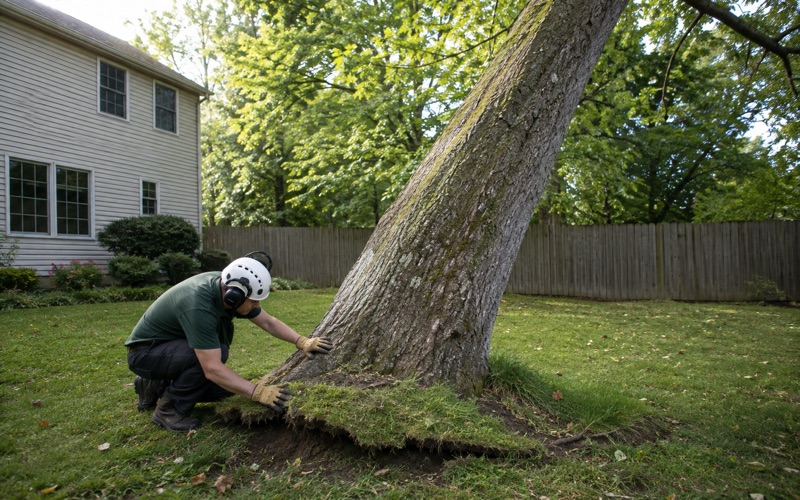
We look for that at the estimate, checking lean, soil heaving on the windward side, and any movement at the root collar after a wet stretch. It is often what decides whether a tree gets a crown reduction and a return visit or comes down now.
Wind events, and the housing stock underneath them
Severe thunderstorm wind is the recurring driver of tree damage here. Trees came down on MD 732 Dorsey Run Road near Brock Bridge Road on July 21, 2020, and on Brock Bridge Road near River Bridge Way on June 21, 2021, both of them roadside failures and both the kind of call our 24-hour storm response exists for.
The community sits in National Weather Service public forecast zone MDZ014, covering Anne Arundel County, forecast out of the Baltimore/Washington office, and that is the zone we watch when a line of storms is moving through. It is also why an emergency call here is usually a wind failure rather than a slow decline that finally gave way.
The housing makes those failures tighter to work than they look from the street. Of 7,586 housing units in the community, 2,823 are single-family attached and 2,347 are single-family detached, so a townhouse row with a shared roofline is the more common backdrop and a clean drop zone is the exception.
Sectional dismantling is the normal method here
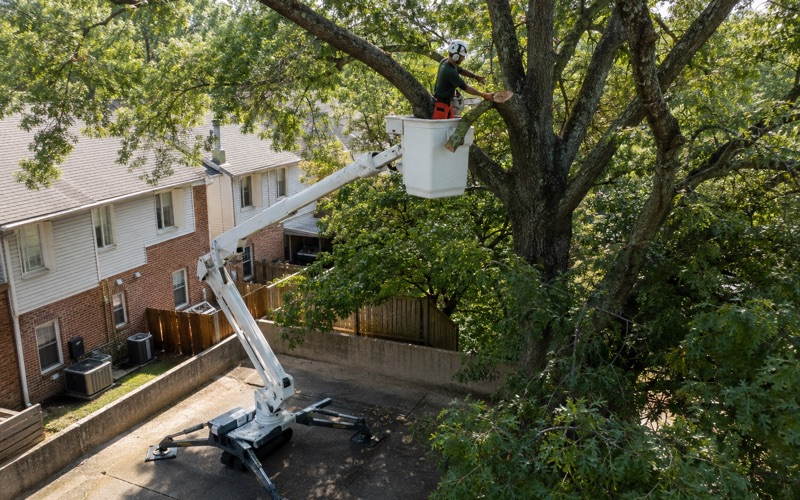
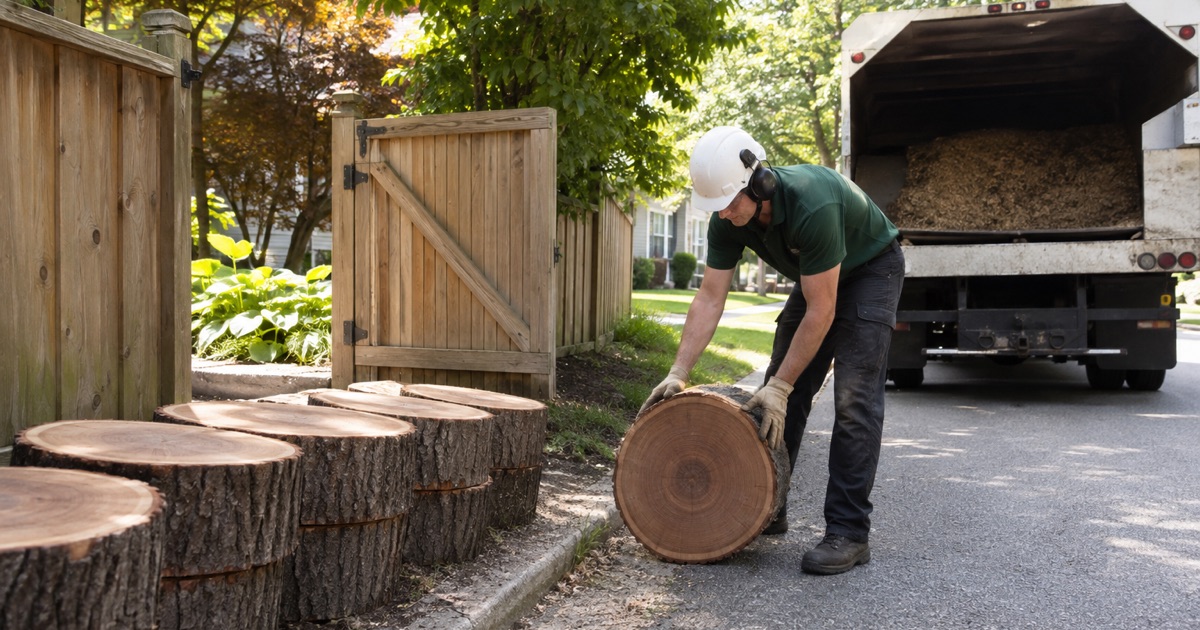
On attached housing we take trees down in pieces, using sectional dismantling with rigging, an aerial lift where the setup allows one, and a crane where there is no drop zone at all and no room to rig into. It is slower per tree than felling, and it is why a removal in a townhouse court quotes differently than the same tree standing on an open lot.
Compact tracked machines matter for the same reason, because a rear yard reached only through a standard gate is normal in the older part of the community, where 1,231 units date to the 1960s and carry mature canopy over small lots. The 2,575 units built between 1990 and 1999 hold younger and more uniform trees, planted closer together.
What we check before recommending removal
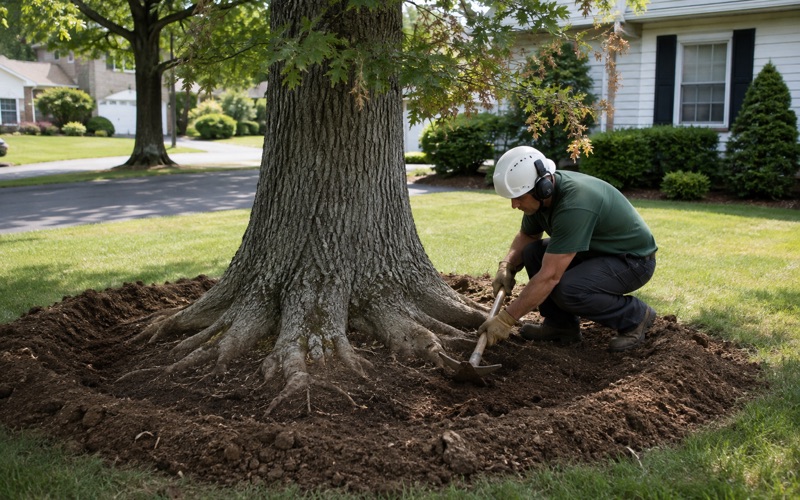
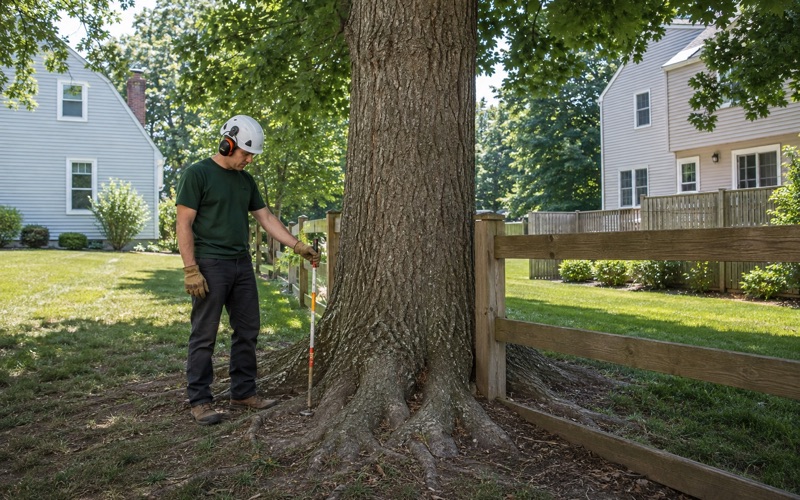
We measure diameter at breast height, look at co-dominant stems for included bark, check deadwood standing over a target, and map the critical root zone against wherever anyone wants to dig. Where the structure is sound and the real problem is load, crown reduction, deadwooding, or cabling and bracing is the honest answer and we say so rather than selling a removal.
Pruning is specified to ANSI A300 and the crew works to ANSI Z133, which is what keeps a rigged section traveling where it was planned rather than through a fence. Whatever we recommend goes on the written scope before anyone commits, and the crew that wrote it is the crew that shows up.
Confirming jurisdiction before we quote
We locate the parcel itself rather than reading the mailing address, because the address says Laurel and the approval says Anne Arundel County, and only one of those puts a crew on site legally. Once the county is confirmed we route whatever permit applies, then schedule, including around the HOA boards, property managers and multifamily grounds staff who need notice before equipment arrives.
A storm call runs the other way around, with the tree secured first and the paperwork chased behind it. If a trunk is resting on a roof or lying across a driveway we get a crew out inside 24 hours, stabilize what is moving, and keep clear of any conductor until the utility has released it.
The estimate visit costs nothing, and neither does a second look at a tree you are unsure about after a storm or a wet week. Call Severn Tree Removal and we will tell you what the tree needs, who has to approve it, and what the ground will allow on the day we come.
- 20+ Years in Anne Arundel County
- Free On-Site Estimates
- 24-Hour Storm Response