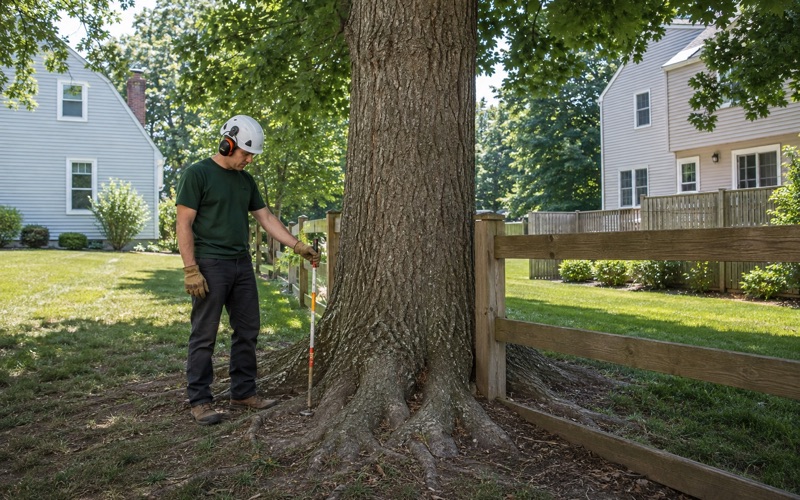
Severn Tree Removal has been doing tree removal in New Carrollton for more than twenty years, and the work here has a shape of its own. Most of what we take down stands on a detached lot with a driveway down one side and a fence line down the other. The rest sits on apartment grounds, where a grounds cycle rather than a storm decides when the crew shows up.
Every job opens with a free on-site estimate and a written scope. The tree, the method, the debris terms and the stump go on paper before anyone is booked, so the number does not move once the chipper is parked on the street.
We also settle the permitting before you go on the calendar. Whether a tree needs a city sign-off, a state permit or nothing at all comes down to where its trunk stands, and that is a question worth answering at the estimate rather than on the morning of the job.
Pepco is the utility over these streets
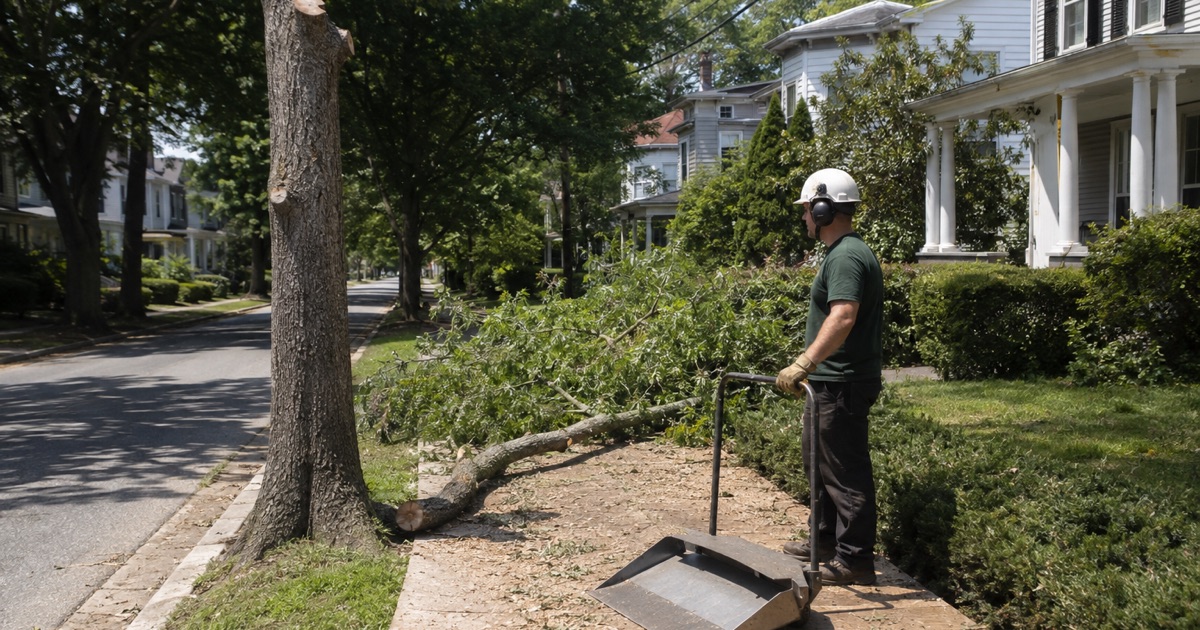
Electric distribution here is Pepco, which serves most of Prince George’s County. That matters the moment a limb comes to rest on a conductor, because the first call is not to a tree company at all.
When a limb is on a line
A tree touching an energized line is the utility’s problem until the utility says otherwise. A downed-line or limb-on-a-line call in New Carrollton goes to Pepco, which handles vegetation management and line clearance on its own distribution system. We do not cut inside a conductor’s clearance zone, and no honest outfit will offer to.
Once the line is cleared, the rest of the tree is ordinary work again, and often urgent: a stem that leaned far enough to reach the wires has usually already lost its footing. Our storm response runs on a 24-hour turnaround for fallen trees, trees resting on a structure and trunks hung up where they should not be.
The service drop is a separate question
The wire running from the pole to your own roof is not the primary line overhead, and crowns grown up around a drop are common on streets this old. Clearing one is a normal part of planning a removal. We point out what is in the way during the estimate and say plainly which parts of it are ours to touch and which are not.
A tree at the curb answers to the state
A tree standing in the public right-of-way is a roadside tree under Maryland law. Trimming, planting or removing one calls for a Roadside Tree Care Permit from the Maryland Department of Natural Resources Forest Service, and the county’s own woodland rules expressly preserve that requirement rather than replacing it.
We pull that permit as part of the job instead of handing you a form and wishing you luck. Permit routing is something we absorbed years ago, because five counties and four towns across our service area answer the same question in four or five different ways.
Looking for tree removal closer to Takoma Park? See Tree Removal Services in Takoma Park.
A 1960s subdivision growing one crop of trees
New Carrollton went up quickly and largely at once. 45.6% of the housing stock dates from the 1960s and 94.0% of it was built before 1980, and that is a planting record as much as a building record.
Whole streets aging on the same clock
When a planned suburb is laid out over a few seasons, the yard trees and the street trees go in together. Sixty years on they reach the same size, drop the same limbs in the same storm, and come due for the same decisions within a couple of years of one another.
That is why one call on a block is so often followed by three more. We would rather walk all of them in one visit and tell you which two need to come down this year and which four have another decade in them; a second look at a tree you are unsure about is free, the same as the first.
Clay under the root plate
The city sits on the Atlantic Coastal Plain east of the fall line, where state geology maps the surface as the Potomac Group, comprising the Patuxent, Arundel Clay and Patapsco formations. The mapped soil at the center of town is the Christiana series, a clayey coastal-plain soil.
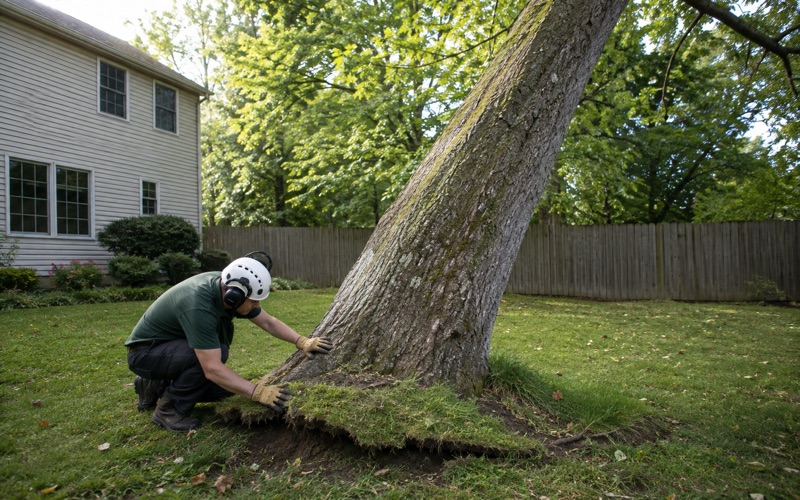
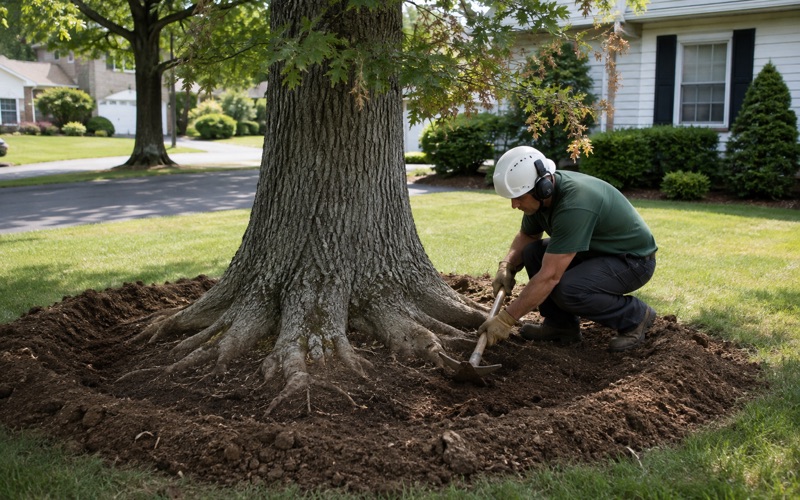
Clay subsoil keeps roots shallow and wide rather than deep, and it holds water. After a long soaking rain the common failure mode here is not a clean trunk break but the whole root plate lifting: windthrow, with the turf peeling up on one side of the trunk.
We read that in a standing tree well before it happens. A raised root collar, a fresh crack in the lawn or a lean that has changed since spring all say the same thing, and loblolly pine, a coastal-plain species that belongs in the local mix, tends to show it early.
What a sixty-year-old crown needs short of removal
Not every tree at this age is a removal. Co-dominant stems with included bark at the union are the defect we find most often on trees set out as saplings when these houses were new, and cabling and bracing can carry one of those for years.
Crown reduction takes weight off an over-extended limb, deadwooding clears what has already died, and crown raising lifts a canopy off a roof line or a driveway. The pruning is done to ANSI A300, and we will say so at the estimate when pruning is the honest answer instead of a removal.
Detached lots on one side, apartment grounds on the other
Of 4,699 housing units in the city, 47.8% are single-family detached and 43.3% sit in buildings of five or more units. Those two halves want quite different things from a tree crew, sometimes on the same block.
Access is a driveway and a side gate
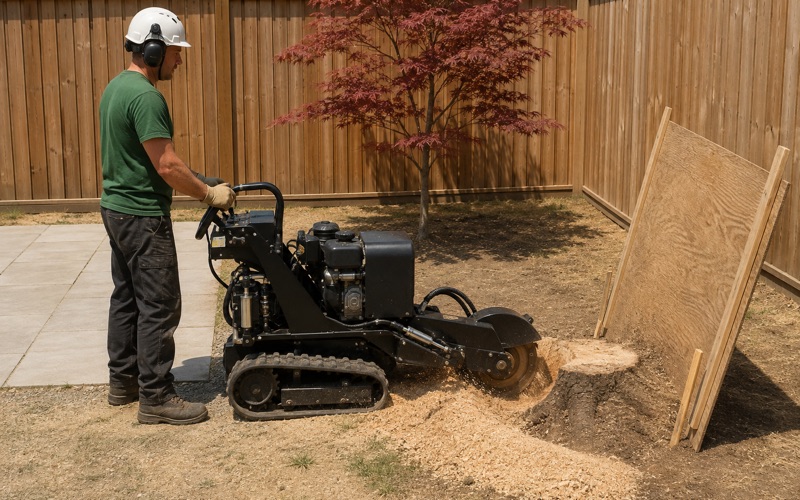
A mid-century detached lot gives us a driveway, a side gate and a back yard, with no shared rear service lane to work from. Our compact tracked equipment is sized to pass a standard back-yard gate, which is what lets a machine reach a tree behind the house instead of a crew hauling every round out by hand.
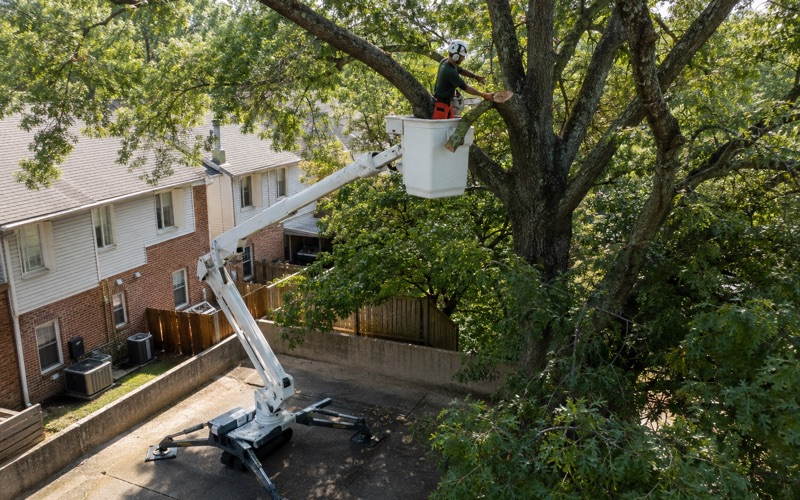
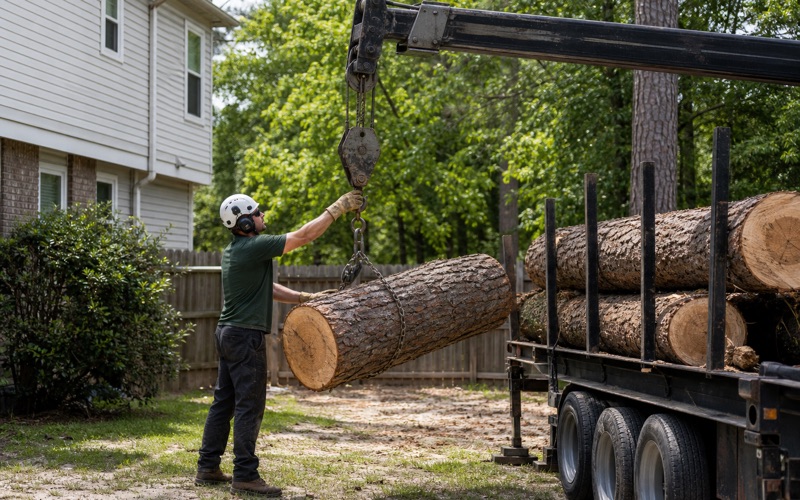
Where there is genuinely no drop zone left, with a stem boxed in by a house, a shed and a fence, we bring a crane and take the tree apart in sections rather than trying to fell it. Lawn and hardscape protection matting goes down on every job either way.
Almost no townhouse rows to work in
Attached single-family housing is effectively absent here, at 0.6% of the stock against 47.8% detached. That near-zero is a finding rather than a gap: the same census tables that record a large apartment share for this city record attached units at well under one percent.
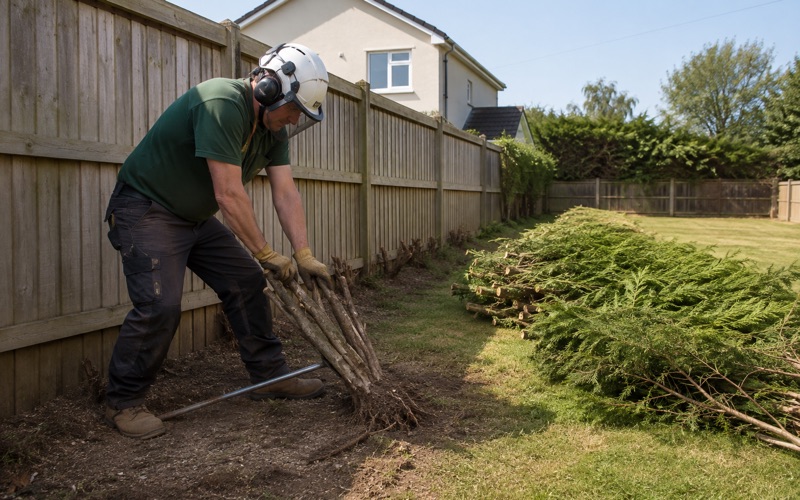
It changes the job in a practical way. Nobody here needs rear-alley staging or party-wall rigging planned for them. What we plan around instead is a detached house, its neighbors close on both sides, and a fence line we would rather not take apart to get a chipper through.
Two different calls on the same street
A homeowner usually calls after something has happened: a limb down, a lean that got worse overnight, a stem hanging over the roof. The work is one tree, priced once, and the questions are what it costs and how soon we can be there.
The apartment side of the city buys on a cycle instead. Grounds staff and boards work to a budget year, want the whole site walked in one pass, and need dates that do not collide with residents’ parking. We build schedules around HOA boards, managers and multifamily grounds, because that is close to half of what this city is.
Permits, licensing and what a removal includes
Three separate authorities can have a say about one tree in New Carrollton. Which of them applies depends entirely on where the trunk stands, and we work that out before scheduling rather than after.
Your tree, the City’s tree, and the tree at the curb
A tree standing in your own yard is yours to remove. A tree on City property is not: the city’s code requires written permission from both the Maryland Department of Natural Resources and the City Public Works Director before it is removed or destroyed, and before construction that would significantly and permanently detract from its health or growth.
The City also keeps an official street tree list approved by the City Council, and requires that street tree stumps be taken below the surface so the top of the stump does not project above grade. A violation is a municipal infraction carrying $1,000. It is a short chapter, and worth reading before anyone touches a tree near the curb line.
When the county’s woodland rules come into it
Prince George’s County’s woodland conservation ordinance is triggered by applications, building, subdivision, zoning and grading, rather than by a homeowner deciding a yard tree has to go. A regulated application needs a Type 1 or Type 2 Tree Conservation Plan, or a Standard Letter of Exemption, and the exemption decision is issued within 20 calendar days.
The county’s separate canopy requirement sets a minimum of 20% of net tract area in the residential zones and 15% in the commercial and industrial ones, and it expressly exempts any permit pertaining to an existing single-family detached home. In a city built this heavily of detached houses, that carve-out covers a great deal of the property in it.
Where the rules do apply, size decides how carefully. The county defines a specimen tree as one of 30 inches diameter at breast height or more, or 75% or more of the diameter of the current champion of that species. We measure before quoting rather than after, and we use the county’s own figure rather than importing a threshold from a neighboring jurisdiction.
Licensed work and a written scope
Anyone doing tree work for hire in Maryland has to hold, or work under the supervision of, a Maryland Licensed Tree Expert, and that license number belongs on the written contract. Ask for it. It is the quickest way to tell a real company from a truck and a chainsaw circling the neighborhood after a storm.
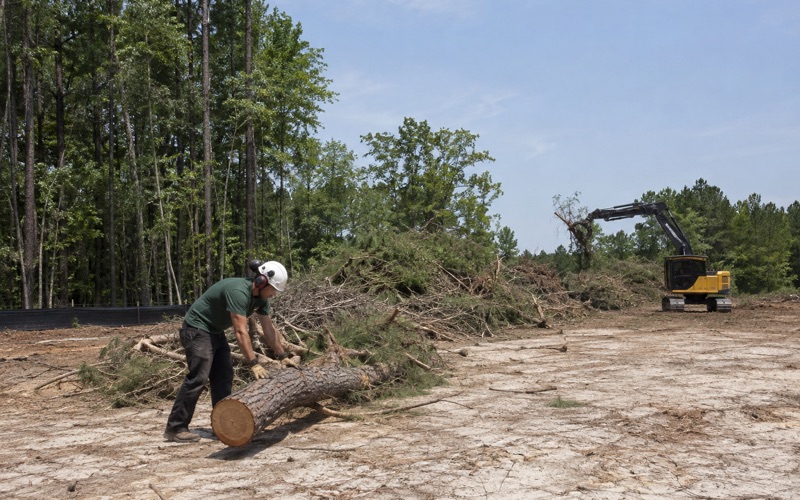
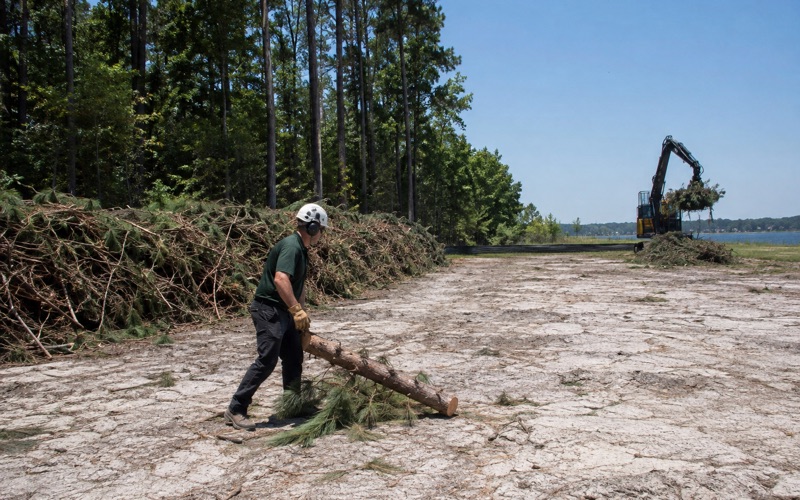
Our removals are written the same way every time: brush chipped, trunk rounds cut to length and stacked or hauled, stump and grindings settled up front rather than argued over at the end. The crew that walks the property with you at the estimate is the crew that does the final rake-out.
- 20+ Years in Anne Arundel County
- Free On-Site Estimates
- 24-Hour Storm Response