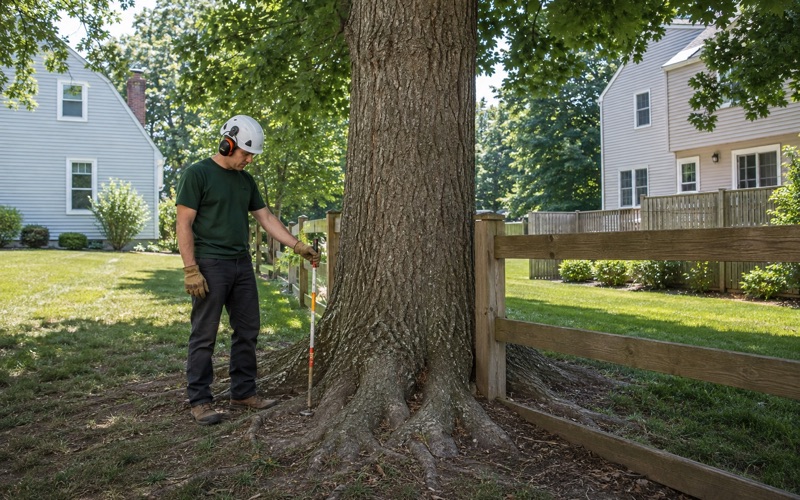
Severn Tree Removal has handled tree removal in North Laurel for more than 20 years, and the fact that governs the work here is when the housing went in rather than anything about the trees themselves. This is not a place with a scattering of very old survivors and a lot of young replacements around them. The big trees mostly arrived together, and they are coming due together.
Every job opens with a free on-site estimate and a written scope before a crew is booked: which trees, which method, and exactly what leaves the property. Brush chipped, trunk rounds, the stump and the grindings are all settled in that document rather than argued about on the day.
The crew that walks the property at the estimate is the crew that finishes the rake-out. We route permits before we put a date on the calendar, because five counties and four towns answer the same question differently, and North Laurel’s answer catches people out.
The Largest Trees Here Came In With the 1970s
The oldest housing in North Laurel is not old by East Coast standards, and that puts a ceiling on what any tree on a residential lot can be. Knowing where the ceiling sits changes how a removal is rigged and what it costs.
One decade carries 14.0% of the units
The 1970s are a real presence in North Laurel at 14.0% of housing units, and that is the oldest substantial cohort in the community. Only 3.5% of units were built before 1960, and 21.9% of the stock went up before 1980; the decades that follow are larger by share but their canopy is correspondingly younger, at 21.3% in the 1980s, 19.1% in the 1990s and 25.6% in the 2000s.
So the biggest specimen on a given street is usually a tree that was planted, or left standing, when a 1970s subdivision was graded. It is a fifty-year-old tree in a landscape where almost nothing is older, which makes it both the largest liability on the block and the hardest thing to replace.
What fifty years of growth means at the trunk
Five decades puts a red oak or a tulip poplar well past the diameter at breast height where a straightforward fell makes sense on a subdivision lot. The wood is heavy, the crown is wide, and there is rarely a drop zone that does not contain a roof, a fence line or a driveway.
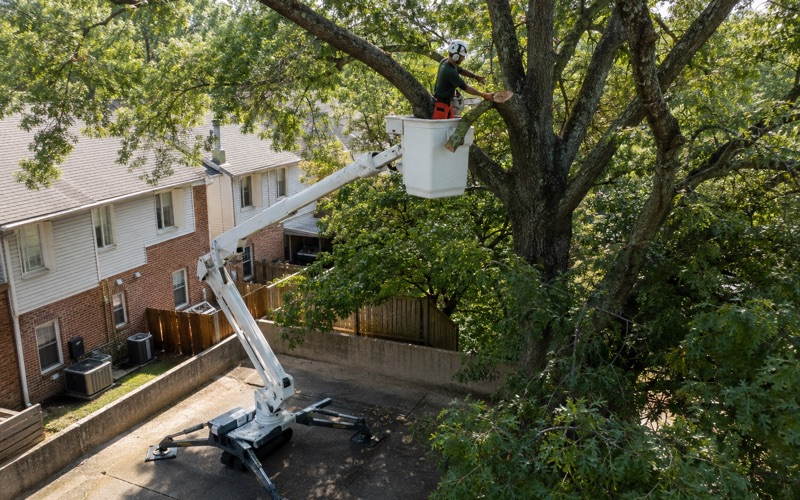
Most of what we do on this cohort is therefore sectional dismantling, with the tree coming down in controlled pieces rigged off the stem and an aerial lift set where the approach allows one. Where there is no drop zone at all, a crane is the answer, and it puts less load on the ground than an afternoon of repeated rigging.
Reading the defects this cohort tends to carry
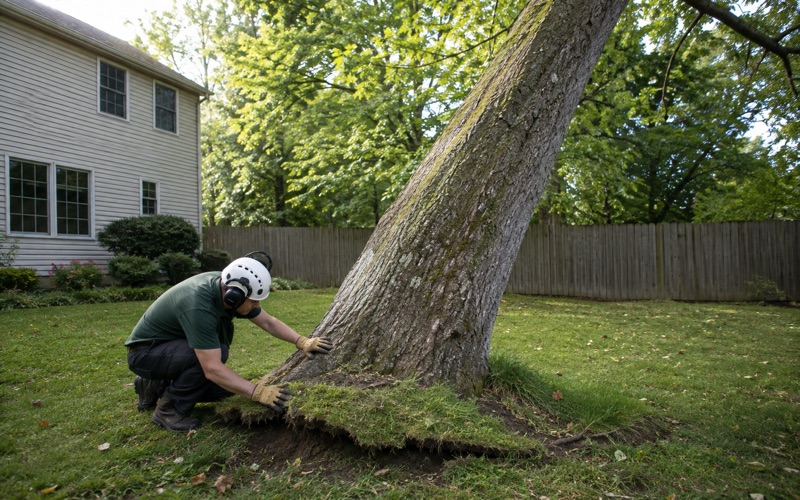
A tree that has spent fifty years in an open lawn grows differently from one that came up in a woodlot. We look first at co-dominant stems with included bark at the union, because that is the failure that drops half a canopy onto a structure with no warning at all.
Root collar excavation, sometimes with an air spade, tells us whether the root plate was buried during grading or has been girdled since. Our ISA Certified Arborist assessment separates a tree that needs pruning from one that needs removing, and we would rather establish that at the estimate than halfway through a job.
Looking for tree removal closer to Crofton? See Tree Removal Services in Crofton.
Removal Size Arriving Across a Whole Street
Because the trees went in together, they reach the size and the condition that force a decision together. Neighbors on one block often call within the same season, and that shapes both access and scheduling.
One planting date, one failure window
A street of same-age trees does not fail in a tidy sequence, one at a time. The same storm loads them the same way, the same dry summer stresses them the same way, and the epicormic shoots that follow a hard year show up along the whole row at once.
We would rather look at a block than a single tree. When an HOA board or a property manager asks us to walk a street, we can sequence removals over two or three visits, cut the equipment moves down, and tell individual owners which trees genuinely have years left in them.
Access on attached rows
Attached single-family units are 37.2% of North Laurel’s stock and detached houses 31.0%, so machine width rather than machine power is usually the binding constraint. A standard stump grinder needs a gate roughly 35 inches wide to reach a townhouse back yard, and plenty of rear gates in these rows are narrower than that.
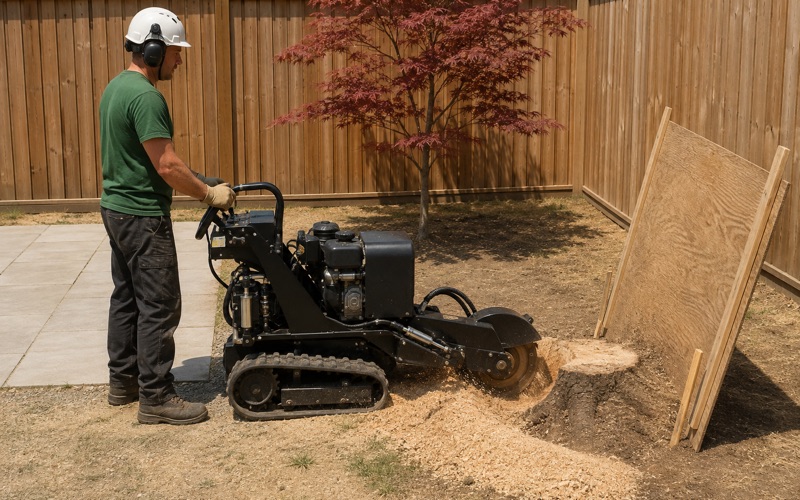
Our compact tracked equipment is sized to pass a standard back-yard gate, which is the difference between grinding a stump and digging one out by hand. Where a machine still will not fit, we say so at the estimate and price the alternative then, rather than discovering it with a crew already standing in the driveway.
Ground that decides where the machine sits
Surface geology across the community samples as 38.6% Sykesville Formation gneiss and 19.3% Baltimore Complex metagabbro and gabbro, which give hard, shallow crystalline ground, alongside 41.2% Cretaceous Patuxent, Arundel Clay and Patapsco formations, which give soft sand and clay instead. North Laurel sits 98.5% within the Piedmont Plateau Province, just on the upland side of the Fall Line, with a narrow 1.5% strip of Atlantic Coastal Plain along its southeastern edge.
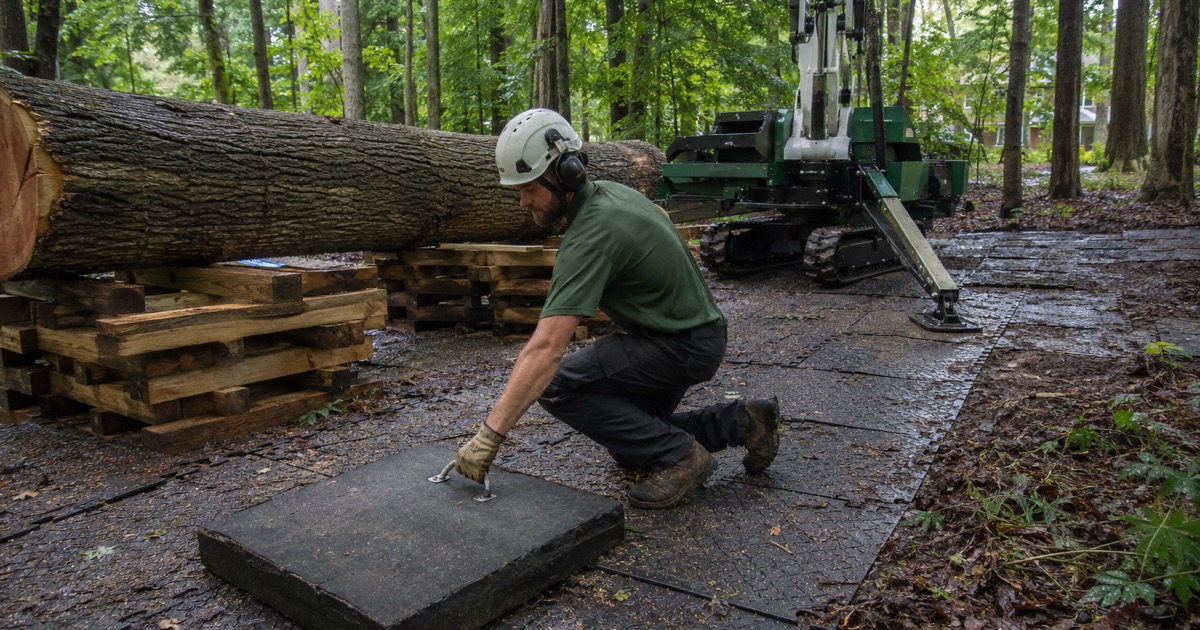
Arundel Clay is heavy and poorly drained, so where it surfaces the ground stays saturated for days after rain. That limits where a crane or a chipper can be set, and it raises windthrow risk on shallow-rooted trees, which is one more reason an even-aged row can go over in a single event. Lawn and hardscape protection matting goes down on every job regardless of what the ground is doing.
A Laurel Mailing Address, a Howard County Rulebook
North Laurel is a census-designated place in Howard County, adjacent to the incorporated municipality of the same name across the Patuxent River in Prince George’s County. The mail says Laurel; the permits do not.
Who actually signs off
Municipal tree ordinances from across the river do not reach a property here. Clearing tied to subdivision, development or grading is reviewed by the Howard County Department of Planning and Zoning, which is also the office that accepts a Declaration of Intent.
Building, grading and demolition permits come from the Howard County Department of Inspections, Licenses and Permits. Trees in the county road right-of-way, including limb elevation, dead tree removal, storm limb clearance and stump grinding, belong to the Bureau of Highways Tree Division at the Department of Public Works, reachable at 410-313-7450 in business hours.
Licensing is answered at the state level rather than the county one. Maryland Natural Resources Article section 5-417(a)(1) requires a Maryland Licensed Tree Expert license to do tree work for hire, and COMAR 08.07.07.03D requires a written contract carrying that license number, which is one reason our scope is on paper before anything is scheduled.
Roadside trees and the state permit
A Roadside Tree Care Permit from the Maryland Department of Natural Resources Forest Service turns on where the trunk stands in the public right-of-way, not on who planted the tree or who mows around it. Natural Resources Article section 5-406(d) bars a county or municipality from issuing a building permit until that permit is obtained, and the penalties run $2,000 and $5,000.
There is an emergency exception for a genuine hazard, and it carries a one-week reporting duty under COMAR 08.07.02.03C. Trees inside the state highway right-of-way answer to the State Highway Administration, and vegetation on Baltimore Gas and Electric’s own distribution circuits is handled under its Vegetation Management Plan.
Forest conservation, and where it stops
Howard County’s Forest Conservation Manual states plainly that “The Forest Conservation Act is not a tree preservation act.” Development activity on a single lot smaller than 40,000 square feet is exempt outright under Section 16.1202(b), unless that area already sits under an approved Forest Conservation Plan.
In practice an ordinary homeowner removal here is not a forest conservation matter, though a recorded easement on a subdivision does persist and has to be deducted from net tract area where one exists. One question does not arise at all: no part of the North Laurel CDP lies within the Chesapeake Bay Critical Area, since a polygon intersect against the state layer returned zero features and the Patuxent is non-tidal at this point.
Working Ahead of the Cohort Instead of Behind It
The useful thing about an even-aged canopy is that it is predictable. If the big trees on a street went in together, the decisions can be staged deliberately instead of arriving as a run of emergencies.
Staging removals rather than reacting to them
Not every fifty-year-old tree needs to come down this year. Crown reduction, crown thinning and deadwooding buy real time on a sound stem, and cabling and bracing will hold a co-dominant union that is not yet splitting.
We prune to ANSI A300 and rig to ANSI Z133, and we will say when a tree is worth keeping. A second look at a tree you are unsure about costs nothing, which is how most of the staged plans on these blocks start.
Ash on a three-year clock
Emerald ash borer has been established in Maryland since 2003 and kills a large ash in roughly three years, leaving brittle standing deadwood that is considerably more dangerous to dismantle than live timber. No statewide ash mortality percentage is published, and the federal quarantine was removed in 2020.
An ash planted with a 1970s street is now big enough that taking it down early and taking it down dead are two different jobs at two different prices. We would rather remove it while the wood still holds a rigging point.
Storms, and the queue that follows them
North Laurel sits in NWS forecast zone MDZ506, Central and Southeast Howard, under the Baltimore/Washington forecast office. We hold 24-hour response for storm damage, fallen trees and trees resting on a structure, with crews who work this region’s storm season and its species year-round.
Report a downed line to BGE at 1-877-778-2222 and a limb on a line at 1-800-685-0123; the utility’s duties under COMAR 20.50.12.09 do not extend to removing the wood afterward. On the county side, the Tree Division notes that right-of-way stump grinding “may take up to a year, depending on the current workload and backlog”, which is worth knowing before you plan around it.
- 20+ Years in Anne Arundel County
- Free On-Site Estimates
- 24-Hour Storm Response