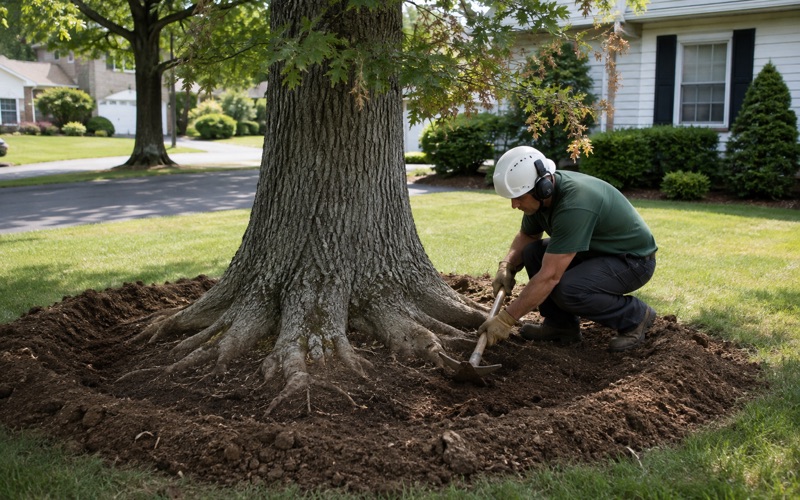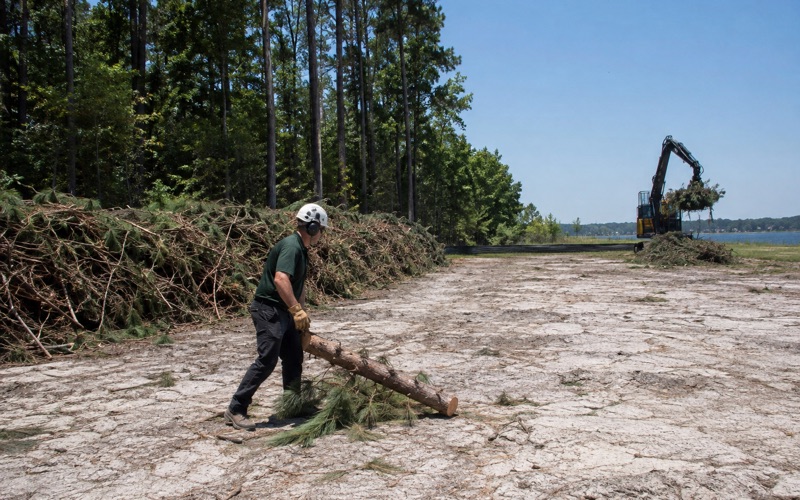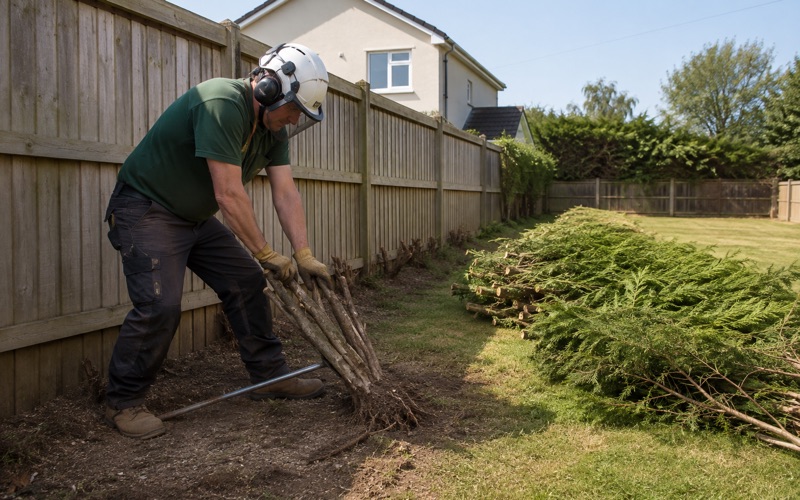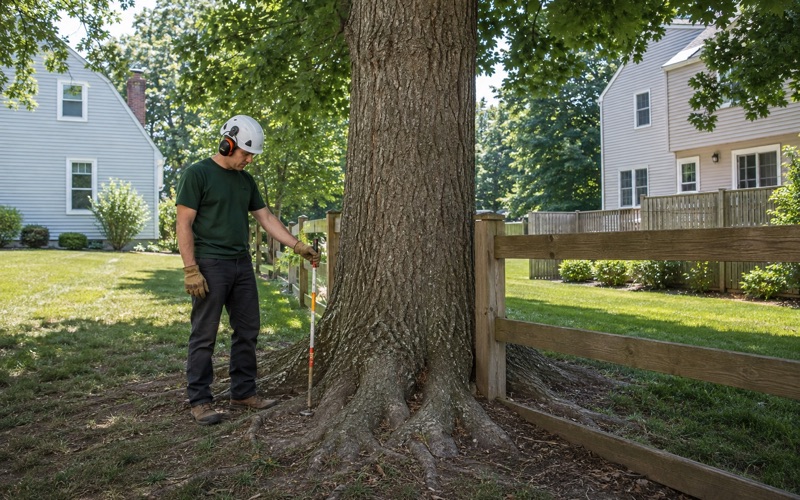
Severn Tree Removal has handled tree removal in Savage for more than 20 years, and the first thing we settle on a Savage estimate is which half of the community the address sits in. That answer changes the access plan, the approvals and the price, and it changes all three before a saw comes off the truck.
Every removal we quote starts as a free on-site visit with the scope written down: what comes down, how it leaves the property, and what is left where the tree stood. Brush chipped, trunk rounds, stump grinding and the grindings themselves are settled in writing before a crew is booked, so none of the finish is left to interpretation.
We also route the permits ahead of scheduling rather than after, because the paperwork behind a Savage removal is not the same on every street here. Storm work runs on a 24-hour response, and a tree resting on a roof, a fence or a parked car gets looked at the day it is called in.
Two Savages inside one census-designated place
Savage is a single unincorporated community in Howard County, but its housing stock is two distinct eras sitting side by side. Roughly 11.7% of units here predate 1940 and 27.2% predate 1960, while 37.3% went up during the 1980s and 38.2% of the stock dates to 1979 or earlier. The trees follow the houses.
The pre-1940 mill village
The older half is the village that grew up around Savage Mill, which dates from about 1816; the mill complex and the workers’ housing to its north were listed on the National Register as the Savage Mill Historic District in February 1975. Lots there are small, streets are narrow, and houses sit close to the pavement and to each other.
The trees on those lots have had a century or more to size up on ground platted long before anyone planned for a bucket truck. A maple or an oak that has stood since the village’s mill years usually shows co-dominant stems, included bark at the union, and a good deal of interior deadwood by the time we are asked to look at it.
The 1980s subdivision next door
The other half went in during the 1980s on later-platted ground, and its canopy was planted rather than inherited. Those trees are around forty years old now, which is old enough to reach a roofline and young enough that the structural problems in them are often still correctable.
That gap changes what we recommend. On the newer side a crown reduction, some deadwooding, or cabling and bracing across a weak union will frequently buy another decade; in the village, a tree at the end of its structural life is usually past the point where any of that is honest advice.
Telling which half your address sits in
You rarely need a map to sort them out. The village reads as short setbacks, on-street parking and close-set frontages, while the subdivision reads as driveways, side-yard clearance and room to swing a boom, and we confirm which one we are working in at the estimate because they produce different rigging plans.
It is also worth knowing that a good share of the canopy people picture when they think of Savage is not on private property at all. The Little Patuxent River runs through the community with steep valley walls, and Savage Park carries much of that tree cover on public land, which is nobody’s private removal to authorize.
Looking for tree removal closer to Brooklyn Park? See Tree Removal in Brooklyn Park.
Removals in the mill village
In the old village the constraint is almost never the tree. It is everything around the tree: what can reach it, where the wood can be set down, and how much of the street a crew is allowed to occupy while doing it.
Getting equipment to the tree
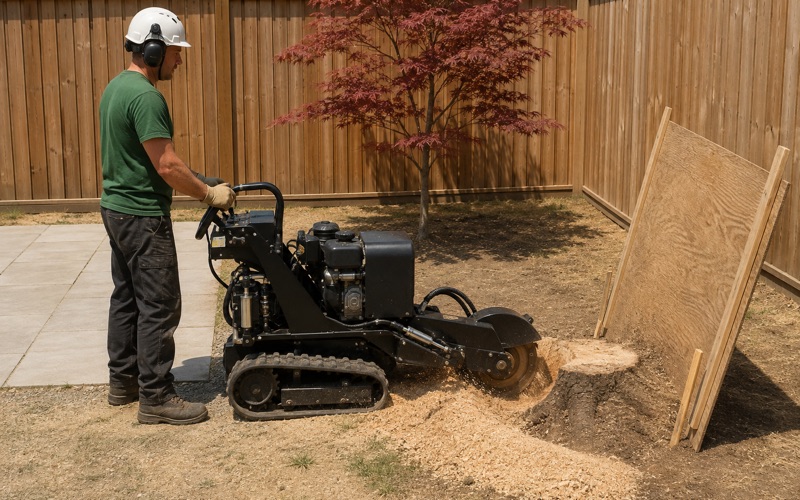
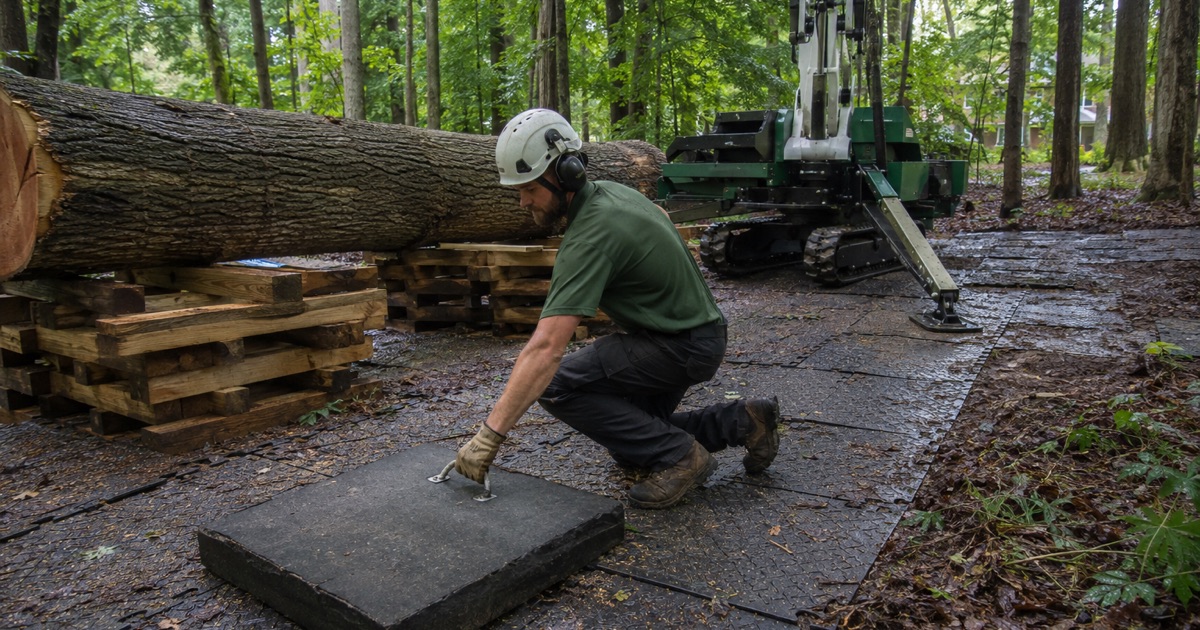
Narrow streets, short setbacks and parked cars mean crane and bucket-truck siting is frequently the limiting factor on a village job. We size the machine to the property rather than the other way around, and our compact tracked equipment is built to pass a standard back-yard gate.
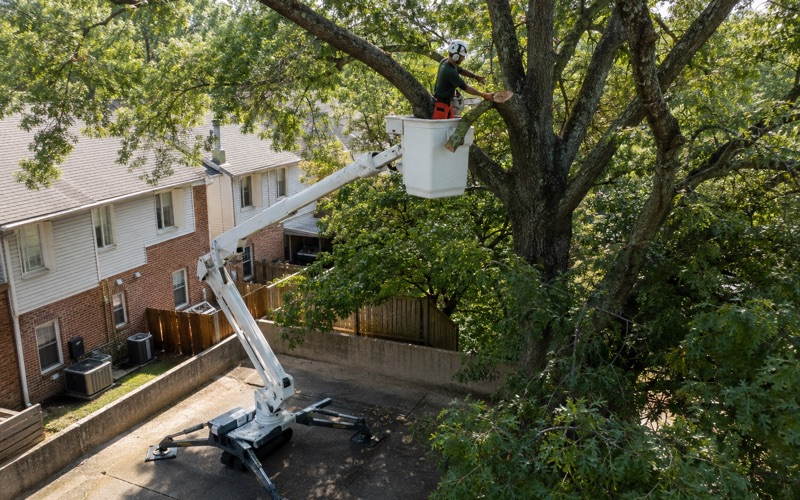
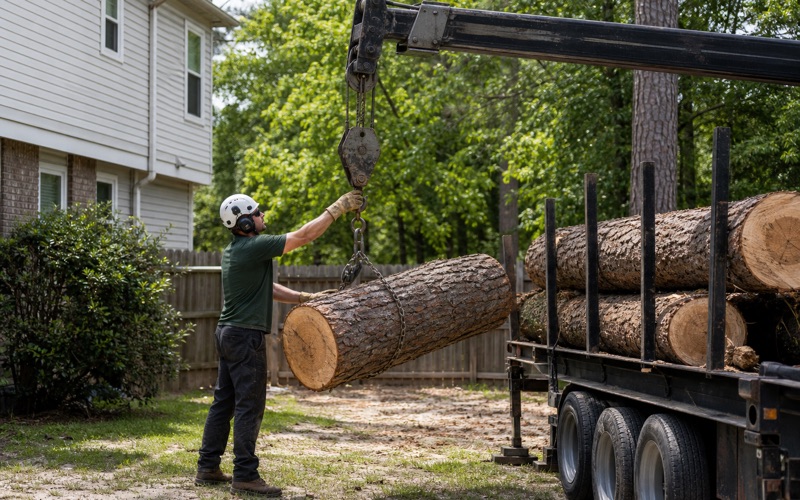
Where a rear-yard tree can only be reached through that gate, the removal becomes a sectional dismantle on rigging lines instead of a fell. Where there is no drop zone at all — and in the village there frequently is not — we bring a crane and lift each section out over the roofline to a set-down point at the curb.
Historic review and the trees near the buildings
Exterior alterations to contributing properties inside the locally regulated historic area covering the mill village are reviewed by the Howard County Historic Preservation Commission. A removal is not automatically an exterior alteration, but on a contributing property that is a question worth answering before a date is set, and we handle that routing as part of the estimate.
Howard County’s Forest Conservation Manual is explicit that individual trees are protected under the program only in narrow cases, one of which is trees associated with historic structures. That is the exception most likely to surface anywhere in Savage, and where it surfaces is here rather than in the subdivision.
What the written scope covers
Our estimate names the tree by species and diameter at breast height, the method, the drop or lift point, and the condition of the ground the machine will cross. On a small village lot we also note where a neighboring tree’s critical root zone falls, because tracking a machine over it is a slower problem to fix than a bent fence panel.
Lawn and hardscape protection matting goes down on every job, which counts for more on a lot where the crew, the machine and the wood are all sharing the same twenty feet. The same crew that walked the property at the estimate is the crew that finishes the rake-out.
The 1980s subdivision and the trees planted with it
The newer half of Savage was landscaped in one push, so a great deal of its canopy shares an age, a short species list and a set of problems that arrive on the same schedule. Detached single-family homes are 47.2% of Savage’s units and attached single-family another 21.5%, and 58.6% of the 3,007 occupied units are owner-occupied.
A planted canopy reaching forty
A tree planted with a house in 1985 is now over the roof it was meant to frame, and the first sign is usually a limb on the gutter rather than anything visible at the trunk. We would rather be called at that stage, when the choice is still between a reduction and a removal.
Another 20.4% of Savage’s units sit in structures of 10 to 19 units, and that work runs on a different clock. We schedule around HOA boards, property managers and grounds staff, with the access windows and the resident notice agreed before the trucks arrive.
Ash and Callery pear
Emerald ash borer has been established in Maryland since 2003 and kills a large ash in about three years, leaving brittle standing deadwood behind it. A dead ash does not come apart like a live one, because the wood fails without warning under a climber’s weight, so those come down from an aerial lift or a crane instead.
Callery pear — the Bradford pear planted heavily through subdivisions built in the 1990s and 2000s — is prohibited for sale in Maryland from January 15, 2026. It fails at its co-dominant unions under wet snow with no warning at all, which makes it a tree worth removing on a chosen date rather than an unchosen one.
Why stump grinding is not one price across Savage
All of Savage sits in the Piedmont Plateau Province, upland of the Fall Line, but the surface geology inside the CDP is close to evenly split: about 50.1% Baltimore Complex metagabbro, gabbro and amphibolite, and 46.2% Cretaceous Patuxent, Arundel Clay and Patapsco sand, gravel and clay. That is hard crystalline rock and soft ground inside one small community.
The split shows up twice on a job. It governs how a stump grinder works down through a root plate, and it governs how that root plate behaved while the tree was still standing in wind, which is why we look at the ground before quoting the grinding rather than pricing it off stump diameter alone.
Permits, approvals and the 40,000 square foot threshold
Most of what people expect to be complicated about removing a tree in Savage turns out not to be, and the reason is a single threshold in the county code. The parts that are complicated are the ones nobody expects.
Why the threshold clears the old lots
Howard County exempts development activities on single lots smaller than 40,000 square feet from the forest conservation program, provided the area is not already subject to an approved Forest Conservation Plan, under Section 16.1202(b). Virtually every lot in the pre-1940 village falls far below that figure, so an ordinary homeowner removal there does not enter the program at all.
The exemption turns on the lot, not on the era, so on the subdivision side it is something we check rather than assume. Clearing tied to subdivision, development or grading is reviewed by the Howard County Department of Planning and Zoning, which is also where a Declaration of Intent is accepted, and we establish which reading applies to your address before scheduling.
Roadside trees and the state permit
The Maryland Roadside Tree Law turns on where the trunk stands, not on who planted the tree. If it stands in the public right-of-way, a Roadside Tree Care Permit from the Maryland Department of Natural Resources Forest Service is required, and Natural Resources Article Section 5-406(d) bars the county from issuing a building permit until that permit is obtained.
Building, grading and demolition permits themselves come from the Howard County Department of Inspections, Licenses and Permits, and trees inside a state highway right-of-way belong to the Maryland Department of Transportation State Highway Administration. One approval Savage never needs: no part of the CDP lies within the Chesapeake Bay Critical Area, because the Little Patuxent is non-tidal here.
County trees, utility lines and licensing
Dead trees in the county right-of-way are removed by the Howard County Department of Public Works, Bureau of Highways Tree Division, at 410-313-7450 during business hours; the county notes that its stump grinding may take up to a year depending on current workload and backlog. Anything touching a wire is Baltimore Gas and Electric’s, which holds vegetation-management duties under COMAR 20.50.12.09 and is not responsible for hauling the wood away.
Report a downed line to BGE at 1-877-778-2222 and a limb resting on a line at 1-800-685-0123, and treat both as reasons to stay well back rather than to look closer. We will work alongside a utility clearance where one is scheduled, but we do not cut a tree that is still in contact with an energized conductor.
Tree work for hire anywhere in Maryland requires a Maryland Licensed Tree Expert under Natural Resources Article Section 5-417(a)(1), and COMAR 08.07.07.03D requires a written contract carrying that license number. Ask for it here and ask for it anywhere else in the state; ours carries it, our crews work under Licensed Tree Expert supervision, and every cut and every climb follows ANSI A300 and ANSI Z133.
- 20+ Years in Anne Arundel County
- Free On-Site Estimates
- 24-Hour Storm Response