Severn Tree Removal has handled tree removal in Scaggsville for more than 20 years, and the first thing we tell a homeowner here is that the ground decides how a tree comes down. Every estimate we write starts at the base of the trunk, not at the roof it is leaning over. That visit costs nothing, and the scope is written down before a crew is booked.
Most of the removal calls we take in this community are not about a dead stem. They are about a sound, healthy tree that has started to move, and movement here announces itself at ground level rather than in the canopy. We would far rather look at that early than clear it off a driveway later.
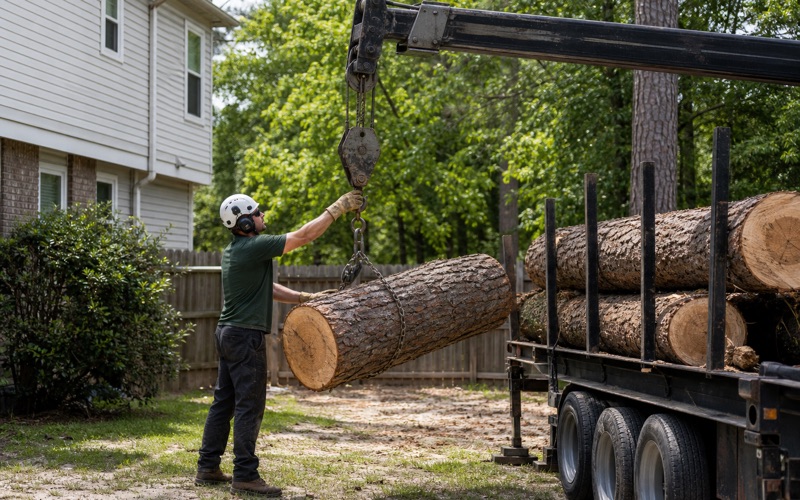
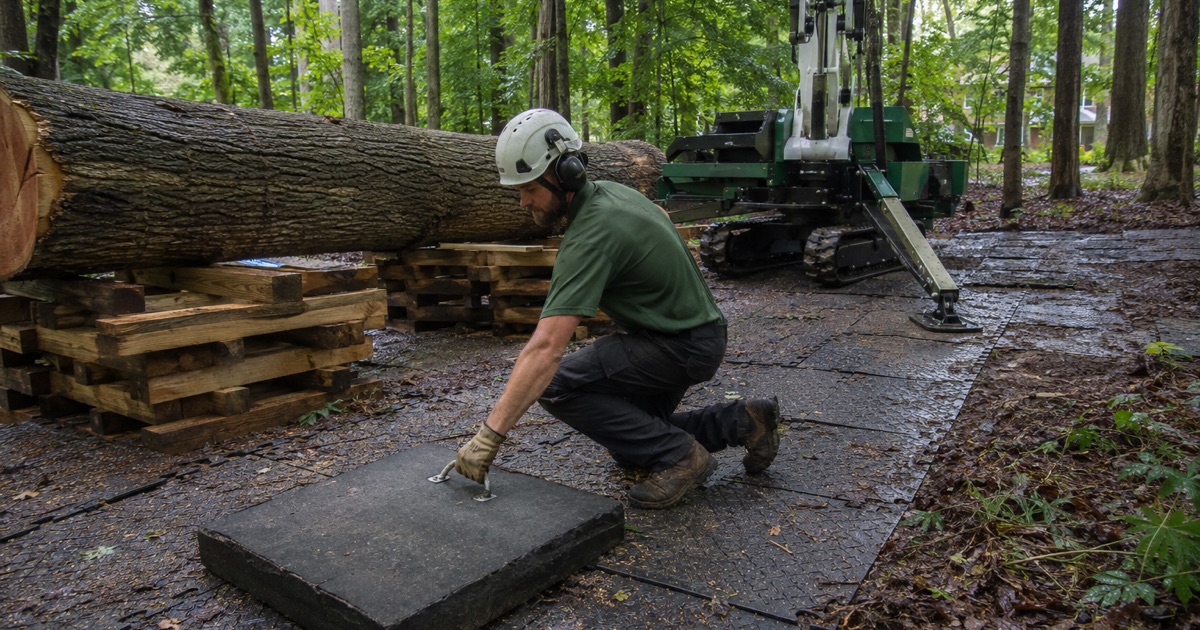
Our crews run compact tracked equipment sized to pass a standard back-yard gate, protection matting for lawn and hardscape, and crane-assisted removal where there is no drop zone to fell into. The same crew that walks the property with you does the cutting and the final rake-out. Storm damage, fallen trees and trees resting on a structure get a response inside 24 hours.
What Sits 19 to 33 Inches Under a Scaggsville Yard
The mapped soil across this community is Glenville-Baile silt loams on 0 to 8 percent slopes, formed in loamy colluvium weathered from phyllite and schist. It is a water-holding profile rather than a shedding one: 54.9 percent silt, a silt loam surface, a K factor of .43 and a high frost action rating. Those numbers describe ground that stays damp and moves with the seasons.
Glenville silt loam and the depth roots will not cross
The Glenville series is classified as an Aquic Fragiudult, and its defining feature is the fragipan — a dense zone running from 19 to 33 inches with a consistence that is firm or very firm and brittle. Roots reach it and stop. Everything a mature tree has for anchorage is developed above that depth.
This is not stone, and it is not a shelf of anything hard. It is soil that has become tight and brittle enough that roots cannot work their way into it, and water behaves much the same way, perching above the pan instead of draining down through it.
A root plate instead of a root system
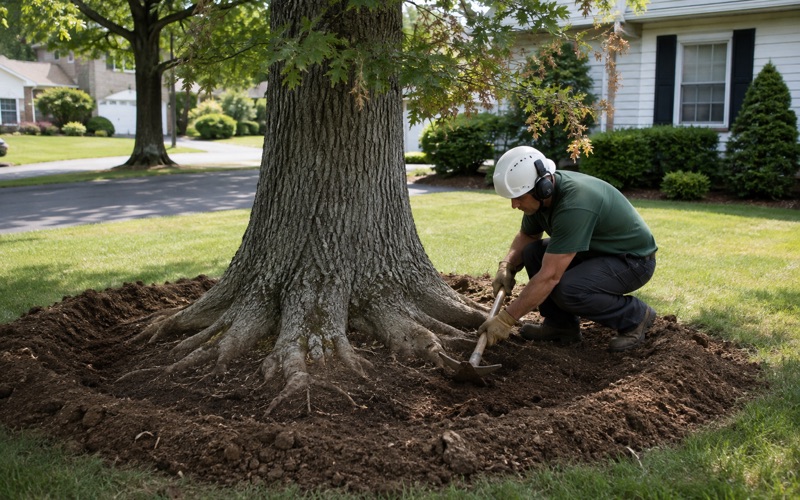
When a tree can only root in the upper foot and a half of soil, what it builds is a plate: a wide, flat disc of roots and held soil that functions like a footing. On a deep, well-drained profile the same species would push structural roots much further down and gain a completely different kind of hold.
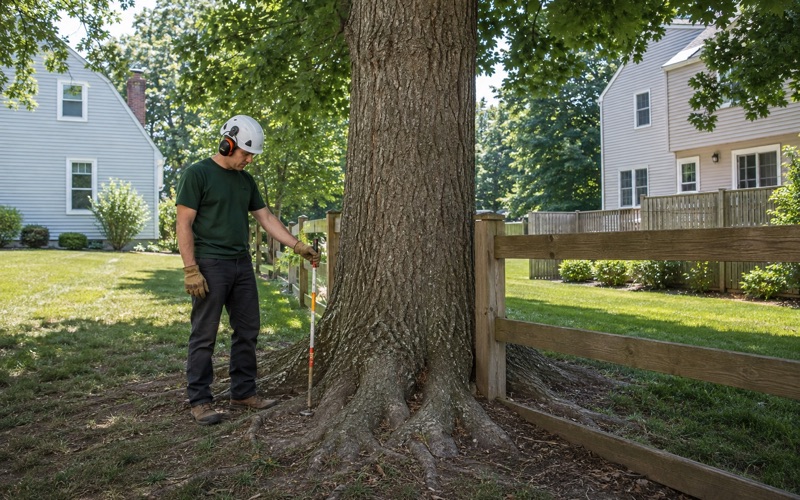
Diameter at breast height tells us what is standing above ground. On this soil we are equally interested in what the critical root zone has to work with, because two trees of identical size can behave very differently depending on where the pan falls beneath them.
The wet half of the same map unit
Baile is the other component of that map unit, a poorly drained Typic Endoaquult that sits in upland depressions and on footslopes. It formed in silty local alluvium over residuum from mica schist and gneiss, it meets hydric soil criteria, and pin oak, birch, red maple and holly are its native company.
In practice a single property can carry both. A crew may work a firm pan at the front of a lot and a soft, wet depression at the back, so the access plan has to account for both before anything is driven across the yard.
Looking for tree removal closer to West Laurel? See West Laurel Tree Removal.
Why Trees Here Come Out Whole Instead of Snapping
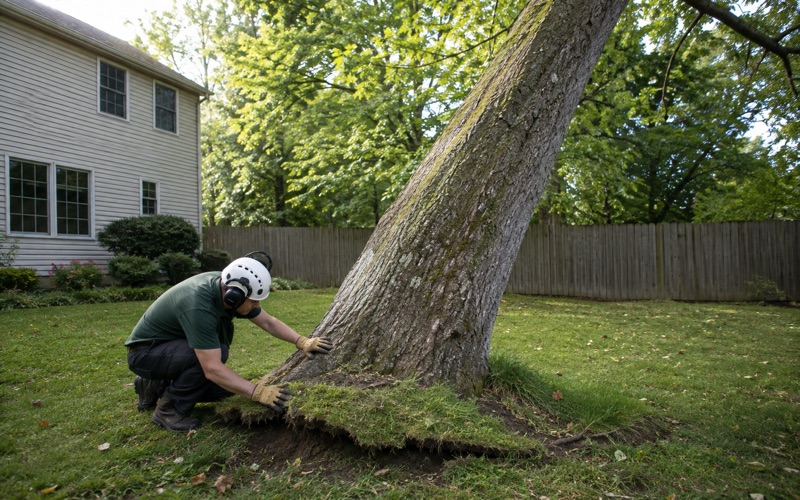
Ask most people to picture tree failure and they describe a trunk broken partway up. On this map unit the far more common outcome is the entire tree leaving the ground with its plate still attached, turf and all, the stem intact from butt to tip. The soil gives up before the wood does.
Whole-plate windthrow, and what it looks like
Windthrow on a shallow plate is a rotation rather than a break. The plate levers upward on the windward side, the ground heaves on the leeward side, and the whole stem travels in one piece until something stops it — usually a roof, a fence line or a parked vehicle.
Because the wood itself is sound, none of the usual warnings are available. There is no decay pocket to find, no cavity to sound out, and often no visible defect anywhere in the stem at all.
Reading the plate before we cut
Our assessment here spends more time at the base than in the crown. We look for soil cracked in an arc on one side of the trunk, turf lifted or domed on the opposite side, and a root collar whose relationship to grade has changed since anyone last paid attention to it.
A root collar excavation, done with an air spade where the situation warrants it, answers what a walk-around cannot. It also separates a genuine plate problem from something ordinary and manageable, such as included bark between co-dominant stems.
How the dismantle plan changes
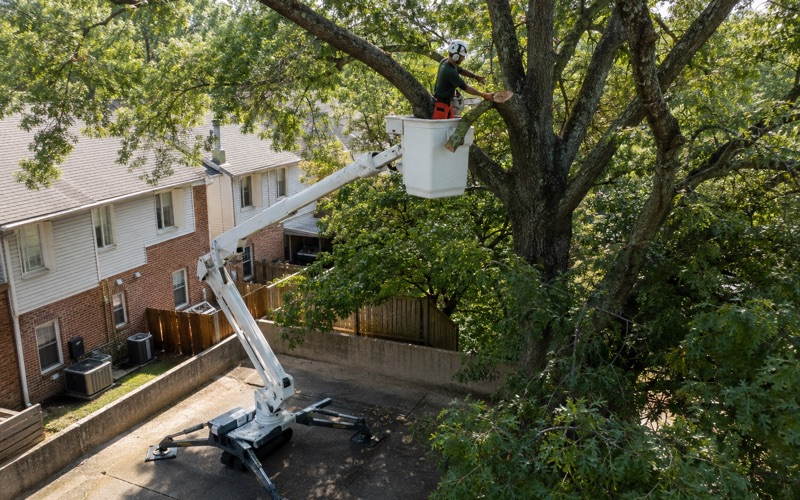
A tree standing on a compromised plate is not a tree to climb. Sectional dismantling worked from an aerial lift, or a crane-assisted removal where no drop zone exists, keeps a climber off a stem that may shift under load.
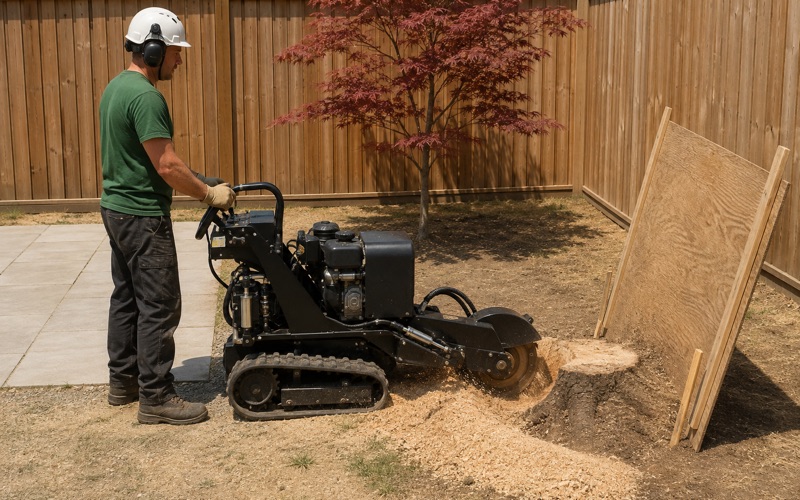
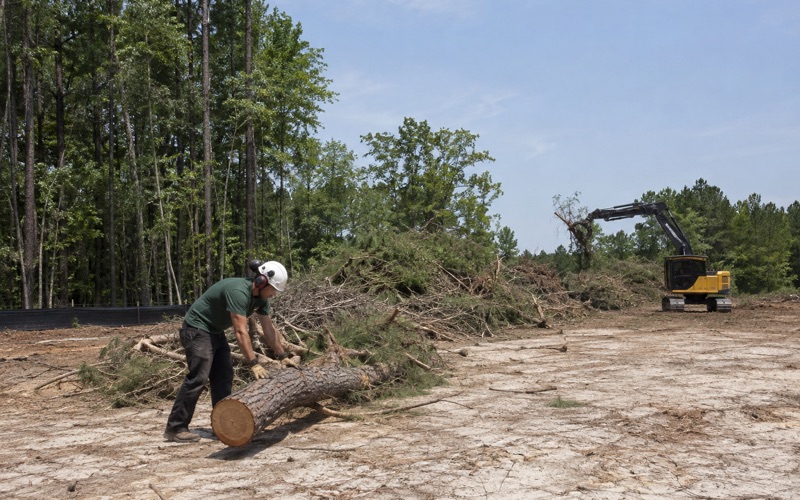
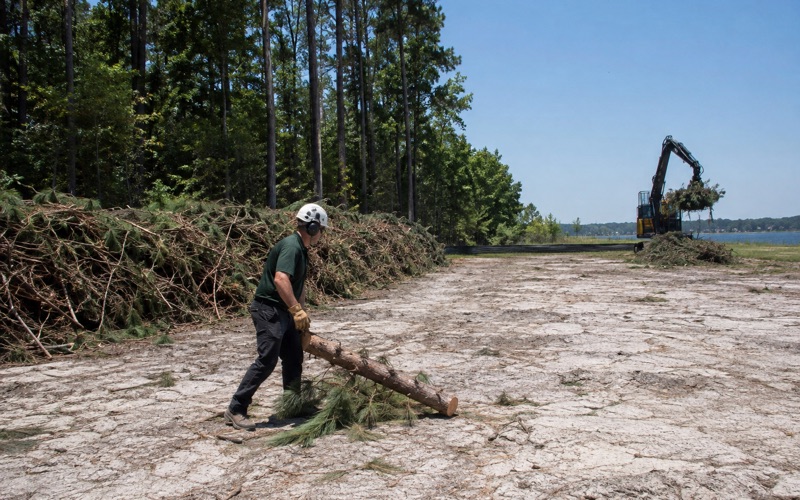
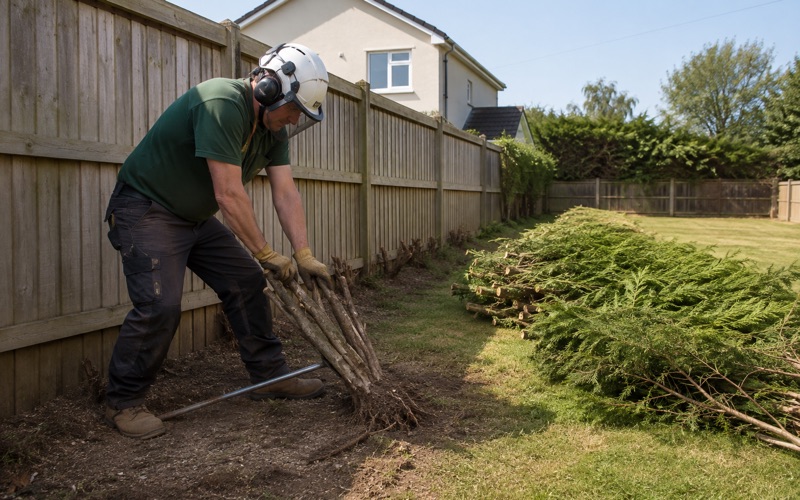
Every removal we quote spells out what happens to the material as well: brush chipped, trunk rounds handled to a stated plan, and the stump and its grindings settled before the crew arrives. Nobody should be learning the debris terms after the tree is already down.
Saturated Ground, Access and Timing
Because the map unit carries a seasonal high water table above the fragipan, the calendar matters here in a way it does not on a well-drained site. The same ground that carries a chipper truck in September will rut in March, and a stump grind on saturated silt loam is slow, sticky work. We would rather say that in the estimate than discover it on the day.
Seasonal water above the pan
Water perched over a fragipan has nowhere quick to go. It softens the exact zone the root plate depends on, which is why the highest-risk moment for a tree here is a wind event arriving on top of several days of rain rather than a dry blow.
The high frost action rating on this soil pushes in the same direction through the winter, cycling the surface again and again. Ground that has spent a season heaving and settling is not gripping a plate the way it did in August.
Protecting turf, drives and walks
Protection matting goes down on every job we run, and on this profile that is not a cosmetic gesture. Silt loam at 54.9 percent silt compacts and smears under a tracked machine far more readily than a coarse soil does, and the damage shows up as ruts that outlast the stump.
Our tracked machines are sized to pass a standard back-yard gate, which usually means reaching a rear tree without pulling a fence panel or crossing the full width of a lawn. Where the ground is genuinely too wet to work, the honest answer is to move the date.
Storm calls and trees resting on a structure
Storm damage, fallen trees and trees on a structure get our 24-hour response, and after a saturated-ground blow those calls arrive in clusters. An uprooted tree is loaded in ways a snapped stem is not, because the plate is still attached and still trying to rotate back into the hole it came out of.
Baltimore Gas and Electric handles line clearance on its own distribution system, and BGE states that final disposition of the cut wood is the responsibility of the property or tree owner. That is worth understanding before anyone assumes the wood left in the yard belongs to someone else.
Reading a Lean After Heavy Rain, and Who Signs Off
Housing here is concentrated in a narrow window: 61.4% of the units were built between 1980 and 1999. The yard trees that came with those houses are now roughly 30 to 45 years old, which on this soil is precisely the size at which a homeowner stops handling a tree themselves and calls someone.
The signs worth a phone call
A lean that is new is worth a call; a lean the tree has carried for decades usually is not. What separates them is the ground — fresh soil cracking in a crescent, a lifted mat of turf, or a gap opening where the root collar meets grade.
County survey work reads the local overstory as woodland in early to middle succession, with tulip poplar dominant ahead of red maple, American beech, black walnut, red and white oak, black cherry, blackgum, sycamore and hickories. Tall, fast-grown, comparatively weak-wooded stems standing on a shallow plate are exactly the combination that moves.
When a second look is worth taking
The estimate visit is free, and so is a second look at a tree you are unsure about. We would rather walk a property twice and find nothing than be called out after the fact.
When we do write a scope, it goes down on paper before a crew is booked, and the crew that arrives is the one that walked the property with you. That continuity earns its keep on jobs where the plan turns on what somebody actually saw at the base of the trunk.
Permits, licensing and roadside trees
Scaggsville is a census-designated place in Howard County with no municipal government of its own, so there is no town tree permit to pull. Howard County’s forest conservation program, under Title 16, Subtitle 12 of the county code, attaches to development of land 40,000 square feet or greater, which leaves an ordinary yard-tree removal outside that requirement entirely.
A tree standing in the public road right-of-way is a different matter. It needs a Roadside Tree Care Permit from the Maryland Department of Natural Resources Forest Service under Natural Resources Article sections 5-401 through 5-411, and along Scaggsville Road and the older lanes off it that catches more front-yard trees than owners expect. All commercial roadside tree work must be conducted under the direction of a Maryland Licensed Tree Expert, and we route permits before we schedule rather than after.
One review that does not apply here is worth stating plainly, because it was checked rather than assumed. No part of this community falls within the Chesapeake Bay Critical Area: a point query at the community centroid returns no feature, while the identical query returns features at the tidal control points at Fort McHenry and Fort Howard Park.
- 20+ Years in Anne Arundel County
- Free On-Site Estimates
- 24-Hour Storm Response