Severn Tree Removal has been handling tree removal in South Laurel for more than twenty years, and the first thing our estimator studies on a job here is not the tree — it is the ground holding it up. The mapped soil under this community falls in the highest-runoff class there is, which changes the price, the equipment and the calendar in ways that are easy to miss until a machine sinks.
That single soil fact drives most of what we do differently here. It decides whether we can put a tracked machine on the turf at all, how long we wait after a rain before we try, and whether the removal is better done from a crane parked on pavement. None of it is guesswork; it is read off the site during the estimate and written into the scope.
Every estimate is free and on site, the scope is written down before a crew is booked, and the same crew works the job from that first visit through the final rake-out. Brush chipped, trunk rounds, the stump and the grindings are all settled in writing up front, and there is no charge for a second look at a tree you are unsure about.
Hydrologic Group D and What It Means Underfoot
Soil surveys sort ground into four hydrologic groups by how readily water moves down through it. Group A is sand that swallows a downpour whole; group D sits at the far end, the highest-runoff and lowest-infiltration class. The soil mapped under South Laurel is group D, and nearly everything practical about working here follows from that.
The Christiana-Downer-Urban Complex
The soil mapped at the center of the CDP is the Christiana-Downer-Urban land complex on 5 to 15 percent slopes. Its surface horizon runs about 66 percent silt and 12 percent clay, a fine-grained mix that packs tight and holds water near the top of the profile instead of passing it down.
The urban land component of that name is not filler. It marks ground cut, filled and regraded during development, which describes most of the residential fabric here, so the profile under a given back yard may have been rearranged since the houses went in. We treat a graded lot and an undisturbed one as two different access problems.
Clayey Fluviomarine Deposits
The parent material is clayey fluviomarine deposits — fine sediment laid down under mixed river and marine influence, then weathered in place. Sediment that fine leaves very little pore space between particles, and pore space is the only thing that lets rainfall move downward. Water that cannot go down goes sideways, or it stays.
Below that, the state geologic map puts the surface unit at Kp, the Potomac Group, made up of the Patuxent, the Arundel Clay and the Patapsco, deposited as nonmarine river floodplain and back-swamp sediment in the Cretaceous. This is Atlantic Coastal Plain ground, and clay is the theme from the surface horizon on down.
What the Highest-Runoff Class Does to a Root Plate
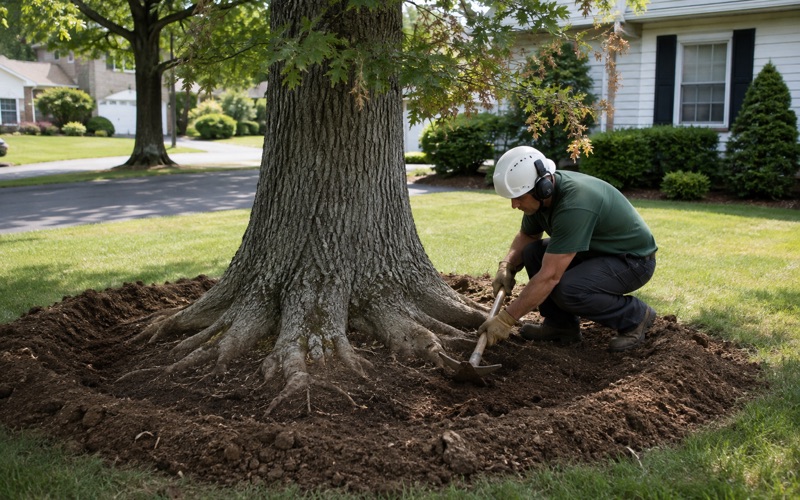
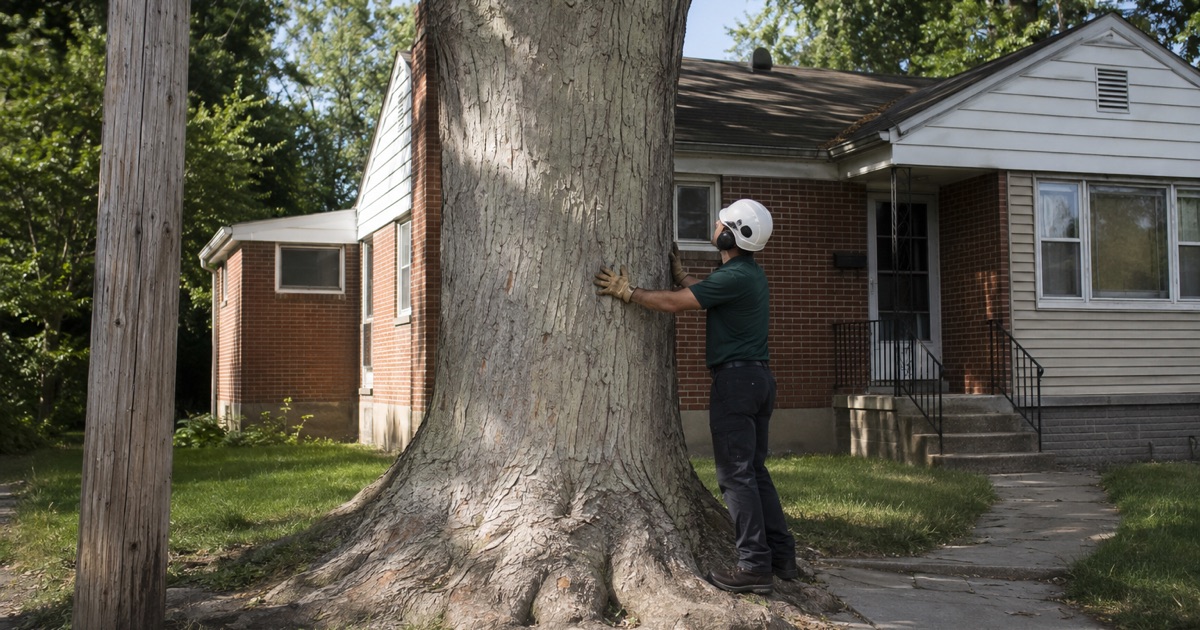
Trees answer ground that will not drain by rooting shallow and wide. Roots follow air and moisture through the top foot or so of soil, so the root plate spreads outward rather than driving down, and the anchorage a mature tree ends up with is broad but thin.
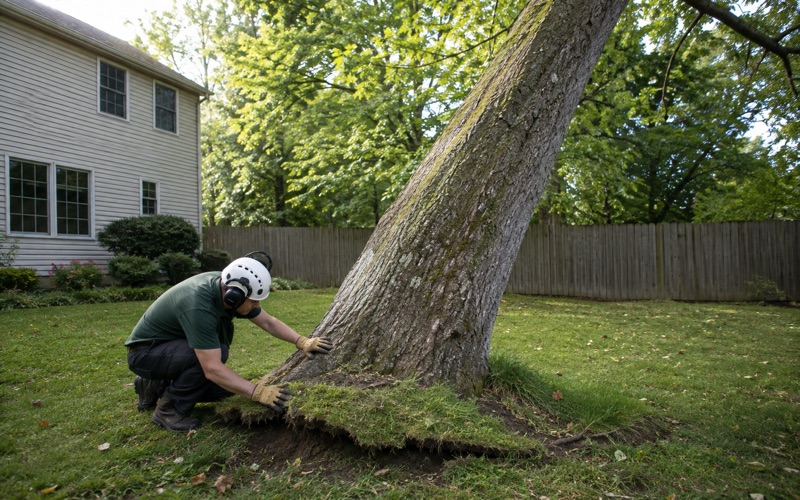
That changes how a big tree fails. On this soil the common storm failure is a whole-tree lean or a windthrow that lifts the root plate as a single disk, rather than a clean break partway up the trunk. A leaning tree with turf heaving on one side of it is an emergency, and it is the call we field most often here after a wet blow.
Looking for tree removal closer to Crownsville? See Crownsville Tree Removal.
Working Machinery on Ground That Sheds Water
Saturated, tight ground is a job-site problem before it is a tree problem. Group D soil does not quietly absorb the rain that fell two days ago; it holds that water near the surface, and a machine crossing at the wrong moment leaves ruts that outlast the stump by a season.
Reading the Ground Before the Truck Arrives
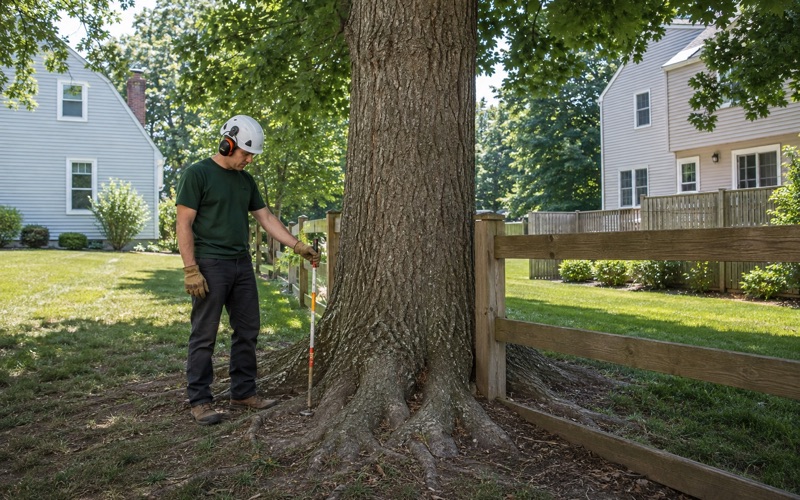
Our free on-site visit includes walking the route the equipment has to take, not just standing under the tree. We note where water stands, where the turf feels spongy underfoot, and how that 5 to 15 percent slope drains across the access path.
That walk is where the price is actually set, and it is what lets us commit the scope to writing before anyone is booked. There is no charge for the visit, and none for coming back a second time on a tree a customer is still weighing.
Matting and Compact Tracked Equipment
Lawn and hardscape protection matting goes down on every job we run, and on this soil it earns its keep several times over. Matting spreads a machine’s load across a far larger footprint, which is the difference between turf that recovers on its own and turf that has to be regraded.
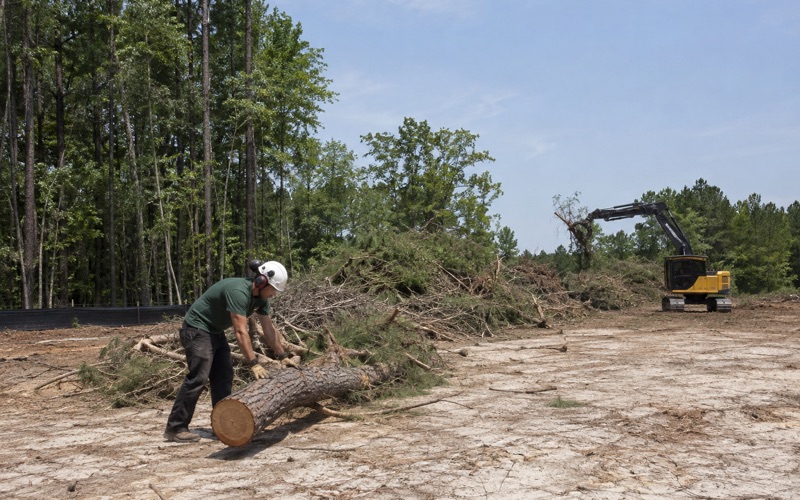
Our compact tracked equipment is sized to pass a standard back-yard gate, and tracks carry weight over soft ground far better than wheels do. Even so, matting extends the working window rather than removing the limit; on properly saturated ground we stop and wait instead of crossing.
Crane-Assisted Removals
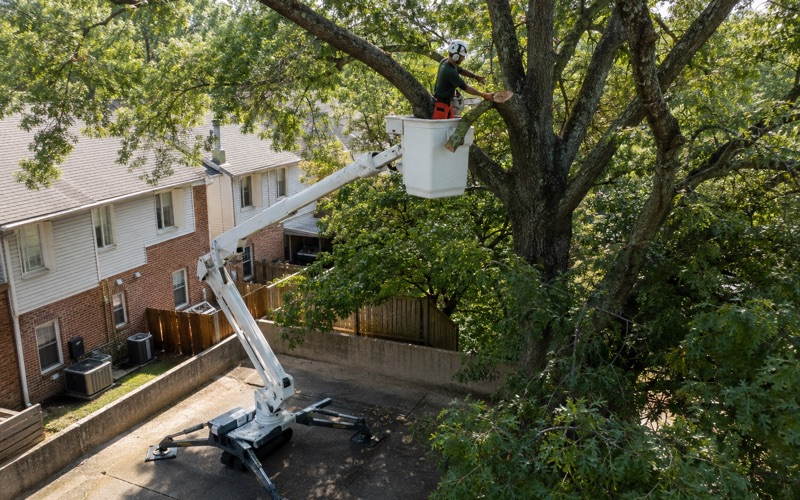
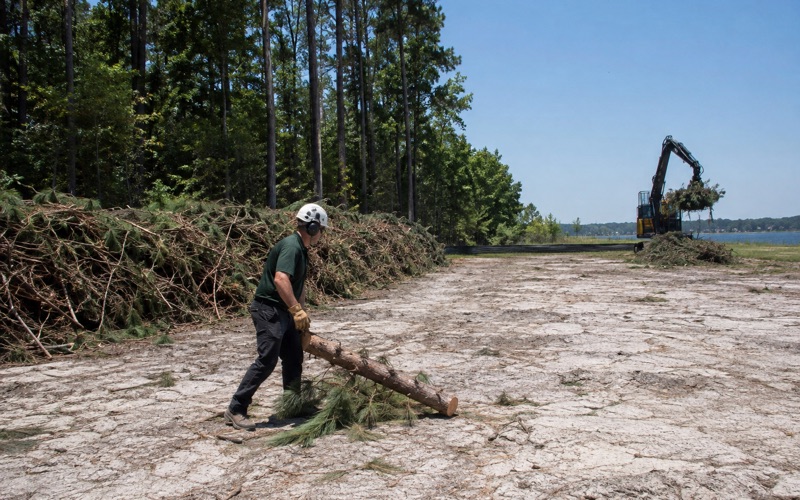
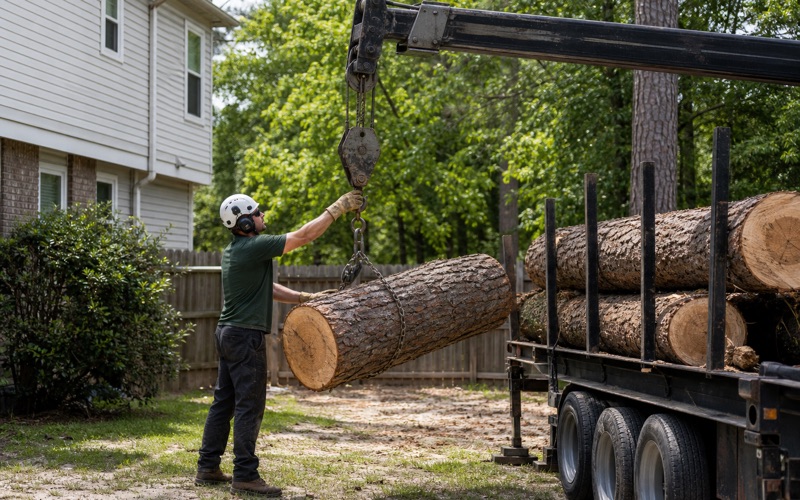
Some removals here are best done without setting a machine on the turf at all. Where we can rig from paved parking or a street and still reach the canopy, a crane-assisted removal lifts the wood out over the wet ground rather than dragging it across.
That is also the answer where there is no drop zone to fell into, which is common on the tighter lots and inside shared parking courts. Sectional dismantling with the crane holding the weight keeps every piece controlled and keeps the traffic off soil that cannot take it.
Drying Time, Scheduling and Storm Work
The practical cost of the highest-runoff class is time. After a real rain the surface here needs longer to firm up than well-drained, gravelly ground does, and that wait is a scheduling fact we plan around rather than an excuse we produce afterward.
Why We Book a Window, Not a Single Day
For a machine-access removal in South Laurel we hold a window and confirm the morning of, because the ground gets the final vote. Two dry days will usually do it after an ordinary rain; a saturated stretch in spring can push the same job out further.
Because the crew that priced the work is the crew that shows up, a moved date never means re-explaining the site to someone new. The inclusions were written down at the estimate, so a weather delay shifts the calendar without reopening the scope or the number.
Storm Response on Saturated Ground
Storm calls arrive at the worst possible moment for this soil, since the ground is at its softest exactly when a tree is resting on a roof. We respond within 24 hours for storm damage, fallen trees and trees leaning on a structure.
Emergency work on wet ground is a different job from a scheduled removal. It generally means more rigging and less machine, and it means treating a lifted root plate as a live load that can settle further without warning while the crew is under it.
Multifamily Grounds and Property-Manager Schedules
Most of the housing here is not a single-family yard. Some 52.6 percent of units sit in buildings of five or more, and 28.5 percent are in buildings of ten to nineteen units — the garden-apartment shape, with shared parking courts and grounds crews instead of a driveway and a side gate.
Access on those properties is scheduled rather than assumed, so we build around HOA boards, property managers and multifamily grounds staff. With 59.3 percent of occupied units rented, the buyer is often a management company working a maintenance cycle; the 27.6 percent of occupied units that are owner-occupied single-family detached houses are a real part of our work here too.
Who Signs Off on a Removal Here
South Laurel is an unincorporated area and census-designated place in Prince George’s County, with no municipal government of its own. There is no city tree permit and no city arborist, so every approval question is a county or a state question, and we route it before we schedule. No part of the CDP falls inside the Chesapeake Bay Critical Area either — a point query at the centroid returns no feature while the identical query at a Baltimore control point does return one, so that absence is a real finding rather than a failed lookup.
County Woodland Conservation and When It Bites
The county’s woodland conservation ordinance, Subtitle 25, Division 2, is administered by the Prince George’s County Planning Department and is triggered by an application — building, subdivision, zoning or grading — rather than by a homeowner deciding to take down a yard tree. Most residential removals here never touch it.
A Standard Letter of Exemption is issued where a lot or parcel is under 40,000 square feet, or holds under 10,000 square feet of woodland, and a numbered Letter of Exemption covers cumulative disturbance of less than 5,000 square feet of woodland over a five-year period. The county’s separate tree canopy coverage requirement is triggered by building and grading permits proposing 5,000 square feet or more of gross floor area or disturbance, and it expressly exempts any permit pertaining to an existing single-family detached home.
Specimen Trees and a Stock Planted in One Generation
Prince George’s County defines a specimen tree as one with a diameter at breast height of 30 inches or more, or 75 percent or more of the diameter at breast height of the current champion of that species. Woodland is defined as a perpetual biological community dominated by trees covering 10,000 square feet or greater. Those are the figures that govern here, and we do not carry a threshold over from another jurisdiction’s code.
The age of the housing is why that threshold comes up at all. Some 58.6 percent of the stock predates 1980, with the largest cohort at 28.3 percent going up in the 1970s and another 17.2 percent in the 1960s, so whole streets were planted in one generation and the biggest yard trees are now fifty to sixty years old and well past what a homeowner can safely drop.
Roadside Trees, State Licensing and Pepco
Trimming, planting or removing a tree in the public road right-of-way needs no county Letter of Exemption, but it does need a permit under the Maryland Roadside Tree Care Law, and all commercial roadside tree work has to be conducted under the direction of a Maryland Licensed Tree Expert. We handle that routing before a date is set, because the counties and towns in our service area answer these questions differently.
Statewide, no person or firm may engage in tree work for hire without a license issued by the Department of Natural Resources, and the licensee’s written contract must carry that name and license number. Pepco, not BGE, is the electric distribution utility here, so a limb on a line or a downed conductor is a Pepco call; Pepco also runs its own vegetation management on a four-year cycle, reviewing public trees in the right-of-way with the jurisdiction and discussing private trees with the owner directly.
- 20+ Years in Anne Arundel County
- Free On-Site Estimates
- 24-Hour Storm Response