
Severn Tree Removal has been doing stump grinding in Severn, MD for more than 20 years, serving surrounding cities including Fort Meade, Jessup, Elkridge, Odenton and Glen Burnie. It is the half of a tree job that most quotes handle vaguely, and the half homeowners most often end up unhappy about, so we price it as its own line with its own written inclusions rather than folding it into a removal total.
There is a local advantage worth knowing about. The soil under most of this area is Patapsco-family sand — deep, loose and fast-draining — so grinding here cuts easily and the spoil comes up light and free-draining rather than as heavy wet clay. A stump job on this ground is genuinely cleaner than the same job twenty miles inland, and it means the machine spends its time on wood instead of fighting the soil.
What decides the price and the schedule is rarely the stump itself. It is whether a machine can reach it, how much of the root flare is going with it, and what you want done with the pile of grindings afterward. All three are settled at the free on-site estimate, in writing, before a crew is booked.
What a Stump Grinding Job Includes
Grinding Depth and What the Priced Standard Means
The priced standard in this market is grinding 6 to 8 inches below grade, which is enough to clear turf, sod and most replanting. Deeper is possible and is quoted as such, because it is more machine time and considerably more spoil. If you intend to put a fence post, a patio footing or a new tree in the same spot, say so at the estimate — that is a different depth and a different price, and finding out afterward means bringing the grinder back.
The Root Flare, Not Just the Stump
A stump is the visible end of a buttress system that spreads several feet in every direction. Grinding the disc alone leaves the flare roots to settle and rot at their own pace, which is what produces a sunken ring in a lawn a year later. We grind the flare where the finish matters, and we say when we are not, so a lower quote is a smaller scope rather than a surprise.
The Grindings, the Crater and the Restoration
Ground wood occupies far more volume as chips than it did as stump, so every grind produces a mound. Leaving it in place fills the hole and settles over a season but takes nitrogen out of the soil as it decomposes; hauling it off and backfilling with topsoil and seed gives you lawn immediately. Both are legitimate, they cost different amounts, and the estimate names which one you are buying.
Surface Roots, Exposed Runners and Lawn Damage
Surface roots running out from the stump under a lawn are quoted separately from the stump itself, because they are a different operation with a different machine path. Where a lawn or a bed has to survive the job, lawn and hardscape protection matting goes down before the machine tracks over anything, which is what keeps a grind from turning into a turf repair.
Grinding Against Full Stump Removal
Why Grinding Is the Default
Grinding chews the stump and its buttress roots into chips and leaves the surrounding soil structure intact. It is faster, cheaper and far less disruptive on a finished lawn than any alternative, and on a small-lot residential property it is almost always the right answer. Most homeowners asking for stump removal actually want the stump gone from view and the lawn usable, which is exactly what grinding delivers.
When Excavation Is Genuinely the Right Call
Pulling the whole root plate makes sense when something structural is going into that footprint — a foundation, a pool, a retaining wall — or where a contractor’s plan requires the ground to be clear of woody material at depth. It leaves a crater that has to be backfilled and compacted, and on this loose sand that backfill has to be done properly or it settles under whatever is built on it.
Grinding Near Utilities, Septic and Irrigation
A grinder cannot see a gas service, an irrigation line, a septic lateral or a low-voltage lighting run, and a stump sitting on top of one is a genuine constraint rather than an excuse. Utility marking happens before the machine arrives, and where a line runs through the root plate we grind to the safe depth and tell you what is being left rather than guessing at it.
Replanting in the Same Spot
Wood chips and soil mixed together are not a planting medium, and a young tree dropped into a fresh grind hole usually struggles. If a replacement tree is going in, the grindings come out, the hole is backfilled with soil, and we would rather move the new tree a few feet than plant it into the decomposing remains of the old one’s root plate.
Access, Machines and Awkward Stumps
Gate Width Decides the Machine
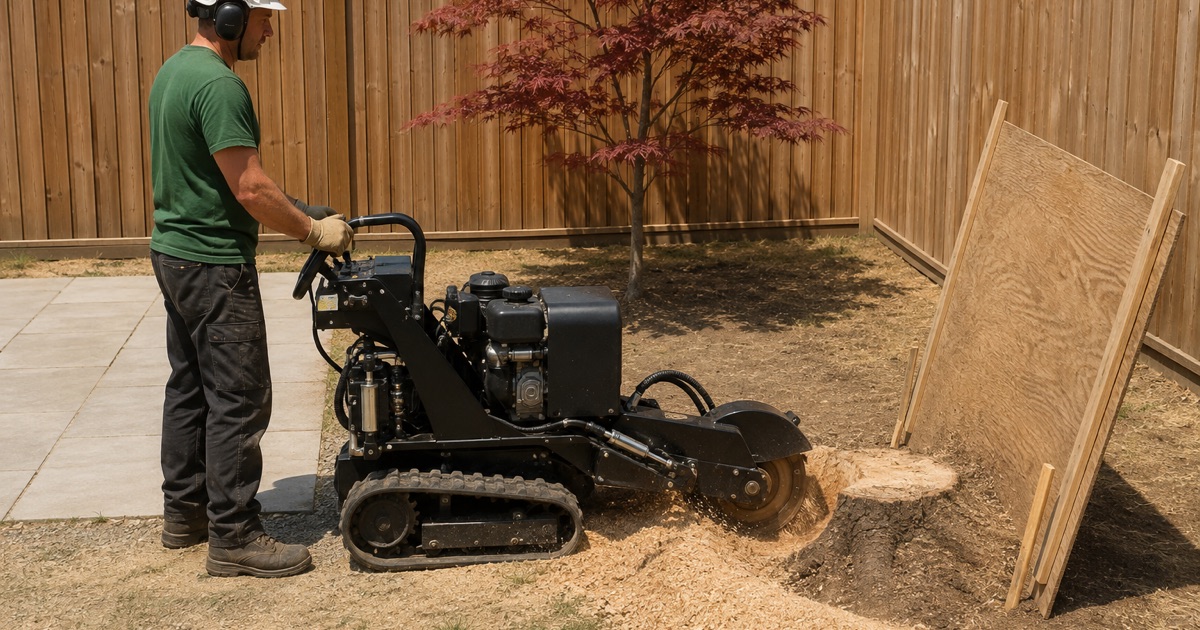
A standard stump grinder needs a gate roughly 35 inches wide to reach a rear yard, and in the townhouse and rowhouse blocks across this service area a great many rear gates are narrower. We measure the access at the estimate rather than on the morning of the job, and match a compact tracked grinder, a walk-behind machine or a different route to what the fence line actually allows.
Slopes, Retaining Walls and Tight Sight Lines
A grinder works by sweeping a cutting wheel across the stump, which needs stable footing and room to swing. On a slope, against a retaining wall or in a corner between a shed and a fence, the machine’s working envelope rather than its cutting capacity is the limit. We look at that before quoting, because a stump that is easy to reach and hard to work is the one that runs long.
Multiple Stumps and Cleared Lots
Several stumps in one visit is materially cheaper per stump than several visits, since mobilization is a real share of a small job’s cost. On a cleared lot or a fence line the sensible approach is one pass with the machine already on site, and it is worth grouping stumps you have been putting off rather than calling us back for them one at a time.
Storm Stumps and Uprooted Trees
A windthrown tree on sandy soil often takes its root plate out of the ground with it, standing the plate vertical. That is a different job from grinding a cut stump: the plate has to be cut down, the soil returned to the hole and the remaining stub ground, and the volume of soil hanging in the roots is what drives the time.
Pricing, Exclusions and Disposal
How Stump Work Is Priced Here
Stump grinding is normally priced by stump diameter rather than by the hour. As a dated local benchmark, the ProMatcher Research Team put Severn area stump removal at $3.88 to $4.18 per linear inch of stump diameter in May 2021. Diameter is measured across the stump at grade, which is why a stump that looks small from the porch can price higher than expected once it is measured at the flare.
The Exclusions That Make Two Quotes Different
Published stump prices in this market routinely exclude minimum service charges, surface roots, multi-stump discounts and travel surcharges, and removal prices commonly exclude stump grinding altogether. Two quotes that look alike stop looking alike as soon as you read what each one leaves out, which is why our estimate names the inclusions on the same page as the number.
Where the Grindings and the Wood Go
Maryland’s spotted lanternfly quarantine regulates moving logs, stumps, firewood and yard waste statewide, so disposal has rules attached to it whether or not the material is infested. County curbside is not a route for any of it. The estimate names the destination for the grindings and any wood, rather than assuming a truck will work it out on the day.
Restoring the Area Afterward
Backfilling with topsoil, raking level and seeding is a separate line, and it is the one worth buying if the stump sat in a visible part of the lawn. Grindings settle unevenly for a season or more, so a lawn that was patched properly at the time looks finished within weeks rather than showing the outline of the old stump through a summer.
- 20+ Years in Anne Arundel County
- Free On-Site Estimates
- 24-Hour Storm Response