Severn Tree Removal has been doing tree removal in Takoma Park for more than 20 years, and here the permit calendar sets the schedule long before a rope goes into a tree. An approved removal is posted for 15 days, and any resident of the city may appeal it while it hangs there. We handle that routing first and book the crew second.
The order is deliberate. Five counties and four towns across our service area answer a permit question differently, so we read the local rule before quoting a date rather than after a homeowner has already cleared a Saturday.
Every job opens with a free on-site estimate and a written scope: which stems come down, what gets chipped, where the trunk rounds are stacked, and whether the stump and the grindings are settled in the price. What is written at that visit is what the crew performs, and it is the same crew from the estimate through the final rake-out.
Fifteen days in which any resident can appeal
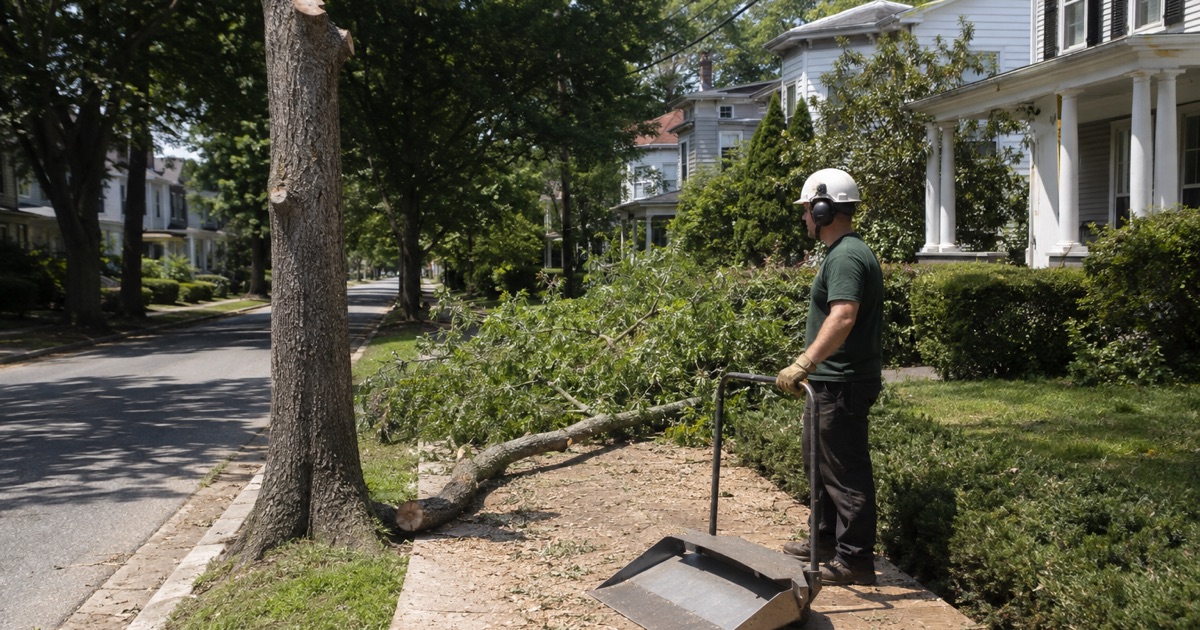
The city’s Urban Forest Manager reviews a tree removal application and issues a preliminary decision. That decision is then posted for 15 days, and during that window any Takoma Park resident may appeal it to the Tree Commission. Nothing issues until the period runs out or the appeal is decided.
An appeal goes to the Tree Commission, which hears challenges to preliminary permit decisions. For a homeowner the practical consequence is simple: the decision that matters is not the one made at the counter, it is the one that survives the posting.
The trees the ordinance actually reaches
Takoma Park’s threshold is low. An urban forest tree is any tree whose trunk measures 24 inches or more in circumference at four and one-half feet above ground level, which is seven and five-eighths inches or more in diameter at breast height, and a permit is required to remove, relocate or destroy one.
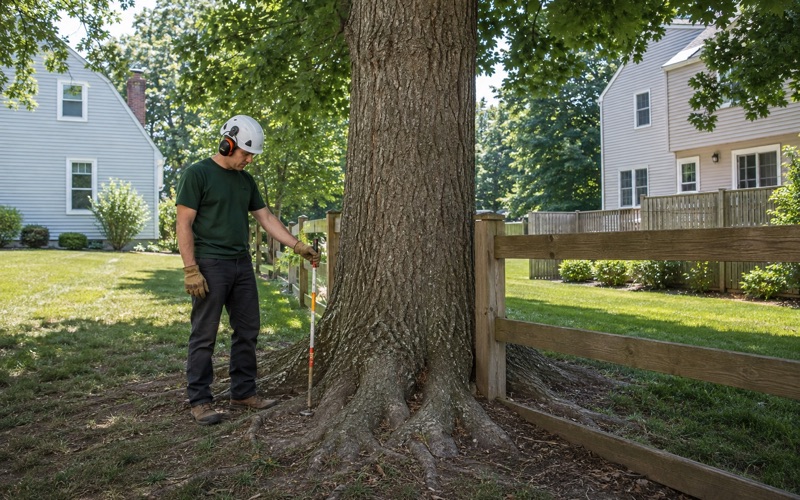
That catches trees most people would describe as small. We tape the trunks at the estimate and tell you which stems on the lot sit over the line, because a yard with four trees on it is easily a yard with three permit applications.
How the posting window sets your date
The 15 days are the fixed part of the timeline, so we schedule backward from the end of them instead of promising a date the permit cannot support. A removal booked around that window runs on the day it was booked.
Inside the Takoma Park Historic District, a Historic Area Work Permit may also be required for a tree larger than 6 inches in diameter. That is a Montgomery Planning process run by the Historic Preservation Commission, separate from the city permit and on its own clock, so we start both early.
When a waiver takes the place of the wait
The city can grant a permit waiver where it determines the tree is dead or hazardous, and that is the route most of our urgent work takes. Action required on an emergency basis to prevent harm to life or property does not need a permit at all.
We hold 24-hour response for storm damage, fallen trees and trees resting on a structure, and we draw the same waiver-or-emergency distinction on site that the city will draw on paper. Documenting a defect while the tree is still standing is what keeps a genuine emergency from reading later as an unpermitted removal.
Looking for tree removal closer to Fort Meade? See Tree Removal in Fort Meade.
The six-month deadline on the replacement planting
A permit that clears preliminary approval carries a replanting obligation, and the obligation has a clock on it. The replacement planting plan must be provided within six months of preliminary approval, or the application is automatically withdrawn and the process begins again.
That is a real risk on a job people treat as finished the moment the tree is down. The permit and the replanting are one file, and the second half of it has a shorter life than most owners assume.
What preliminary approval commits you to
Preliminary approval is not the end of the file; it is the point at which the replacement planting becomes a scheduled task with a date attached. Six months sounds generous until the removal happens in one season and the planting plan waits on a landscaper in another.
We put the deadline in the written estimate on any permitted removal. It sits in front of you from the start rather than surfacing in a letter half a year later.
Fees, and the fee-in-lieu when the lot is full
The standard application fee is $50, or $25 where every tree in the application is dead. Where required replacement trees cannot be planted, the city takes a fee-in-lieu of $312 for each required 1.5-inch tree.
On a small lot already carrying a house, a driveway and a mature canopy, that arithmetic matters. Knowing it before the application goes in is the difference between a planned cost and a surprise.
Finding somewhere to put the replacement
Nearly half of the city’s occupied homes are owner-occupied single-family detached houses on lots laid out generations ago, and the replanting space is rarely where the removed tree stood. Old root plates, brick walks and utility runs all take candidate spots off the list.
We walk the replanting question during the estimate rather than after the stump is ground. There is no charge for that visit, and none for coming back to look again at a tree or a location you are unsure about.
The Licensed Tree Expert the city puts on the property
Takoma Park runs its own tree regime and has expressly exempted itself from Montgomery County’s tree protection and canopy preservation provisions, so the rules inside the city limits are the city’s own. One of them governs who is allowed to do the work.
That exemption is written into the code itself. It means a correct answer about a tree three blocks outside the line can be the wrong answer inside it, which is why we treat a Takoma Park address as its own jurisdiction from the first phone call.
A site visit written into the code
No person or firm may perform tree pruning, tree removal or other tree work for hire in the city without supervision, involving a site visit, by a Licensed Tree Expert in good standing with the Maryland Department of Natural Resources. A violation is a municipal infraction.
That reaches further than holding the state license does on its own, because it puts the licensed person on the property instead of on the paperwork. Our estimate visit is that site visit, which is one reason we will not quote a removal here from photographs.
The standards the ordinance names
The code also requires the work itself to follow ANSI A300 Parts 1 and 2 and ANSI Z133.1. Those standards cover how the cuts are made and how the crew is rigged and protected while making them.
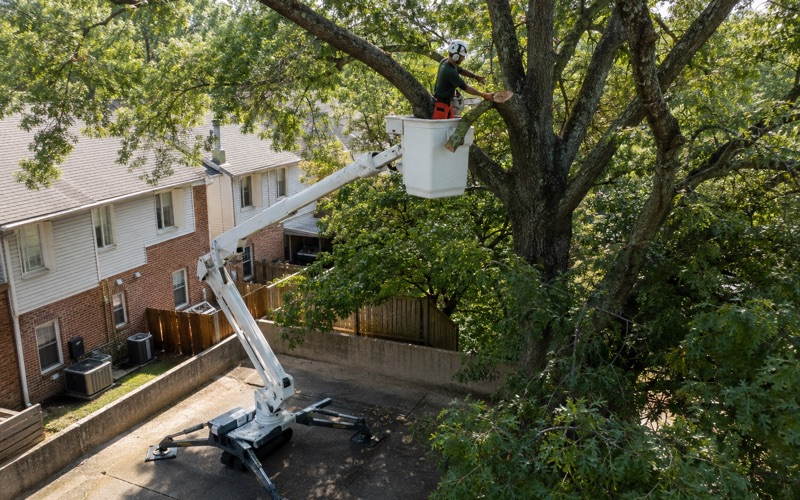
In practice that governs ordinary decisions on the job. It decides how a co-dominant union with included bark is taken apart, how much live canopy a crown reduction is allowed to remove, and whether a stem comes down in sections under a crane where the yard offers no drop zone.
Work short of a removal that still needs a filing
A tree impact assessment is required before excavating more than three inches deep over more than 25 square feet within 50 feet of an urban forest tree, before activity in its critical root zone that may destroy a significant portion of the roots, before building a structure other than a fence within 50 feet of it, and before paving more than 25 square feet within 50 feet of it. The same filing is triggered by pruning more than 5% of the live canopy.
A patio, a shed pad or a heavy deadwooding pass can therefore reach the ordinance without a single tree coming down. We tell you which side of that line a job falls on before it is scheduled.
Working a Takoma Park property around the calendar
Once the permit questions are answered, what is left is the property itself. That means what is growing on it, what is underneath it, and how a truck and a chipper are supposed to reach the back of it.
Storm season sets the pace of the rest. On June 5, 2024 the National Weather Service confirmed two EF-1 tornadoes in Montgomery County, at Poolesville with estimated peak winds of 105 mph and at Gaithersburg with 95 mph; the Poolesville survey counted roughly two dozen pines with trunks over two feet across snapped or uprooted. This city falls in forecast zone MDZ504, Central and Southeast Montgomery, and we watch that zone rather than the county as a whole.
Old houses, older trees
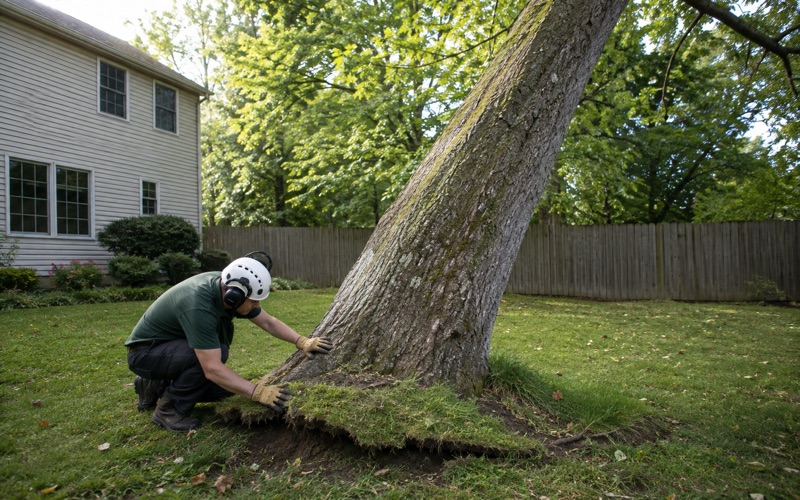
94.5% of the city’s housing units were built before 1980 and a quarter of them predate 1940, so the yard trees on many lots are older than anyone who has ever owned the house. Northern red oak belongs in the Piedmont mix here, and specimens of that age carry decay pockets, co-dominant stems and real windthrow exposure.
Sligo Creek and Long Branch, tributaries of the Northwest Branch of the Anacostia, run through the city, and the nine-mile Sligo Creek Trail follows one of them. That stream-valley parkland puts large public canopy directly against private back yards, so a rear-lot removal is often performed underneath a neighboring tree we are not touching.
The ground under the stump grinder
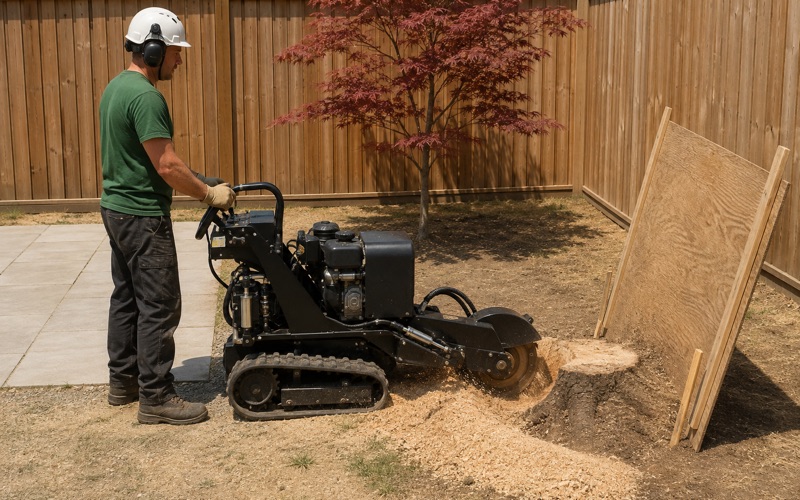
The city sits on the Piedmont Plateau. State geology maps the Sykesville Formation, a boulder gneiss, beneath it, and the mapped soil at the centroid is the Gaila series at 95% of the map unit. Residuum over shallow rock limits how deep a stump grinder can reasonably work and leaves a heavy, rocky root plate.
We state the grinding depth we expect in writing, and the grindings are settled on the same line. Nobody is left negotiating about a hole in the lawn after the truck is loaded.
Access, equipment and whose calendar it is
Most of these back yards are reached through a side gate rather than a driveway. Our tracked machines are sized to pass a standard back-yard gate, and protection matting goes down on lawn and hardscape on every job, which matters more on an old brick walk than on new concrete.
With 44.9% of the city’s housing units sitting in buildings of five or more units, half the work here is booked with a property manager or grounds staff rather than a single homeowner. We schedule around boards and maintenance windows as readily as around a day off.
- 20+ Years in Anne Arundel County
- Free On-Site Estimates
- 24-Hour Storm Response