Severn Tree Removal has handled tree removal in West Laurel for more than twenty years, and the first question we ask about a new address here is which ground it sits on. Two different soils meet inside this one community, and they hold a mature tree in two different ways.
That is not a technicality. It decides whether a tree can be felled or has to come down in rigged pieces, whether a machine can park near the stem, and what the work costs. We settle it on the property, not from a photo.
Every estimate is free and on site, and the scope goes in writing before a crew is booked: what comes down, how the brush and trunk rounds are handled, and what happens to the stump and the grindings. Storm calls get an answer within 24 hours.
Two soils meet inside one community
West Laurel is one of the few places we work where the geology changes inside the neighborhood rather than at its edge. The Fall Line contact runs through the community, and the soil survey shows it plainly.
What the SSURGO mapping actually shows
The Maryland iMAP SSURGO soils layer maps the ground at the community centroid as Manor loam on 15 to 25 percent slopes, formed in residuum weathered from mica schist. A second point on the uplands about a mile southeast maps as the Beltsville-Urban land complex on 5 to 15 percent slopes, formed in silty eolian deposits over loamy fluviomarine deposits. Crystalline-rock residuum sits on the Patuxent valley slopes; sediment sits on the uplands.
No single series covers the whole community, which is why a crew that assumes one ground gets caught out on the other. The state geology polygon is coarser than the soil survey: the mapped unit at the centroid is Kp, whose 1968 map name is Potomac Group / Undifferentiated Mesozoic and Crystalline Rocks, and whose province field reads Coastal Plain across both halves.
The finer mapping is the one we plan from, because it is the one that describes what a root plate is actually sitting in. Two addresses in the same community can sit on either side of that contact, and the survey is how we know which before anybody climbs.
Manor loam on mica-schist residuum
Manor loam is the valley-slope soil, and its published properties are the ones that matter on a removal. It is well drained, hydrologic group B, with a loam surface texture at 16.6 percent clay, 40.1 percent sand and 43.3 percent silt, and its erosion hazard is rated severe.
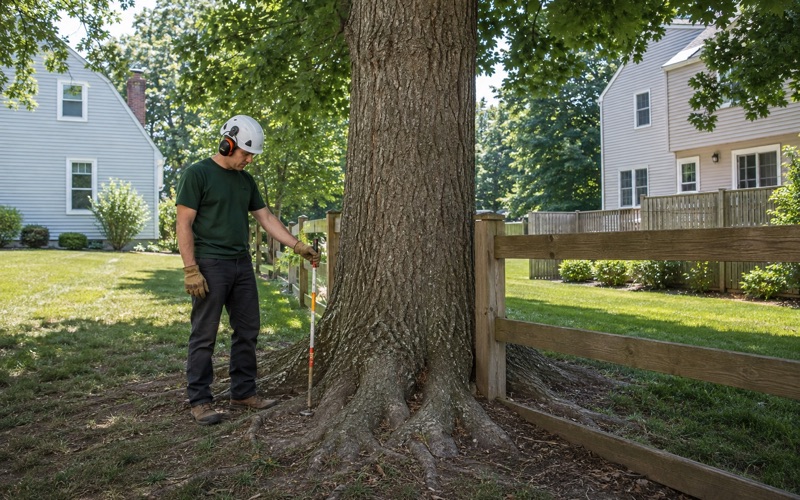
Residuum weathered from mica schist means shallow soil over hard rock. Root plates spread wide and stay thin rather than driving deep, so a tree that looks well anchored from the driveway can be holding on far less than its crown suggests. We read the root collar before we read the canopy on these lots.
Beltsville silt over fluviomarine deposits
The upland complex behaves the opposite way. It is moderately well drained, hydrologic group C, and the silty cap over loamy fluviomarine deposits carries a dense subsurface layer that perches water after a wet stretch.
Roots stay near the surface because there is little reason to go deeper. That keeps a saturated upland yard soft under equipment for days after the slopes have shed their water, and it moves the week we schedule as much as it changes the way we rig.
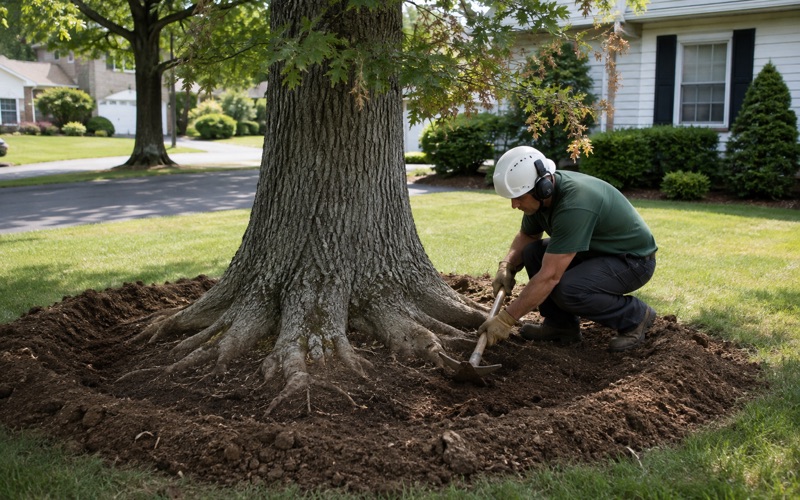
It also changes what we will promise about the stump. A stump grinder working wet upland silt throws a heavier spoil than the same machine on the slope soil, and the grindings settle differently once the hole is backfilled. Where the ground is going to be replanted, we say what to expect at the estimate rather than afterward.
Looking for tree removal closer to Fulton? See Tree Removal in Fulton.
What each ground changes about the work
The two soils fail differently, and the difference shows up in how a tree has to be taken apart rather than in how it looks standing in the yard. We plan the removal around the ground the tree grew in, then price it.
Rigging distance is set by the slope
On a 15 to 25 percent grade the distance between a spar and a safe landing is a function of the hill, not of the yard. There is often no drop zone to fell into, so the tree comes down in pieces, with each piece rigged rather than dropped. Our climbers work to ANSI Z133 on the cutting side and ANSI A300 on anything that stays standing.
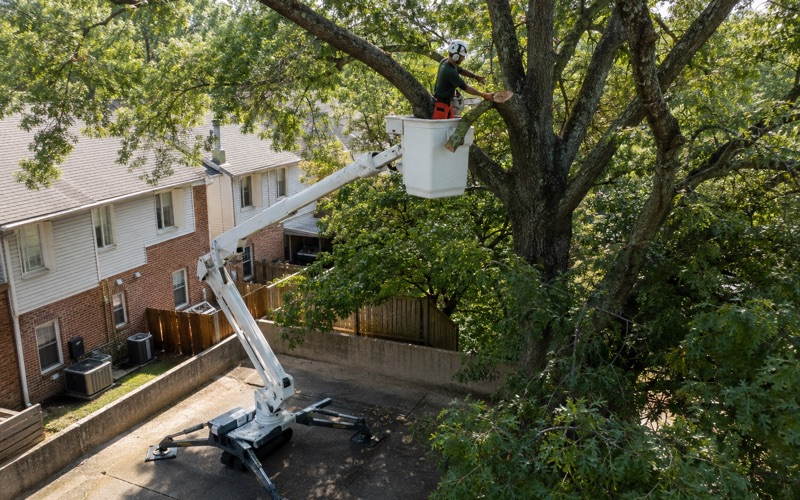
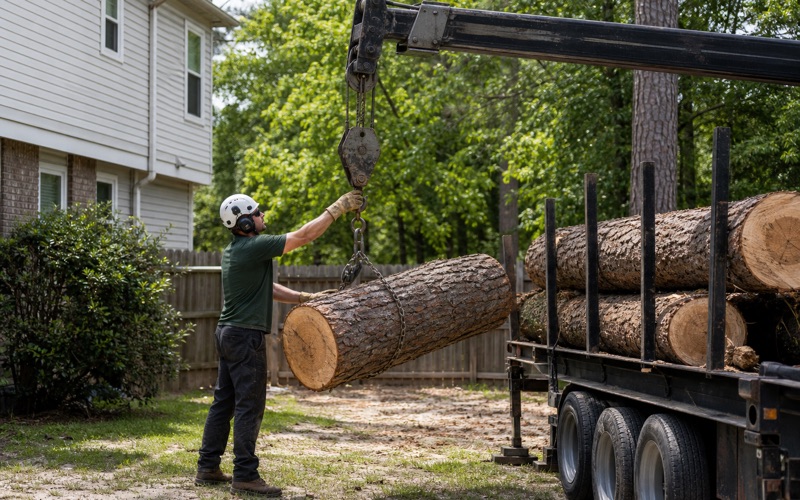
Where the slope leaves no landing at all, a crane-assisted removal lifts wood out over the roofline instead of dragging it across the grade. That is a call we make at the estimate, in daylight, with the whole approach walked.
Machine footing and a severe erosion rating
Steep ground rated severe for erosion is easy to damage and expensive to put right. We lay protection matting on the travel path on every job, both to spare lawn and hardscape and to spread the load where a tracked machine would otherwise cut a channel into the slope.
Our compact tracked equipment is sized to pass a standard back-yard gate, which is the only approach on plenty of these lots. Where footing is genuinely poor, we stage from the flatter side and accept the longer carry.
A canopy that reached size together
80.2 percent of the housing here was built before 1980 and 55.0 percent before 1970, with the 1960s alone accounting for 35.9 percent. The yard trees planted or left standing with those houses are now roughly sixty years old, and whole streets reach that size in the same season.
At that age we start finding co-dominant stems with included bark, and epicormic shoots on limbs that lost their light years ago. Thin root plates on the slope soil make windthrow the likelier failure there, while an upland tree more often comes apart at a union. Cabling and bracing saves some of them; removal is the honest answer for others.
Who signs off on tree work here
No part of West Laurel falls within the Chesapeake Bay Critical Area. A point query at the community centroid returns no feature at all, while the same query at the Fort McHenry control point returns an Intensely Developed Area, so the empty result is a real finding rather than a failed lookup. The Patuxent is impounded and non-tidal here, held back by the T. Howard Duckett Dam.
A census-designated place, governed by the county
There is no municipal government here and no city tree permit, so there is no town arborist to call and no local ordinance layered on top. West Laurel is a census-designated place in Prince George’s County, and every regulatory question is a county, state or WSSC Water question.
We route permits before we schedule rather than after, because the counties and towns across our service area answer differently and a crew standing idle is the customer’s money. Establishing what applies takes a parcel lookup and a phone call, and it happens on our side of the job rather than yours.
The canopy ordinance exempts an existing single-family detached home
Prince George’s County’s Tree Canopy Coverage Ordinance, Subtitle 25 Division 3, applies to building and grading permits proposing 5,000 square feet or more of gross floor area or disturbance. Section 25-127 expressly exempts any permit pertaining to an existing single-family detached home. With 98.3 percent of housing units here single-family detached and 95.6 percent of occupied units owner-occupied, that exemption reaches very nearly every property in the community.
The county’s woodland conservation requirements are triggered the same way, by a building, subdivision, zoning or grading application rather than by a homeowner deciding to take down a yard tree. Worth knowing before any plan is drawn: the county defines a specimen tree at 30 inches diameter at breast height, or 75 percent of the current champion of that species, and on lots of this age a 30-inch trunk is an ordinary find.
Right-of-way trees, watershed land and the utility
A tree in the public road right-of-way needs no county Letter of Exemption, but it does need a Roadside Tree Care Permit from the Maryland DNR Forest Service, and commercial work under that law runs under the direction of a Licensed Tree Expert. Any firm doing tree work for hire in Maryland must hold that license or work under someone who does, and the written contract has to carry the licensee’s name and number under COMAR 08.07.07.
The wooded Patuxent watershed land around the Rocky Gorge Reservoir belongs to WSSC Water and is managed as a drinking-water source, so a tree standing on it is not the adjoining homeowner’s to remove and is not the county’s either. Pepco, not BGE, is the electric distribution utility here and runs vegetation management on a four-year cycle, so a limb on a conductor is a call to Pepco before it is a call to us.
Why the same tree is priced differently across town
Price here follows access and method, and both change over a short distance. Two houses a few streets apart can sit on different soils, different grades and entirely different approaches to the back yard.
Two grounds, two methods
Neighbors compare quotes here and find the numbers do not match for what looks like the same tree. Usually the difference is underfoot: a slope removal with no landing and a long rigged carry is not the same job as an upland removal with a machine parked twenty feet from the stem.
We would rather explain that at the estimate than defend it on an invoice. The visit costs nothing, and neither does a second look at a tree you are unsure about.
What goes into the written scope
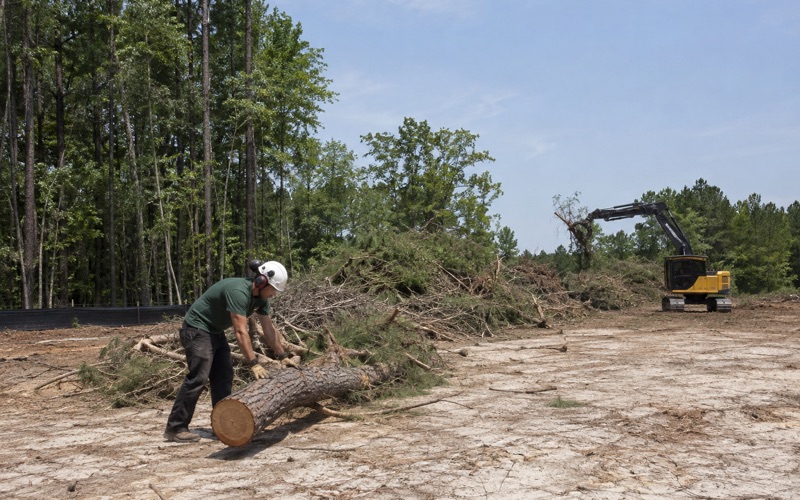
Every removal we quote states its inclusions in writing: brush chipped, trunk rounds handled the way you chose, and the stump and the grindings settled before the crew is booked. Debris is where most disputes start, so we close it first.
The crew that walks the property at the estimate is the crew that does the work and rakes out at the end. On a steep lot that continuity is worth more than it sounds, because the approach is a judgment made on the hill and it does not survive a handoff.
Storm work on the valley side
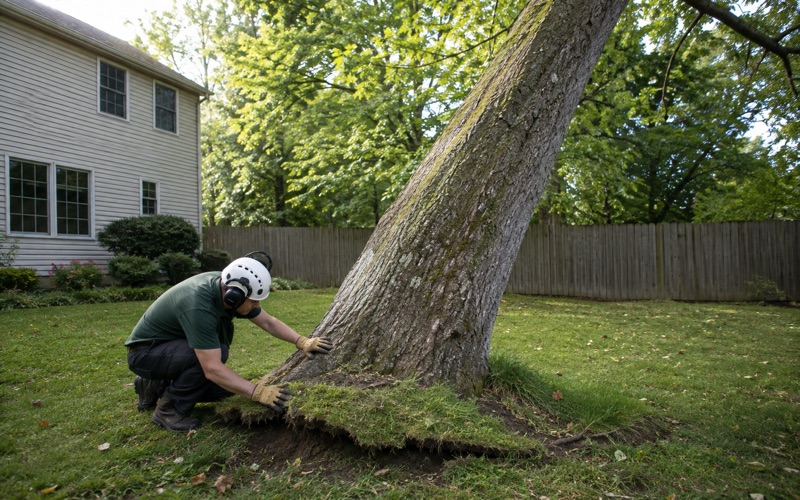
We answer storm calls within 24 hours for fallen trees, hanging limbs and anything resting on a structure. Thin root plates on the schist residuum mean the slope side of the community tends to produce uprooted trees rather than snapped stems, and a lifted root plate is a different problem from a broken top.
Those trees get walked before anything is cut, because a loaded plate can move the moment the trunk is relieved. Two decades of working this region’s storm season is largely knowing which of the two failures you are looking at.
- 20+ Years in Anne Arundel County
- Free On-Site Estimates
- 24-Hour Storm Response