Severn Tree Removal handles tree removal in Woodlawn, Maryland, and has worked this stretch of the Baltimore-Washington corridor for more than 20 years. We take down hazardous and failing trees, clear storm damage, and grind stumps on single-family lots, townhouse rows and managed multifamily grounds.
Every job here starts the same way: a free on-site visit, a scope written down, and the permit question answered before a crew is put on the calendar. We do not book work we have not looked at, and we do not leave the inclusions to be argued about afterward.
Two kinds of call reach us from this community. One is urgent, a tree already down or leaning hard toward something expensive. The other is planned, a manager or an owner working a list before the next storm season. Both get the same written scope and the same crew from first visit to last rake.
Maryland has two Woodlawns, and this is the Baltimore County one
Before we quote anything, we confirm which Woodlawn a caller means. The Census Bureau recognizes two census-designated places by that name in Maryland, and they are separate communities answering to separate county government. Getting it wrong costs a truck roll and a morning.
Two census-designated places, one name
The federal place gazetteer lists a Woodlawn CDP in Baltimore County, west of Baltimore City, and a second, much smaller Woodlawn CDP farther south in Prince George’s County covering about 1.1 square miles. Same name, different place entirely.
For tree work the two are not interchangeable. Different county code applies, different inspectors sign off on the same removal, the drive from our yard is not remotely the same, and the mature canopy on the ground reads differently in each. We ask which one on the first call so the rest of the conversation is about the actual tree.
GEOID 2486475 is the record this page describes
Every census place carries a federal identifier, and ours is GEOID 2486475. Its published centroid is 39.3055, -76.7478, and that is the coordinate the geology, soil and weather-zone lookups behind this page were run against.
We work from the identifier rather than the name when we check which authority reviews a removal. A name search alone returns both communities, and a wrong answer looks exactly like a right one until a permit comes back rejected.
No town hall of its own
Woodlawn has no municipal government. It is an unincorporated census-designated place, so Baltimore County is the authority that answers for grading, subdivision and forest conservation questions inside it, and there is no town counter to visit and no local tree board to satisfy. What that removes in paperwork it puts back in precision, because the answer now turns on the parcel and the trunk position rather than on the town you say you live in.
That surprises homeowners who expect a municipal forestry office to be involved. There is not one here. County environmental review staff and the state forest service between them handle what a town arborist would elsewhere, and neither of them is reachable at a front counter down the road.
Looking for tree removal closer to Ellicott City? See Tree Removal Services in Ellicott City.
9.539 square miles west of the city, and what the ground does to a removal
This Woodlawn covers 9.539 square miles of land, bounded by the Patapsco River and Howard County on the west and by Baltimore City on the east. The footprint is where the practical differences begin.
Piedmont bedrock, not coastal plain
The community sits on the Piedmont Plateau, west of the fall line, and state geology maps the bedrock beneath it as the Baltimore Gabbro Complex. The same query returns Atlantic Coastal Plain at Ocean City and Piedmont Plateau at Westminster, so the reading is a real one rather than a default.
Gabbro weathers to a clay-rich residual soil over shallow rock. A stump grinder finds refusal here sooner than it would east of the fall line, and the depth a grind can reach is a number worth agreeing on before the machine starts rather than after. We put it in the written estimate along with what happens to the grindings.
Soils along the stream bottoms
Mapped soils include the Mount Lucas series, formed over that gabbro, with Hatboro and Codorus along the low ground, and both of the latter are poorly drained floodplain soils. That matters for scheduling rather than for the tree: saturated bottom ground will not carry a grinder or a chipper truck, and a job that looked like flat easy access in August can be impassable a day after rain.
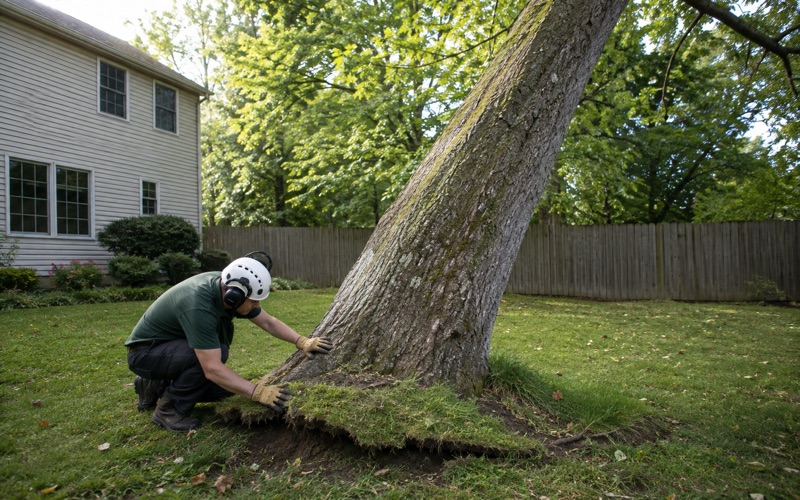
Trees rooted in wet, shallow ground tend to fail as a unit. Windthrow here lifts the root plate as a wide, rocky pad rather than snapping the trunk off clean, which changes the rigging, the equipment and the restoration we put in the quote.
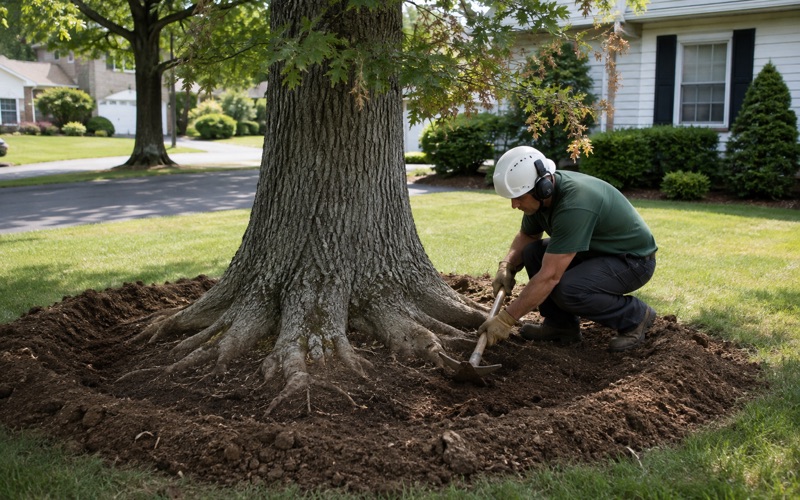
That same clay behaves badly under traffic. Where a lawn has been compacted around a tree worth keeping, root collar excavation with an air spade and targeted soil decompaction are often the more useful spend, and we will say so rather than sell a removal.
The species mix is a Piedmont mix
Northern red oak belongs here and turns up constantly in mature yards. Loblolly pine does not; it is a coastal-plain species, and we do not treat it as a native yard tree in this community.
That distinction matters at diagnosis. Our ISA Certified Arborist looks first at large oaks with co-dominant stems and included bark at the union, records diameter at breast height and marks the critical root zone before anything is staged on it.
Not every finding ends in a removal. Cabling and bracing, a crown reduction to shorten a bad lever arm, or straightforward deadwooding over a driveway are all cheaper than taking a mature tree down, and all of it is pruned to ANSI A300 rather than to whatever fits in an afternoon.
Which authority reviews tree work here
Several bodies can have a say in a Woodlawn removal, and which ones apply depends on where the tree stands. We route that before scheduling, because five counties and four towns across our service area answer the same question differently.
County forest conservation review
Baltimore County Code Article 33, Title 6 covers forest conservation, and the Department of Environmental Protection and Sustainability runs the Environmental Impact Review attached to development, grading and subdivision approvals. Commercial logging and timber harvesting fall under the same title.
One hazardous tree in a back yard is not a development application. We still check, because a lot being cleared ahead of a build is, and because a specimen tree on a parcel under review is not ours to drop on a homeowner’s say-so. That difference decides whether work happens this week or after a review.
One state program does not reach Woodlawn at all. There is no tidal water here: a Chesapeake Bay Critical Area point query returns no feature at the centroid or at the Gwynns Falls edge, while the same query run at tidal control points returns features. The empty result is a finding, not a lookup that failed.
Roadside trees and the state license
A tree standing in the public right-of-way is state business. Work on one requires a Tree Care Permit from the Maryland Department of Natural Resources Forest Service, and we pull it before a crew is booked rather than after.
Maryland licenses the work itself as well. Any person or firm doing tree work for hire must hold, or work under the supervision of, a Maryland Licensed Tree Expert, and the written contract has to carry that license number. Ask every bidder for it, not just ours.
The crew side of that is ANSI Z133, the safety standard the work is performed to. It governs how close anyone works to an energized conductor, and it is the reason some jobs get scheduled around a utility rather than around a customer’s preferred morning.
Utility lines and the federal campuses
Baltimore Gas and Electric handles vegetation management and line clearance on its distribution system, and states that it is not responsible for removing the wood left behind. We take that cleanup on when a homeowner is the one left standing over it.
The Social Security Administration and Centers for Medicare and Medicaid Services campuses are a separate case again. That is federal ground, outside county permitting and contracted through the agencies and the General Services Administration; work on the residential streets around them follows Baltimore County and DNR rules.
Getting the estimate onto the right property
An estimate is only worth reading if it covers the correct address, the correct tree and the correct access. Ours are free, including a second look at a tree you are unsure about.
What we confirm before the visit
On the first call we settle the county, the parcel and the route in: which Woodlawn, which side of Security Boulevard, and whether a crew arrives up a driveway or through shared rear access. Those three answers decide the truck before they decide the price.
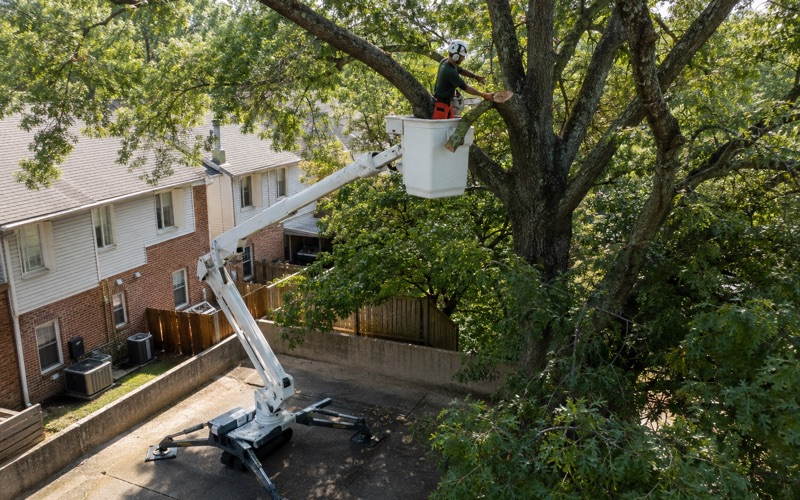
That conversation also settles equipment. Compact tracked machines pass a standard back-yard gate; where there is no drop zone to fell into, we plan sectional dismantling from an aerial lift or a crane-assisted lift instead, and the plan is in the scope before anyone climbs.
Detached lots and attached rows
Of 15,805 housing units here, 45.2% are single-family detached and 30.8% are single-family attached, which is two different jobs a block apart. A detached lot usually gives a driveway, a side yard and somewhere to stage wood; an attached row gives a shared fence line, a rear gate and a neighbor whose property the work has to stay off. We measure which one we are dealing with at the estimate rather than assuming from the street.
A detached lot usually has room to stage a chipper truck and land rounds where they fall. A townhouse row does not, so the tree comes down in measured pieces over a fence line and a neighbor’s roof, and lawn and hardscape protection matting goes under everything that moves.
We price both honestly rather than quoting the easy version and discovering the hard one on the day. Access, not trunk diameter, is usually what separates two otherwise identical removals on the same street.
Multifamily and managed grounds
Another 22.3% of units sit in buildings of five or more, so a real share of the tree work here is bought on a schedule by an apartment or condominium manager rather than in an emergency by an owner. We build around board meetings and resident notice.
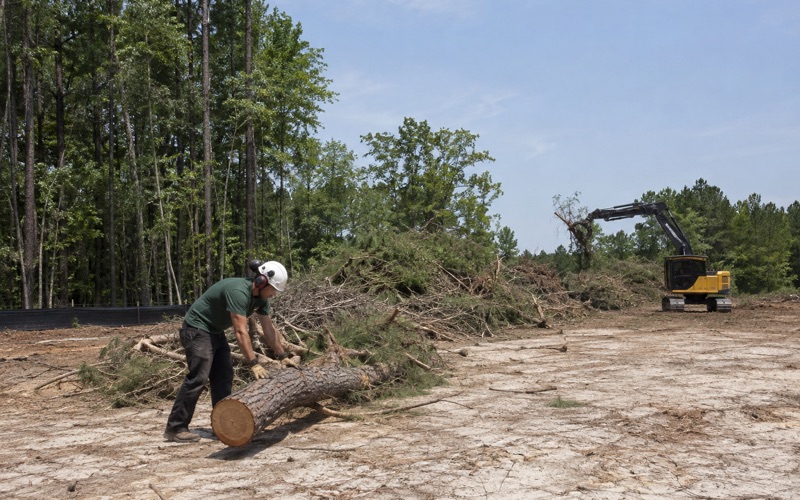
Whoever signs, the inclusions are written down first: brush chipped, trunk rounds stacked or hauled, stump ground, grindings settled one way or the other. The crew that walks the property at the estimate is the crew that does the removal and the final rake-out.
When the weather does the pruning
Storm calls run on a different clock. We respond within 24 hours to fallen trees, trees resting on a structure and driveways blocked by wind damage, and the crews that show up work this region’s storm season and its species year-round rather than arriving behind the weather from out of state.
This is not a quiet corner for wind. Woodlawn lies in National Weather Service forecast zone MDZ011, Southern Baltimore, and on June 5, 2024 a confirmed EF-1 tornado with estimated peak winds of 105 mph tracked 3.3 miles from Arbutus into West Baltimore on a path 175 yards wide, twisting and snapping several large trunks along the way.
- 20+ Years in Anne Arundel County
- Free On-Site Estimates
- 24-Hour Storm Response